Fresh blocks need support before they have curing strength
A block can leave the mould with a clean outline and still arrive at the stacking station with a chipped corner, a leaning wall, or a fine crack. When this happens, increasing cement content is not the first decision to make. Establish whether the defect already exists after demoulding or first appears during pallet transport. The location of that change determines which part of the process deserves attention.
Fresh, dry-cast concrete has enough immediate stability to retain its shape under suitable conditions, but it does not yet have the strength of a cured product. The production board supports the units while conveyors, lifting devices, and stacking equipment move them. A movement that causes no visible problem with an empty board can disturb freshly formed blocks.
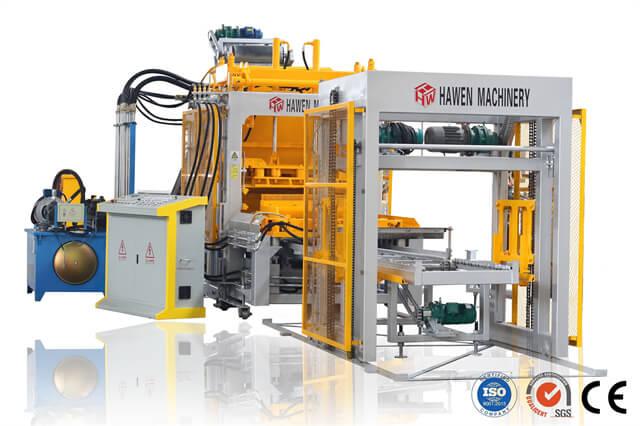
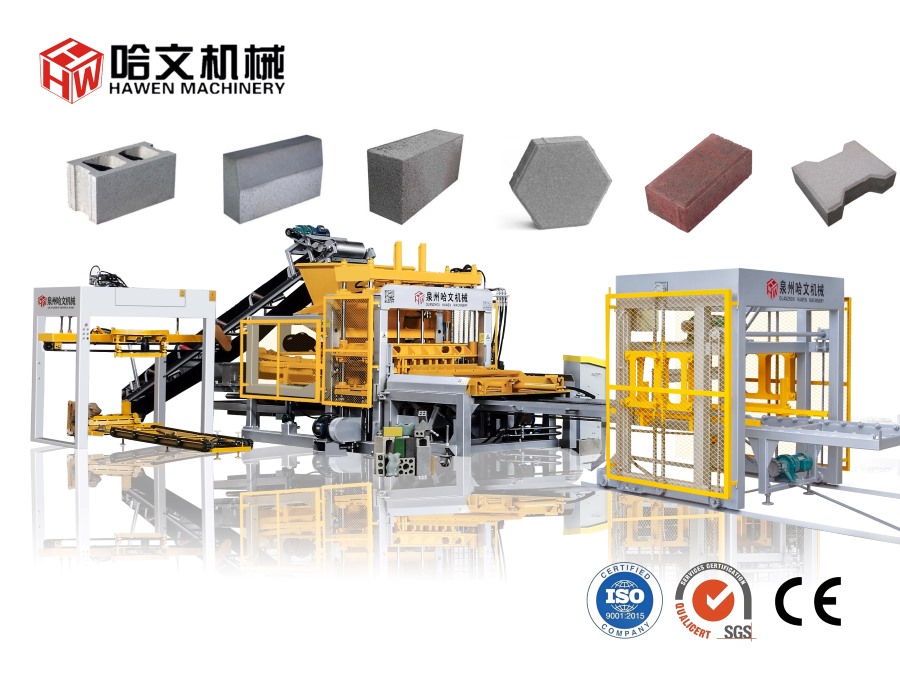
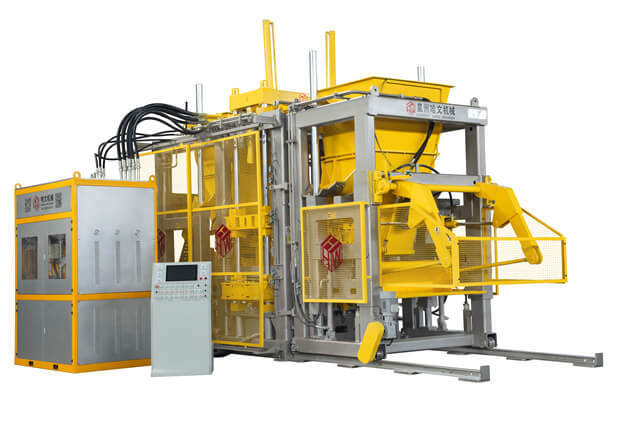
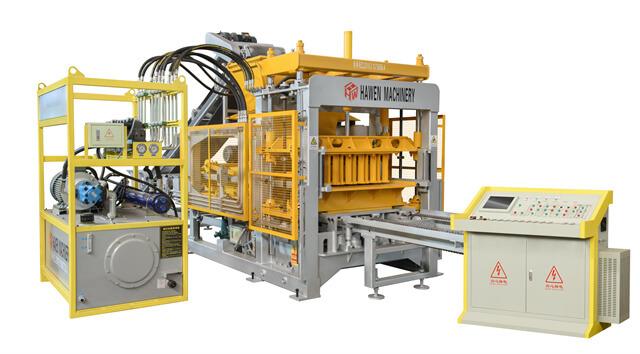
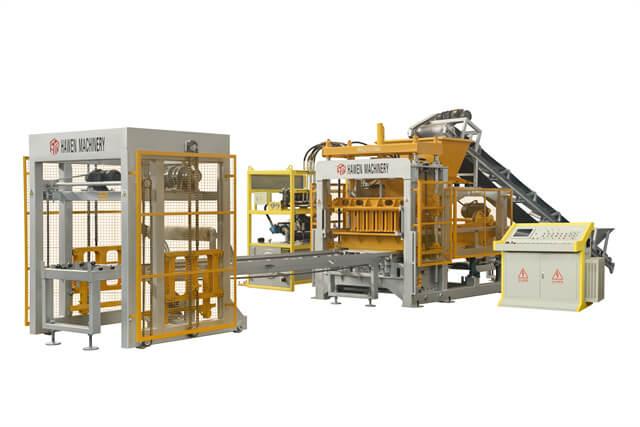
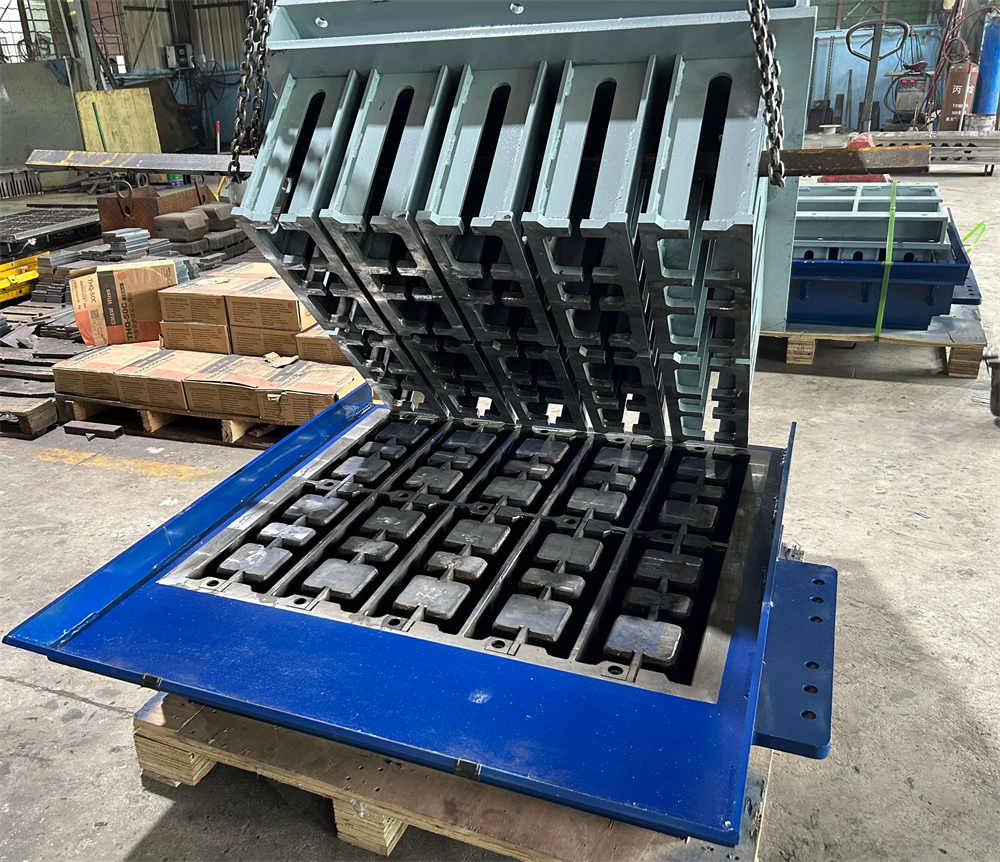
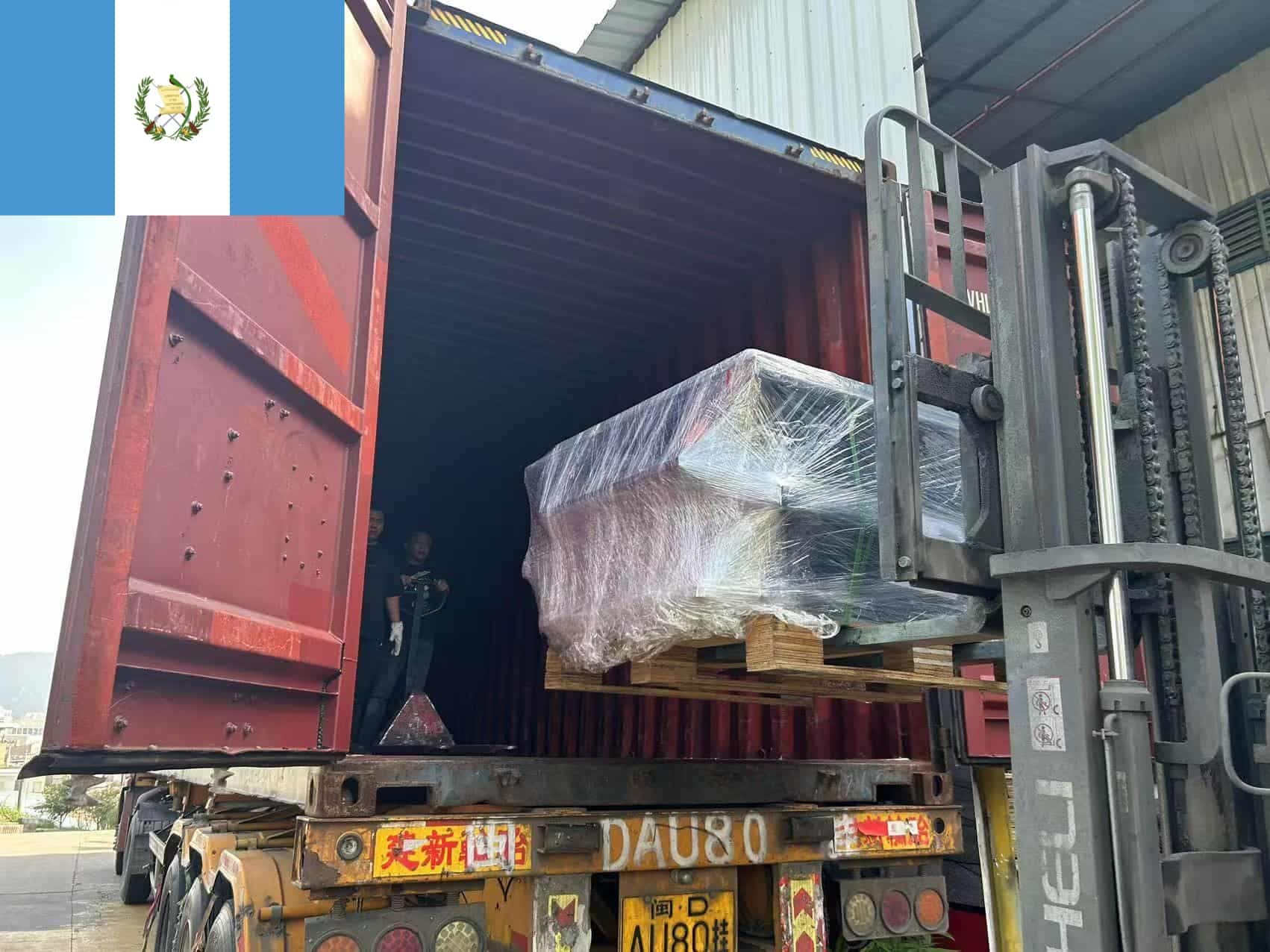
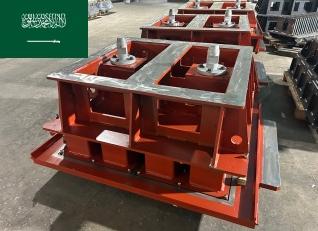
This article concerns the wet-side route between forming and the initial curing arrangement. It does not cover clamping and cubing hardened products. The photographs show relevant HAWEN equipment, not a documented damage incident or proof that a particular machine has the faults discussed below.
Locate the first damaged edge along the pallet route
Divide the route into observation points: after mould release, after the first conveyor handover, before the lift or stacker, and after placement. Record the board identity and the position of each affected cavity. Photographs taken from protected observation positions help distinguish a recurring defect from an occasional handling event.
If the same corner is damaged before the board moves, investigate filling, compaction, mould condition, and release before blaming transport. If intact units change at one handover, examine that interface and its movement sequence. A repeated position on the board is a useful clue, but it is not a diagnosis by itself.
Do not reach into the production line to mark blocks or retrieve a board during automatic operation. Arrange sampling through the approved machine procedure. Stop, isolate energy, and secure raised equipment before any inspection requiring access to a danger zone.
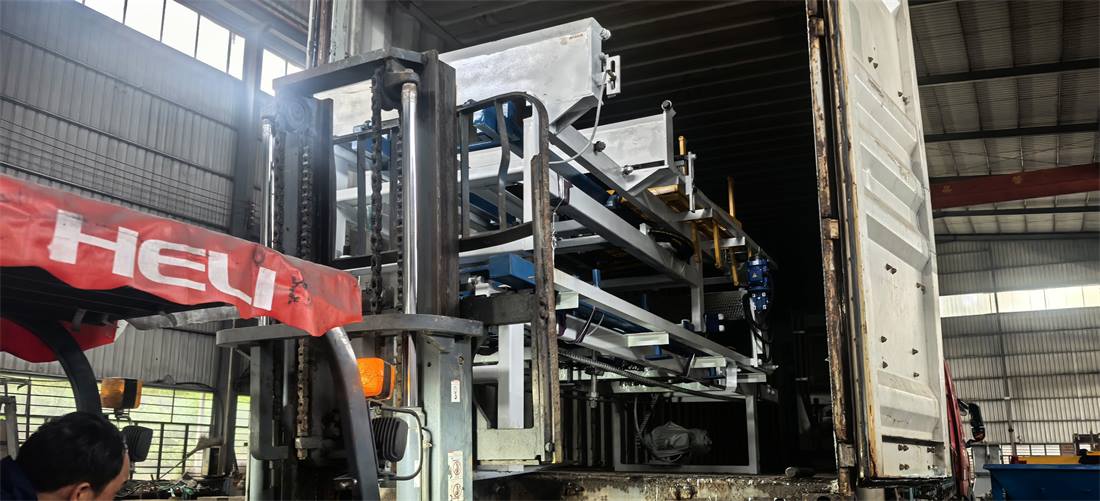
Wet-side conveyor equipment forms part of the route that must be checked after installation; the shipping photograph does not show operating alignment.
Acceleration and stopping matter as much as conveyor speed
Average transport speed alone does not describe how a board is handled. Two conveyors can complete the same journey in similar times while starting and stopping very differently. Sudden changes in velocity impose additional inertial loads on the fresh products, and abrupt mechanical contact can add an impact to that movement.
Separate the commanded speed profile from what the board actually does. The drive may follow a smooth ramp while slack, a worn connection, or an uneven support causes the board to jump. Conversely, a mechanically sound conveyor may still stop abruptly because its sequence or motion settings are unsuitable for the product.
An authorized technician should review the installed drive and control arrangement before changing acceleration or deceleration. Slowing every movement can reduce output without correcting a damaged guide or transfer step. The objective is controlled motion through the sensitive parts of the route, not simply the lowest possible speed.
Transfer gaps and support height can disturb a production board
At a handover, the board changes from one support arrangement to another. Differences in support height, a damaged roller, an obstructed guide, or an unsuitable gap may cause tilting or impact. Inspect the actual load path rather than checking only whether the conveyor motor turns normally.
Use the approved installation drawing and measurement procedure to review alignment. A board that rests correctly while stationary may behave differently as its leading edge enters the next station. Include the loaded condition in the acceptance trial, without placing personnel near moving components.
Track whether damage follows the same physical handover when different products are made. Also check whether only certain boards are affected. These comparisons help separate a fixed machine-interface issue from a board-specific condition, although more than one cause can be present at the same time.
Board flatness, stiffness, and residue change the support condition
The board is part of the handling system. A visibly damaged edge can interfere with guidance, while deformation or inadequate support can change how the fresh layer is carried. The appropriate board specification depends on its material, dimensions, span, loading, and compatibility with the complete production line.
Check cleanliness as well as appearance. Material trapped beneath a board can create a local high point, and buildup at guides can alter how the board enters the next station. Repeated cleaning should not become a substitute for identifying where the material is coming from.
For a controlled comparison, use boards accepted against the supplier's requirements and record which ones pass through each trial. Do not classify a board as suitable merely because it fits inside the machine. A replacement board must work with forming, transport, lifting, and the planned curing arrangement.
Stacker entry and lift placement need a coordinated sequence
A conveyor can deliver a board smoothly and still hand it to a station that is not ready. Review the conditions that permit entry, the receiving position, and the sequence used to lift or place the board. The exact arrangement differs between stackers, elevators, and transfer vehicles.
A position signal is evidence that a sensor has detected its target; it is not a substitute for checking the mechanical receiving condition. Look for a consistent relationship between interruptions, incomplete movements, and damage. Use controller records where available, supported by safe observations of the physical sequence.
Never bypass an interlock to see whether a board will pass through. Diagnose the reason for the interrupted sequence with the supplier's procedure. Any setting change must preserve collision prevention, guarding, and the permitted operating envelope of the handling equipment.
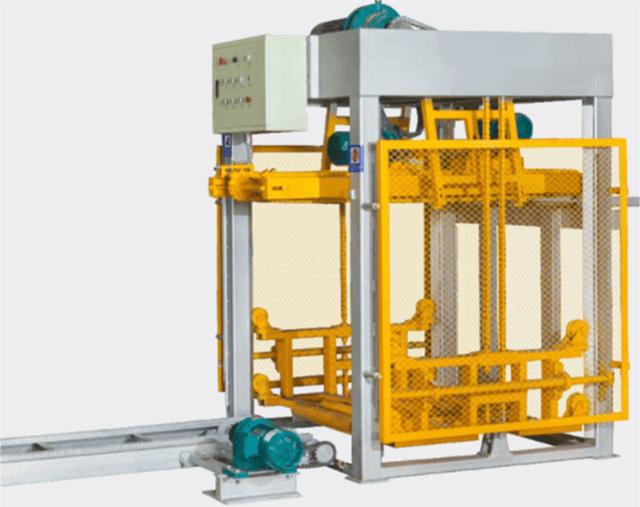
The receiving station must support the board and complete its placement sequence without disturbing the fresh layer.
Mix consistency and product geometry set the handling margin
Handling cannot be assessed independently of the product. Thin webs, tall shapes, and different cavity layouts may respond differently to the same board movement. A transport setting proven for a compact paver should not automatically be approved for every hollow block made on the line.
Record mix identity, moisture-control information, filling conditions, and the forming settings during an investigation. Poor immediate shape stability can make ordinary transport disturbances more visible. However, adding water or changing compaction without evidence may create another problem and hide the original cause.
Compare products immediately after release and again after transport. If the process team changes the mix during a mechanical trial, keep that run separate. Otherwise, an improvement cannot be confidently attributed to the conveyor correction or to the revised material condition.
Match the observed damage to the next inspection
Use the following comparisons to choose a next step, not to declare a failed component. Each observation should be recorded under a defined product and operating condition. Several faults can create similar marks, and a single change may reveal rather than create an existing weakness.
| Observation | Useful comparison | Next area to review |
|---|
| Defect is visible before transport | Same cavity across consecutive boards | Filling, compaction, mould release, and immediate stability |
| Damage first appears at a handover | Before and after images of the same board | Support transition, obstruction, and actual board movement |
| Only selected boards show damage | Board identity and condition | Flatness, edges, residue, and specification |
| Layer shifts when entering the stacker | Receiving position and sequence record | Entry control, support, and placement motion |
| Damage starts after a product change | Geometry and approved product settings | Handling profile and forming consistency |
Specify a loaded transport trial before accepting the line
A buyer reviewing a concrete block production line with pallet handling should request a demonstration that follows fresh products beyond mould release. A short video of the forming cycle does not establish that the complete downstream route handles those products acceptably.
Agree the products, board type, observation points, and defect criteria in advance. Include the most handling-sensitive products within the agreed supply scope, rather than selecting only the easiest shape. The acceptance record should distinguish damage already present at release from damage introduced later.
Review normal starts, stops, and permitted recovery sequences as well as steady production. Use only manufacturer-approved test conditions; do not deliberately create collisions or defeat protections. Record how operators resume after an ordinary interruption and how incomplete boards are handled.
A useful commercial comparison is the number of acceptable units delivered to the intended curing position over a defined period. Nominal forming cycles alone leave out downstream waiting, board handling, and rejects. Compare suppliers using equivalent product and test conditions rather than assuming that a faster headline cycle guarantees higher usable output.
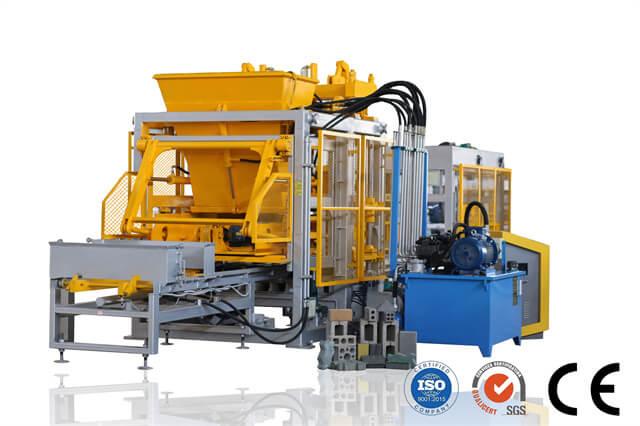
Assess the forming machine and downstream handling as one production route, using the intended products and boards.
Keep one change per trial and preserve the baseline
Before adjustment, save the approved settings and collect a baseline record. Note the product, board identities, elapsed run time, defect locations, and any interruptions. Keep the same inspection method for the next run so that the comparison remains meaningful.
Correct an identified mechanical issue before using motion settings to compensate for it. After authorized work, repeat the defined trial and check both product condition and sequence reliability. Keep unsuccessful tests in the record; they can rule out explanations and prevent the next shift from repeating the same experiment.
Do not conclude that one undamaged board proves a permanent correction. Use an agreed observation period that covers representative operation and relevant transitions. Retain the final settings with the product recipe, and identify who approved them so that future mould changes do not erase a verified handling arrangement.
FAQ
Does cracking during transport always mean that the conveyor is too fast? No. Inspect the first point of damage, board support, transfer alignment, and product stability. Average speed is only one part of the movement.
Can stronger production boards solve every wet-side handling problem? No. Correct board selection is important, but it cannot correct an obstructed handover, an incorrect receiving position, or an unsuitable motion sequence.
Should the same transport settings be used for all blocks? Only where they have been verified for those products. Geometry, board loading, and immediate shape stability can change the acceptable handling conditions.
What should a buyer ask to see in a factory trial? Follow identified fresh products from release to their intended curing position, with representative boards and the agreed acceptance criteria. Record the route, not just the machine's forming action.
Conclusion
Protecting fresh blocks requires a stable product, a suitable production board, and a coordinated handling route. Locate the first point where an intact unit changes, then investigate the support and movement at that stage. For purchasing or commissioning, accept the complete loaded route against agreed product-quality criteria. This provides a stronger basis for judging equipment than a fast empty conveyor or an isolated forming-cycle demonstration.





 Tel: +86-13905968794
 Email: export@hwmachines.com
 MP/WhatsApp: +86-13905968794
 Manufacturer Address:Nanan,Quanzhou City,Fujian Province,China