Why Do Colored Concrete Pavers Turn White? Efflorescence and Factory Quality Control
Table of Contents
White haze, pigment variation, and surface damage
A colored paver can leave the production line looking consistent and develop a pale surface later. That change should trigger an investigation, but it does not automatically mean that the pigment dosage was wrong. A surface deposit, different moisture conditions, cement residue, and a damaged face can all change the appearance of the same product. The first task is to identify what has changed before adjusting the recipe.
Efflorescence is a surface deposit associated with dissolved compounds moving with moisture and remaining at the surface. On cement-based products, calcium compounds can contribute to a pale carbonate deposit. Dark colors often make the contrast easier to notice. The presence of a white deposit alone does not establish whether a paver meets its strength or durability requirements; those properties require their own acceptance tests.
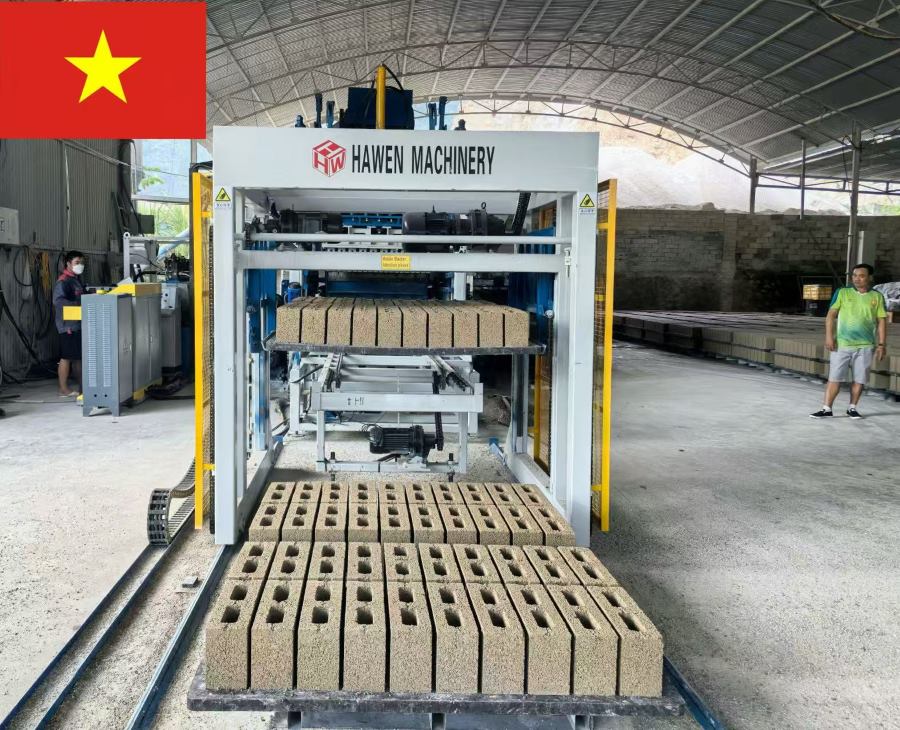
Treat this article as a factory investigation framework. The photographs illustrate paver production and handling equipment, not confirmed examples of efflorescence. A photograph can show the location and pattern of a complaint, but it cannot identify the deposit chemically or prove its cause.
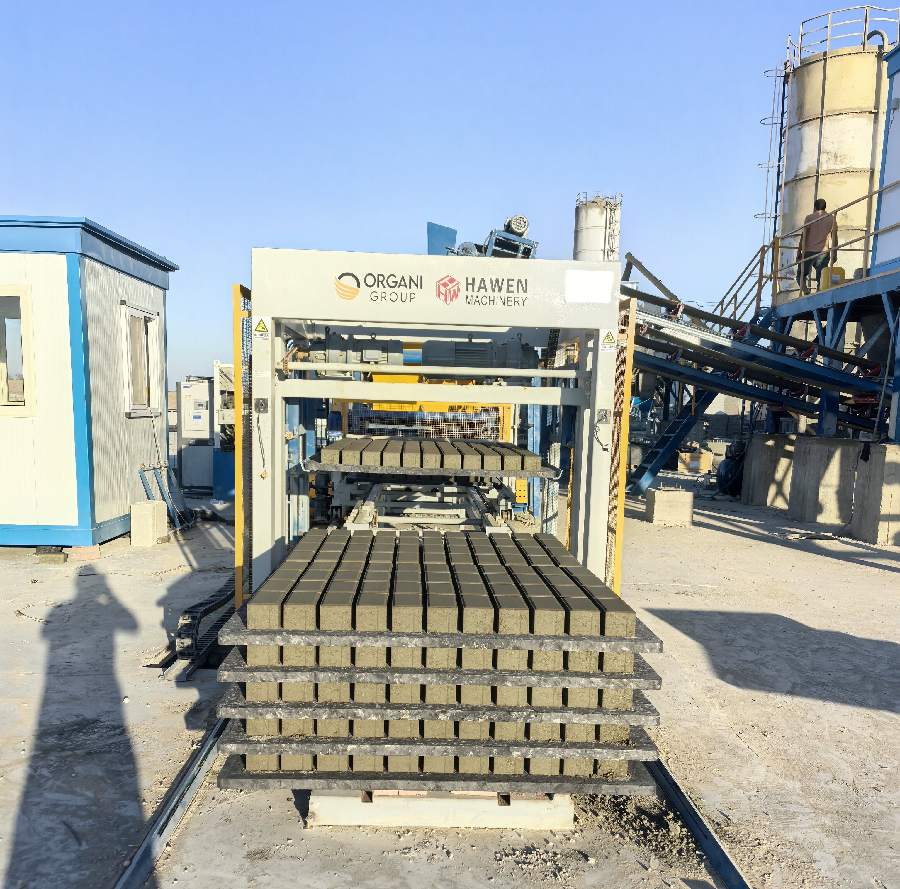
Paver production illustration; these units are not presented as examples of efflorescence.
Water movement between the face mix and the environment
The useful starting model is a source of soluble material, a moisture pathway, and conditions that leave material at the surface. Moisture exposure can occur during production, curing, storage, transport, or installation. The location where a deposit becomes visible is therefore not necessarily the location where the contributing condition began.
Ask when the white appearance first became visible. Was it already present after curing, found when packages were opened, or reported only after installation? Compare retained factory samples with delivered units from the same batch. If the retained samples remain unchanged, examine the different exposure histories before blaming the machine or pigment.
Do not use a single wet photograph as the color reference. Wet and dry surfaces reflect light differently. Compare units of similar age under the same lighting and moisture condition, and record whether the face is bare, coated, dusty, or recently cleaned.
Batch records that separate face-mix variation from deposits
Start with traceability: production date, recipe revision, cement delivery, aggregate source, pigment lot, admixture dosage, and water corrections. Record both base mix and face mix where a two-layer product is manufactured. A change confined to one face-mix batch deserves a different investigation from a pattern affecting many recipes stored in one wet area.
Keep control samples from the start, middle, and end of a suspect production run. Label them and photograph them at agreed ages. This creates a comparison that a supplier, plant manager, and customer can discuss without relying on memory. Avoid selecting only the best-looking unit as the reference.
Check whether the apparent color difference is a removable surface material or a difference within the face itself. Any cleaning trial should use a sacrificial sample and an appropriate product. If identification is uncertain, obtain laboratory or specialist assistance before treating an entire shipment.
For a customer complaint, request photographs of an unopened package, the affected layers, and representative individual units. Ask when the package arrived and when it was opened. These questions document handling history without assuming that either the factory or customer caused the condition. Give the person reviewing the complaint access to the matching factory samples and production records.
Compaction and face-layer consistency
A consistent forming process is part of paver quality control, but increasing vibration time is not a universal treatment for whitening. Review actual product height, mass, face-layer coverage, and visible surface texture against the approved production range. Compare those records with the occurrence of the deposit.
When evaluating a concrete paver production machine, ask how the supplier demonstrates repeatability across the pallet and during sustained operation. A sample cycle demonstrates movement; repeated product measurements provide more useful acceptance evidence. Moisture, feeding, mould condition, and forming settings should be recorded together.
If a trial changes compaction settings, retain the original settings as a control and change one variable at a time. Check demoulding and the required finished-product properties as well as appearance. A cleaner-looking face is not enough to justify a setting that creates another quality problem.
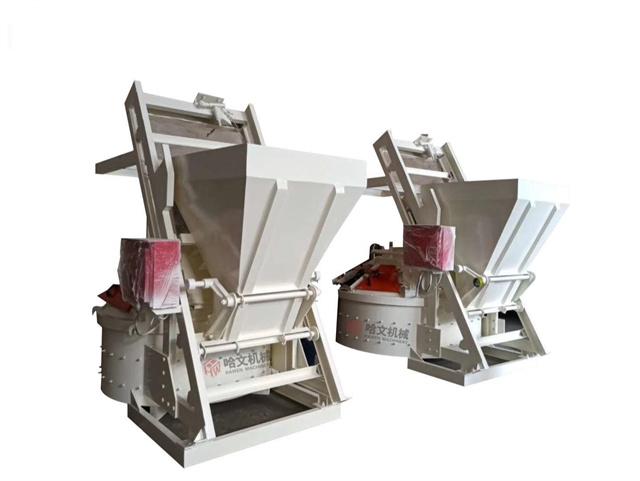
Mixing equipment is one part of a wider batch and appearance-control process.
Curing records and uneven exposure
Review the curing cycle separately from the finished-product drying and storage stages. Concrete needs an appropriate curing process to develop its properties; deliberately drying fresh products too early to avoid deposits is not a sound shortcut. Follow a validated curing procedure for the materials and products being manufactured.
For an investigation, compare rack position, loading time, chamber conditions, and any visible water dripping or pooling. Mark where affected units sat within the rack. A location pattern is an investigation lead, not proof: material variation and process changes may coincide with a particular rack position.
Record the transition out of curing as carefully as the chamber cycle. Two batches may share a nominal curing program but experience different waiting times or rain exposure before packaging. Without these records, the factory can mistakenly attribute a storage problem to the forming stage.
If multiple shifts share a curing chamber, record actual loading and unloading times rather than relying only on the nominal schedule. Changes in queue time can otherwise disappear from the production record. Use the evidence to select the next comparison; do not rewrite the curing program solely because one shipment looks lighter.
Packaging trials and storage comparisons
Inspect packaging for water entry, condensation, and contact marks. Examine whether the affected appearance follows the wrapping, separators, stack edges, or lower layers. Keep storage location and packing time in the batch record so that product history remains available when a shipment is opened.
A practical trial is to divide one verified production batch into clearly identified groups with documented packing and storage conditions. Keep product age, recipe, and curing constant. Inspect the groups at the same intervals, recording photographs and the extent of visible whitening. This is a proposed investigation method, not a reported customer trial.
Packaging changes must also preserve transport stability and weather protection. Do not simply remove all wrapping or prescribe one drying period for every climate. Agree a method using the plant's climate, transport route, packaging materials, and quality requirements, then confirm it with comparable samples.
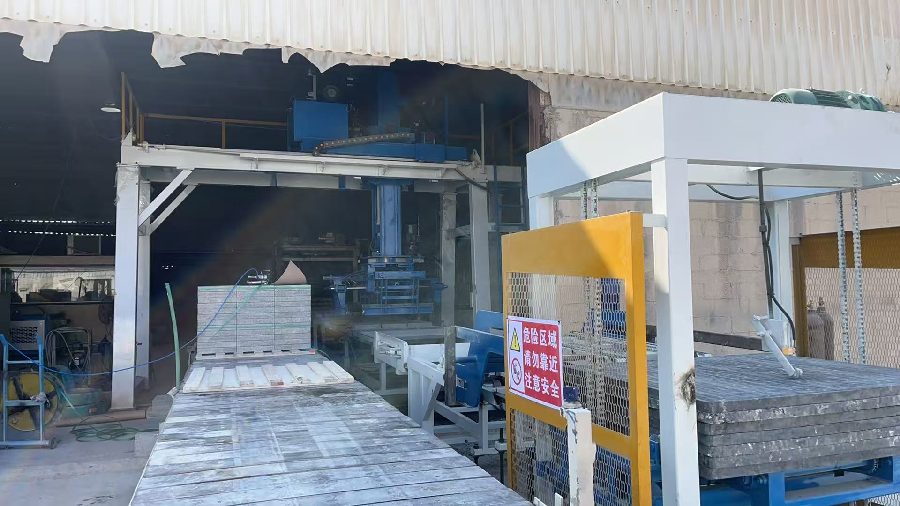
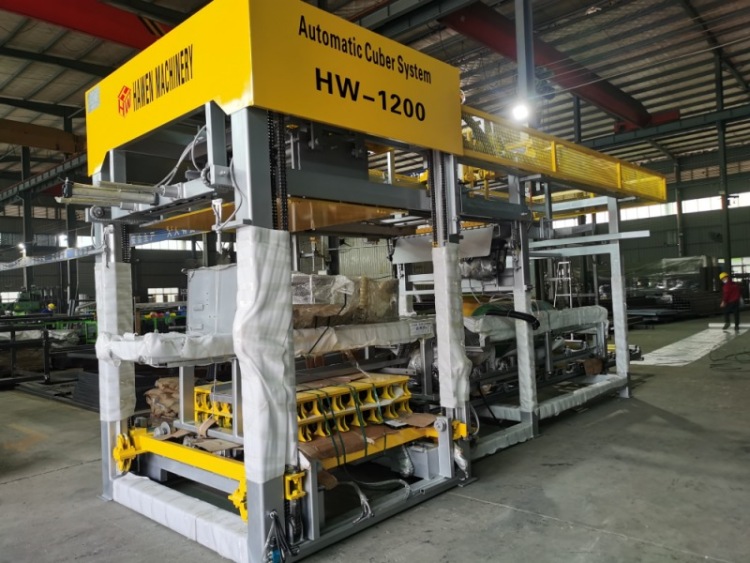
Cubing and packaging are useful checkpoints when tracing product exposure.
An inspection table for white paver complaints
Use observations to decide the next check rather than immediately assigning a cause. More than one condition may be present, and a surface deposit can coexist with an unrelated defect. The following table is a screening guide, not a substitute for material identification or product testing.
| Observation | Next comparison | Avoid assuming |
|---|
| White material appears after storage | Compare retained samples and wetting history | That pigment dosage must be incorrect |
| Only one package layer is affected | Check contact patterns, water entry, and packaging | That all mould cavities produced defective units |
| Shade differs on clean, dry samples | Review recipe, materials, texture, and curing | That every pale area is efflorescence |
| Cracking or surface loss accompanies whitening | Assess the damage and required product tests separately | That the whole complaint is only cosmetic |
Cleaning trials and customer acceptance
Do not recommend an acid concentration from a photograph. Cleaning products can affect cement paste, exposed aggregate, color, and coatings. Select a product intended for the actual concrete paver and follow its manufacturer's directions. First test an inconspicuous or sacrificial unit and assess the fully dried result.
Likewise, sealing should follow identification and suitable preparation, not serve as an automatic way to hide whitening. Check moisture requirements, coating compatibility, and the coating supplier's instructions. A milky coating may require a different response from a mineral deposit on an uncoated paver.
From a shipment acceptance perspective, agree a reference panel and viewing conditions before disputes arise. Specify sample age, moisture condition, lighting, and the process for reviewing appearance complaints. Keep appearance acceptance separate from mandatory product performance requirements. This makes a supplier discussion more precise than promising that every unit will remain permanently identical.
A small factory trial before changing a full production run
Prepare a written trial sheet with one question, such as whether a particular packing condition changes the appearance of otherwise comparable units. State the hypothesis before looking at results. Select more than one unit per group and include samples from different pallet positions so that one unusual surface does not determine the decision.
Assign a sample code that follows each unit from manufacture through assessment. Record who handled it and whether it was moved, wetted, covered, or cleaned. Keep one untreated comparison group. This is especially useful when an apparent improvement might simply result from comparing a freshly washed paver with a dry untreated paver.
Set inspection intervals that match the actual complaint. A problem reported after transport cannot be evaluated only at demoulding. At each interval, use the same viewing area and camera position, and include an agreed color reference where practical. Record unaffected samples as well as affected samples to avoid collecting only evidence that supports the initial explanation.
Before adopting a change, confirm that the result repeats in another production run. Review the commercial effects, including waiting space, extra handling, packaging labor, and any rejected product. An intervention that appears successful in a small sample still needs to fit the factory's real operating conditions.
Maintain a simple decision record for every trial: what was changed, which samples were compared, what the inspection showed, and what remains uncertain. Include the person responsible for the next action. This keeps a temporary production adjustment from becoming a permanent undocumented recipe change. It also lets later shifts understand why the factory adopted a new practice and which observations would justify reviewing it.
FAQ
Does whitening mean the pigment has failed? No. A surface deposit can obscure the color beneath it. Investigate pigment variation if comparable clean, dry samples still show a difference, and review the production records before changing dosage.
Can more cement prevent efflorescence? There is no universal correction of that kind. Any recipe change should be evaluated for appearance, strength, absorption where relevant, workability, and cost. Use controlled trials rather than treating cement dosage as a single-variable cure.
Should the entire shipment be rejected? Follow the agreed acceptance criteria and investigate the affected sample. Separate a cosmetic deposit from cracking, scaling, poor compaction, or other defects that require their own assessment.
Can admixtures guarantee no white marks? Ask for evidence under comparable materials, curing, and exposure conditions. Evaluate the product within the complete mix and production process; a sales claim alone does not establish performance for your factory.
Conclusion
Whitening is best investigated through product history: what was made, how it was cured, when it was packed, and where it became wet. Establish whether the change is a surface deposit, an underlying color difference, or actual damage before modifying production.
For a plant buyer or production manager, the next step is a documented comparison using retained samples and controlled trials. Request measurable acceptance evidence for the proposed equipment or process change, and evaluate appearance alongside the finished product's required performance.
Why Do Colored Concrete Pavers Turn White? Efflorescence and Factory Quality Control
Table of Contents
White haze, pigment variation, and surface damage
Water movement between the face mix and the environment
Batch records that separate face-mix variation from deposits
Compaction and face-layer consistency
Curing records and uneven exposure
Packaging trials and storage comparisons
An inspection table for white paver complaints
Cleaning trials and customer acceptance
A small factory trial before changing a full production run
FAQ
Conclusion
White haze, pigment variation, and surface damage
A colored paver can leave the production line looking consistent and develop a pale surface later. That change should trigger an investigation, but it does not automatically mean that the pigment dosage was wrong. A surface deposit, different moisture conditions, cement residue, and a damaged face can all change the appearance of the same product. The first task is to identify what has changed before adjusting the recipe.
Efflorescence is a surface deposit associated with dissolved compounds moving with moisture and remaining at the surface. On cement-based products, calcium compounds can contribute to a pale carbonate deposit. Dark colors often make the contrast easier to notice. The presence of a white deposit alone does not establish whether a paver meets its strength or durability requirements; those properties require their own acceptance tests.
Treat this article as a factory investigation framework. The photographs illustrate paver production and handling equipment, not confirmed examples of efflorescence. A photograph can show the location and pattern of a complaint, but it cannot identify the deposit chemically or prove its cause.
Colored concrete pavers on a HAWEN production line
Paver production illustration; these units are not presented as examples of efflorescence.
Water movement between the face mix and the environment
The useful starting model is a source of soluble material, a moisture pathway, and conditions that leave material at the surface. Moisture exposure can occur during production, curing, storage, transport, or installation. The location where a deposit becomes visible is therefore not necessarily the location where the contributing condition began.
Ask when the white appearance first became visible. Was it already present after curing, found when packages were opened, or reported only after installation? Compare retained factory samples with delivered units from the same batch. If the retained samples remain unchanged, examine the different exposure histories before blaming the machine or pigment.
Do not use a single wet photograph as the color reference. Wet and dry surfaces reflect light differently. Compare units of similar age under the same lighting and moisture condition, and record whether the face is bare, coated, dusty, or recently cleaned.
Batch records that separate face-mix variation from deposits
Start with traceability: production date, recipe revision, cement delivery, aggregate source, pigment lot, admixture dosage, and water corrections. Record both base mix and face mix where a two-layer product is manufactured. A change confined to one face-mix batch deserves a different investigation from a pattern affecting many recipes stored in one wet area.
Keep control samples from the start, middle, and end of a suspect production run. Label them and photograph them at agreed ages. This creates a comparison that a supplier, plant manager, and customer can discuss without relying on memory. Avoid selecting only the best-looking unit as the reference.
Check whether the apparent color difference is a removable surface material or a difference within the face itself. Any cleaning trial should use a sacrificial sample and an appropriate product. If identification is uncertain, obtain laboratory or specialist assistance before treating an entire shipment.
For a customer complaint, request photographs of an unopened package, the affected layers, and representative individual units. Ask when the package arrived and when it was opened. These questions document handling history without assuming that either the factory or customer caused the condition. Give the person reviewing the complaint access to the matching factory samples and production records.
Compaction and face-layer consistency
A consistent forming process is part of paver quality control, but increasing vibration time is not a universal treatment for whitening. Review actual product height, mass, face-layer coverage, and visible surface texture against the approved production range. Compare those records with the occurrence of the deposit.
When evaluating a concrete paver production machine, ask how the supplier demonstrates repeatability across the pallet and during sustained operation. A sample cycle demonstrates movement; repeated product measurements provide more useful acceptance evidence. Moisture, feeding, mould condition, and forming settings should be recorded together.
If a trial changes compaction settings, retain the original settings as a control and change one variable at a time. Check demoulding and the required finished-product properties as well as appearance. A cleaner-looking face is not enough to justify a setting that creates another quality problem.
Planetary concrete mixer used in concrete product manufacturing
Mixing equipment is one part of a wider batch and appearance-control process.
Curing records and uneven exposure
Review the curing cycle separately from the finished-product drying and storage stages. Concrete needs an appropriate curing process to develop its properties; deliberately drying fresh products too early to avoid deposits is not a sound shortcut. Follow a validated curing procedure for the materials and products being manufactured.
For an investigation, compare rack position, loading time, chamber conditions, and any visible water dripping or pooling. Mark where affected units sat within the rack. A location pattern is an investigation lead, not proof: material variation and process changes may coincide with a particular rack position.
Record the transition out of curing as carefully as the chamber cycle. Two batches may share a nominal curing program but experience different waiting times or rain exposure before packaging. Without these records, the factory can mistakenly attribute a storage problem to the forming stage.
If multiple shifts share a curing chamber, record actual loading and unloading times rather than relying only on the nominal schedule. Changes in queue time can otherwise disappear from the production record. Use the evidence to select the next comparison; do not rewrite the curing program solely because one shipment looks lighter.
Packaging trials and storage comparisons
Inspect packaging for water entry, condensation, and contact marks. Examine whether the affected appearance follows the wrapping, separators, stack edges, or lower layers. Keep storage location and packing time in the batch record so that product history remains available when a shipment is opened.
A practical trial is to divide one verified production batch into clearly identified groups with documented packing and storage conditions. Keep product age, recipe, and curing constant. Inspect the groups at the same intervals, recording photographs and the extent of visible whitening. This is a proposed investigation method, not a reported customer trial.
Packaging changes must also preserve transport stability and weather protection. Do not simply remove all wrapping or prescribe one drying period for every climate. Agree a method using the plant's climate, transport route, packaging materials, and quality requirements, then confirm it with comparable samples.
Automatic cubing equipment for cured concrete products
Cubing and packaging are useful checkpoints when tracing product exposure.
An inspection table for white paver complaints
Use observations to decide the next check rather than immediately assigning a cause. More than one condition may be present, and a surface deposit can coexist with an unrelated defect. The following table is a screening guide, not a substitute for material identification or product testing.
Observation Next comparison Avoid assuming
White material appears after storage Compare retained samples and wetting history That pigment dosage must be incorrect
Only one package layer is affected Check contact patterns, water entry, and packaging That all mould cavities produced defective units
Shade differs on clean, dry samples Review recipe, materials, texture, and curing That every pale area is efflorescence
Cracking or surface loss accompanies whitening Assess the damage and required product tests separately That the whole complaint is only cosmetic
Cleaning trials and customer acceptance
Do not recommend an acid concentration from a photograph. Cleaning products can affect cement paste, exposed aggregate, color, and coatings. Select a product intended for the actual concrete paver and follow its manufacturer's directions. First test an inconspicuous or sacrificial unit and assess the fully dried result.
Likewise, sealing should follow identification and suitable preparation, not serve as an automatic way to hide whitening. Check moisture requirements, coating compatibility, and the coating supplier's instructions. A milky coating may require a different response from a mineral deposit on an uncoated paver.
From a shipment acceptance perspective, agree a reference panel and viewing conditions before disputes arise. Specify sample age, moisture condition, lighting, and the process for reviewing appearance complaints. Keep appearance acceptance separate from mandatory product performance requirements. This makes a supplier discussion more precise than promising that every unit will remain permanently identical.
A small factory trial before changing a full production run
Prepare a written trial sheet with one question, such as whether a particular packing condition changes the appearance of otherwise comparable units. State the hypothesis before looking at results. Select more than one unit per group and include samples from different pallet positions so that one unusual surface does not determine the decision.
Assign a sample code that follows each unit from manufacture through assessment. Record who handled it and whether it was moved, wetted, covered, or cleaned. Keep one untreated comparison group. This is especially useful when an apparent improvement might simply result from comparing a freshly washed paver with a dry untreated paver.
Set inspection intervals that match the actual complaint. A problem reported after transport cannot be evaluated only at demoulding. At each interval, use the same viewing area and camera position, and include an agreed color reference where practical. Record unaffected samples as well as affected samples to avoid collecting only evidence that supports the initial explanation.
Before adopting a change, confirm that the result repeats in another production run. Review the commercial effects, including waiting space, extra handling, packaging labor, and any rejected product. An intervention that appears successful in a small sample still needs to fit the factory's real operating conditions.
Maintain a simple decision record for every trial: what was changed, which samples were compared, what the inspection showed, and what remains uncertain. Include the person responsible for the next action. This keeps a temporary production adjustment from becoming a permanent undocumented recipe change. It also lets later shifts understand why the factory adopted a new practice and which observations would justify reviewing it.
FAQ
Does whitening mean the pigment has failed? No. A surface deposit can obscure the color beneath it. Investigate pigment variation if comparable clean, dry samples still show a difference, and review the production records before changing dosage.
Can more cement prevent efflorescence? There is no universal correction of that kind. Any recipe change should be evaluated for appearance, strength, absorption where relevant, workability, and cost. Use controlled trials rather than treating cement dosage as a single-variable cure.
Should the entire shipment be rejected? Follow the agreed acceptance criteria and investigate the affected sample. Separate a cosmetic deposit from cracking, scaling, poor compaction, or other defects that require their own assessment.
Can admixtures guarantee no white marks? Ask for evidence under comparable materials, curing, and exposure conditions. Evaluate the product within the complete mix and production process; a sales claim alone does not establish performance for your factory.
Conclusion
Whitening is best investigated through product history: what was made, how it was cured, when it was packed, and where it became wet. Establish whether the change is a surface deposit, an underlying color difference, or actual damage before modifying production.
For a plant buyer or production manager, the next step is a documented comparison using retained samples and controlled trials. Request measurable acceptance evidence for the proposed equipment or process change, and evaluate appearance alongside the finished product's required performance.











 Tel: +86-13905968794
 Email: export@hwmachines.com
 MP/WhatsApp: +86-13905968794
 Manufacturer Address:Nanan,Quanzhou City,Fujian Province,China