Many buyers invest considerable time comparing the specifications of an automatic concrete block machine while paying much less attention to the mold itself. In reality, the concrete block mold is one of the most important components of the entire production system. Regardless of how advanced the hydraulic system or vibration technology may be, the final dimensions, surface finish, and consistency of every concrete block are determined by the mold.
During every production cycle, the mold is subjected to high-frequency vibration, hydraulic pressure, continuous abrasion from aggregates, and repeated demoulding. Over thousands of production cycles, even small machining errors or inadequate material strength can gradually affect block dimensions, edge quality, and production efficiency. For manufacturers producing hollow blocks, paving blocks, curbstones, or customized concrete products, mold quality directly influences product consistency and operating costs.
Professional buyers therefore evaluate not only the machine configuration but also the manufacturing process of the mold itself. Important considerations include steel selection, CNC machining accuracy, heat treatment technology, wear resistance, dimensional tolerance, and compatibility with the vibration system. These engineering details usually determine how long a mold can maintain stable production before refurbishment or replacement becomes necessary.
Modern automatic concrete block machines are designed to support rapid mold replacement, allowing manufacturers to produce multiple concrete products using the same host machine. However, quick mold changing only provides value when every mold is manufactured with high precision and consistent dimensional accuracy.
The following sections explain how mold manufacturing technology affects block quality, production efficiency, maintenance costs, and long-term return on investment.
Why the Concrete Block Mold Is the Most Critical Part of a Block Machine
A concrete block machine provides vibration, hydraulic force, and automated movement, but the mold ultimately shapes every finished product. The dimensional accuracy of hollow blocks, paving stones, solid bricks, retaining blocks, and kerbstones depends almost entirely on mold precision. Any deformation, excessive wear, or machining deviation will eventually appear in the finished concrete products.
From a production perspective, mold quality also affects cycle stability. Poorly manufactured molds may increase friction during demoulding, generate uneven pressure distribution, or accelerate wear on guide columns and vibration components. These issues often lead to higher maintenance costs and inconsistent production quality over time.
Another important observation during factory inspections is that buyers frequently compare mold appearance without understanding the internal manufacturing process. Surface painting or polishing may improve visual appearance, but the true quality of a mold depends on machining accuracy, steel hardness, heat treatment depth, and dimensional consistency throughout every cavity.
How CNC Precision Machining Improves Mold Accuracy
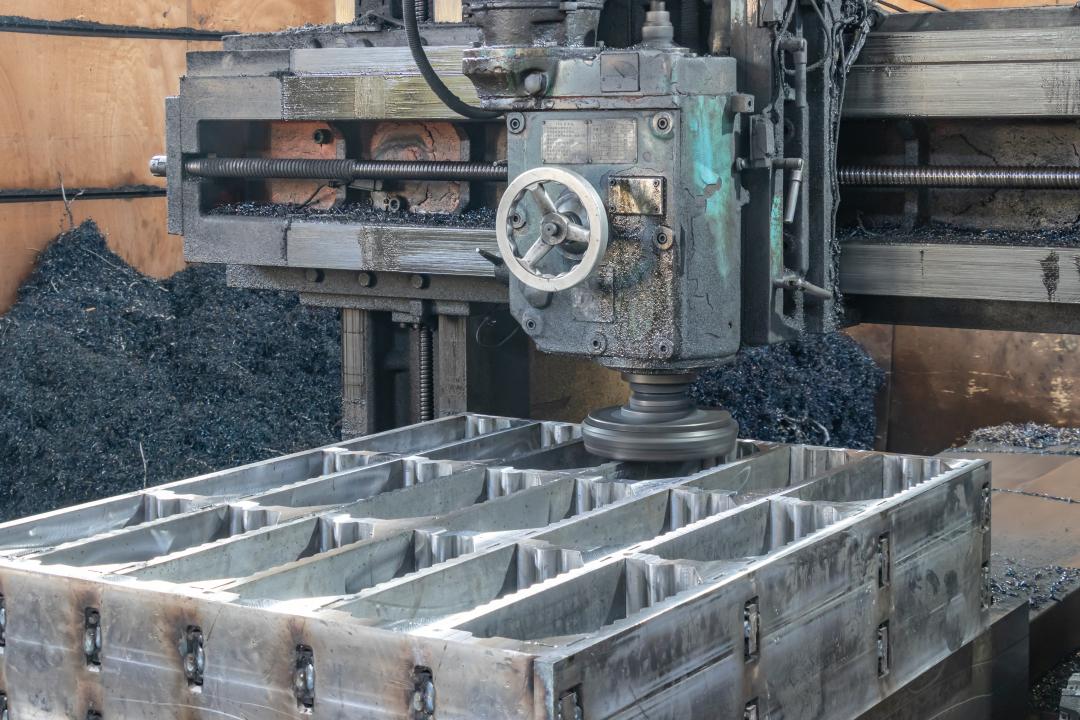
The first image illustrates one of the most important stages of mold manufacturing—CNC precision machining. Modern machining centers allow every cavity, core, guide surface, and fitting position to be manufactured with extremely high dimensional accuracy. Compared with conventional manual machining, CNC processing significantly improves consistency between different molds while reducing assembly errors.
Precision machining is particularly important for hollow block molds because every partition wall inside the mold must maintain identical dimensions. Even minor deviations may cause differences in block wall thickness, resulting in variations in compressive strength, product weight, and stacking stability.
Accurate machining also improves mold interchangeability. Manufacturers producing multiple block sizes can replace molds more efficiently because every mounting surface, guide mechanism, and locking position maintains standardized tolerances. This reduces installation time while improving production flexibility.
Another engineering advantage of CNC manufacturing is smoother working surfaces. Reduced machining marks help concrete release more easily during demoulding, minimizing unnecessary friction and extending the service life of both the mold and the machine's moving components.
Why Mold Material and Heat Treatment Determine Long-Term Performance
Even the most precise CNC machining cannot compensate for poor material selection. After machining, a concrete block mold must withstand continuous vibration, repeated hydraulic pressure, abrasive aggregates, and frequent demoulding. These demanding working conditions require the mold to maintain dimensional stability while resisting wear throughout thousands of production cycles.
High-quality concrete block molds are generally manufactured from high-strength alloy steel with carefully controlled chemical composition. Compared with ordinary carbon steel, alloy steel provides better hardness, higher impact resistance, and improved fatigue strength. These properties help the mold maintain accurate dimensions even after prolonged industrial production.
Heat treatment is another critical manufacturing process. Proper quenching and tempering increase surface hardness while maintaining sufficient toughness inside the steel. This combination allows the mold to resist abrasion without becoming excessively brittle. A well-designed heat treatment process also reduces the possibility of cracking when the mold is subjected to repeated vibration and hydraulic impact.
Professional mold manufacturers pay close attention to hardness consistency throughout every working surface rather than focusing only on average hardness values. Uniform hardness ensures that different areas of the mold wear at similar rates, helping maintain stable block dimensions during long production runs.
Another important observation during mold refurbishment is that excessive wear usually begins at corners, partition walls, and demoulding contact surfaces. Appropriate material selection together with optimized heat treatment can significantly slow this wear process, reducing maintenance frequency and extending mold service life.
Choosing the Right Mold for Different Concrete Products
Different concrete products require completely different mold structures. Although the same automatic block machine can often produce multiple products through mold replacement, each mold must be engineered according to the geometry, wall thickness, compaction requirements, and demoulding characteristics of the finished product.
Hollow Block Mold Design
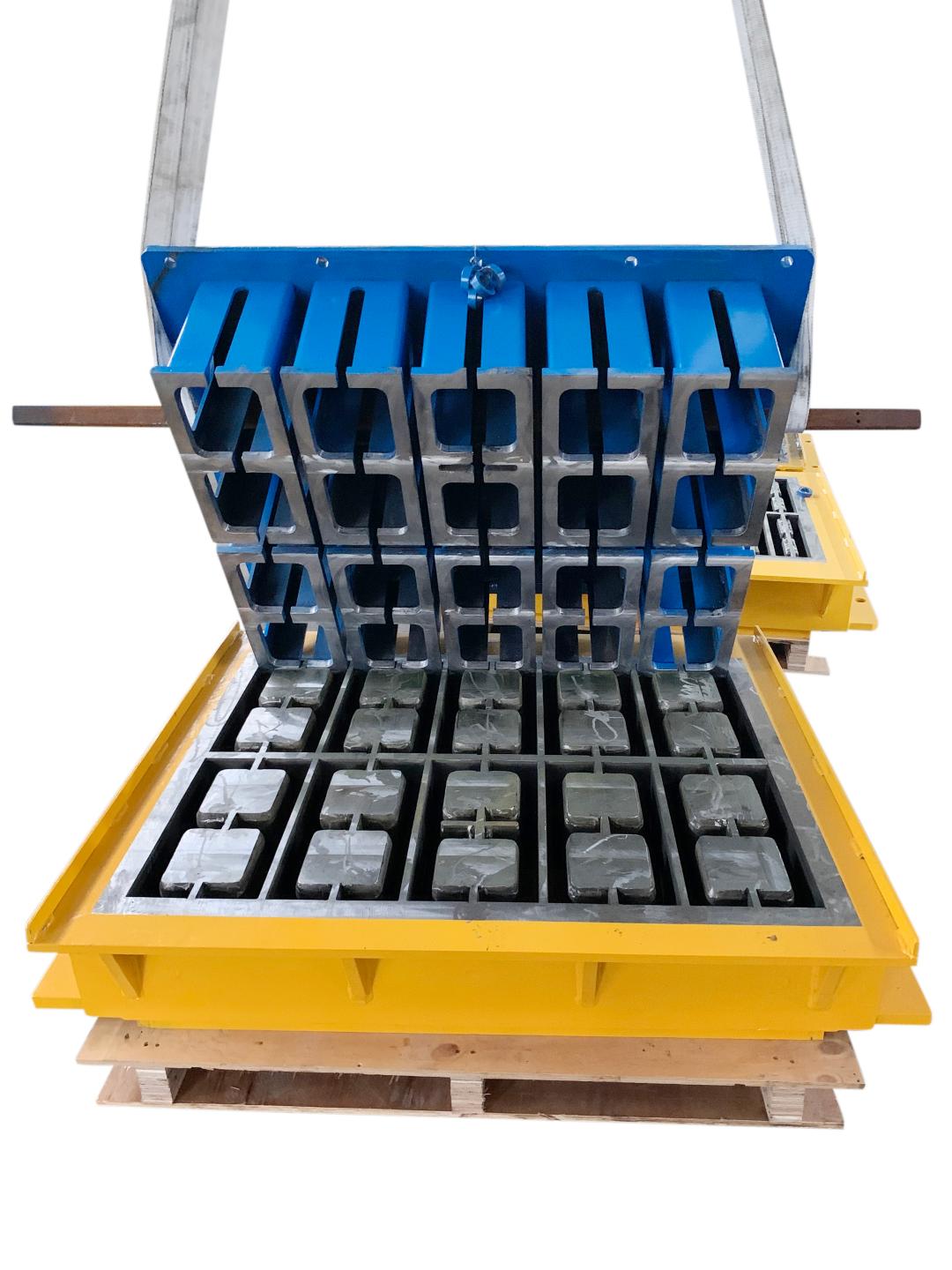
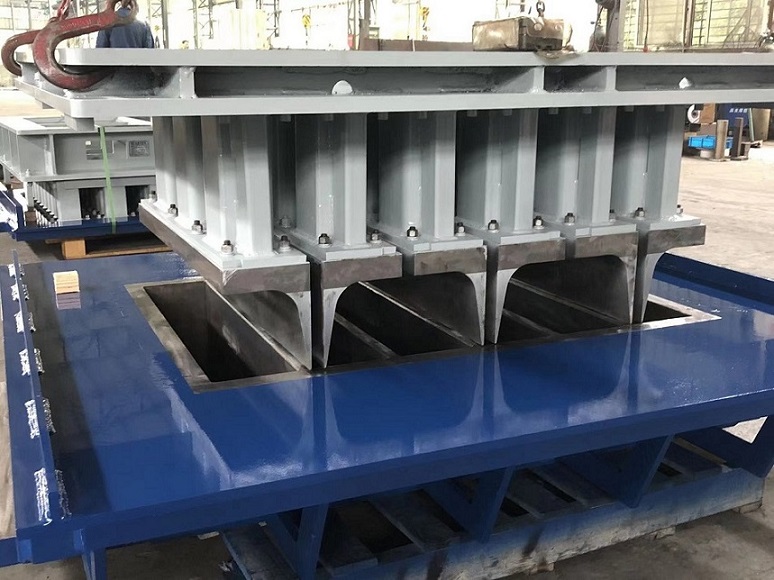
The hollow block mold shown above demonstrates a typical multi-cavity structure used for manufacturing structural concrete masonry units. Each cavity contains precisely machined partition plates that form the internal hollow sections of the block. Maintaining identical wall thickness across every cavity is essential because even slight dimensional differences may influence compressive strength, weight, mortar consumption, and stacking performance.
Engineers must carefully balance mold rigidity and vibration efficiency. Excessively thin partition plates may deform after long-term use, while unnecessarily thick sections increase mold weight and reduce vibration transmission efficiency. Proper structural design therefore improves both durability and block quality.
The guide system also plays an important role. Accurate alignment between the mold box and tamper head ensures smooth demoulding while minimizing unnecessary mechanical friction. This contributes to cleaner block edges and more stable production cycles.
Paving Block Mold Design
Paving block molds differ significantly from hollow block molds because decorative paving products usually require higher dimensional accuracy and better surface appearance. Small dimensional deviations may become highly visible after installation, especially when large paving areas are constructed with narrow joint spacing.
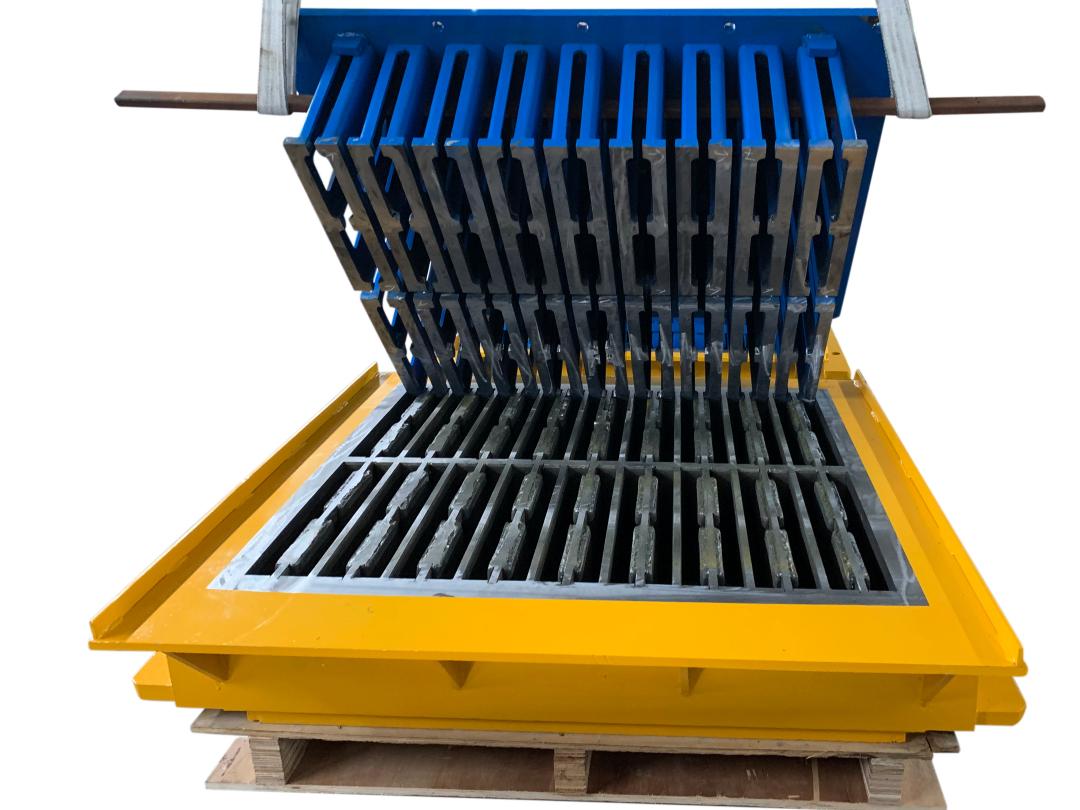
The paving block mold illustrated above contains numerous individual cavities arranged across the mold surface. Every cavity must be machined with consistent dimensions to ensure uniform product thickness, accurate edge geometry, and reliable interlocking performance where applicable.
Because paving products are generally produced in larger quantities than structural blocks, wear resistance becomes even more important. Repeated vibration gradually affects cavity corners and demoulding surfaces, making precision heat treatment and high-quality steel particularly valuable for maintaining consistent product dimensions throughout the mold's service life.
For manufacturers producing colored paving blocks, decorative landscape products, or municipal paving systems, mold precision has a direct influence on installation quality. Accurate dimensions simplify construction, reduce joint variation, and improve the overall visual appearance of completed paving projects.
One practical observation during factory acceptance is that experienced buyers often inspect several freshly produced blocks from different positions on the same pallet instead of evaluating only a single sample. Consistent dimensions across all cavities provide a more reliable indication of mold manufacturing quality than the appearance of an individual block.
Another useful verification method is to examine the contact surfaces between the mold and tamper head. Uniform machining marks, smooth transitions, and accurate fitting gaps generally indicate higher manufacturing precision. These details may appear insignificant during initial inspection, but they often have a substantial impact on long-term production stability and maintenance requirements.
Inspection Checklist Before Purchasing a Concrete Block Mold
Selecting a concrete block mold should involve much more than confirming the product dimensions. Since the mold is responsible for shaping every concrete block produced by the machine, its manufacturing quality directly influences dimensional accuracy, production efficiency, maintenance frequency, and long-term operating costs. A systematic inspection before shipment helps buyers verify whether the mold meets the expected engineering standards.
One practical observation during factory acceptance is that experienced buyers request the mold to be installed on the machine and tested under actual production conditions. Observing only the mold itself provides limited information. A complete production trial demonstrates whether the mold works correctly with the vibration system, hydraulic system, and demoulding mechanism.
Freshly produced blocks from every cavity should be measured for height, length, width, wall thickness, and corner consistency. Small dimensional differences between cavities may indicate machining deviations or assembly inaccuracies that become more significant after long-term production.
Buyers should also inspect the welding quality, guide mechanisms, locking positions, tamper head alignment, and machining finish. Smooth movement without abnormal friction generally indicates better manufacturing precision and reduces unnecessary wear during operation.
Comparison Between High-Quality and Standard Concrete Block Molds
| Evaluation Item | High-Quality Mold | Standard Mold |
|---|
| Steel Material | High-strength alloy steel with excellent wear resistance. | Ordinary steel with lower hardness and shorter service life. |
| Machining Method | High-precision CNC machining with tight dimensional tolerance. | Conventional machining with larger dimensional variation. |
| Heat Treatment | Uniform heat treatment for balanced hardness and toughness. | Limited or inconsistent heat treatment. |
| Demoulding Performance | Smooth block release with reduced mechanical friction. | Higher friction and increased risk of block edge damage. |
| Wear Resistance | Excellent long-term dimensional stability. | Faster wear requiring more frequent refurbishment. |
| Block Consistency | Uniform dimensions across every cavity. | Greater variation between cavities after extended use. |
| Maintenance Cost | Lower long-term maintenance and replacement frequency. | Higher maintenance and shorter service intervals. |
Although premium molds generally require a higher initial investment, they often provide lower operating costs throughout the entire production lifecycle. Better dimensional stability, reduced downtime, fewer repairs, and more consistent block quality contribute to a lower cost per block over time.
FAQ
How long does a concrete block mold normally last?
The service life depends on steel quality, heat treatment, raw material abrasiveness, production volume, vibration intensity, and maintenance practices. Under proper operating conditions, a well-manufactured mold generally maintains dimensional accuracy much longer than a standard mold.
Why is CNC machining important for concrete block molds?
CNC machining provides consistent dimensional accuracy, smoother working surfaces, and better repeatability between molds. This improves block consistency, simplifies mold replacement, and reduces assembly errors.
Does heat treatment affect mold durability?
Yes. Proper heat treatment increases surface hardness while preserving internal toughness, allowing the mold to resist wear, impact, and fatigue during continuous production without becoming excessively brittle.
Can one block machine use different molds?
Yes. Most modern automatic concrete block machines are designed for quick mold replacement, allowing manufacturers to produce hollow blocks, solid bricks, paving blocks, kerbstones, retaining blocks, and customized concrete products using the same host machine.
What should buyers inspect during mold acceptance?
Buyers should verify machining accuracy, cavity dimensions, welding quality, guide mechanisms, heat treatment consistency, block dimensions after production testing, and the overall compatibility between the mold and the block machine.
Why is dimensional consistency so important?
Consistent block dimensions improve construction efficiency, reduce mortar consumption, simplify installation, and enhance the appearance of finished masonry or paving projects. High dimensional accuracy also reflects the overall manufacturing quality of the mold.
Conclusion
The concrete block mold is far more than a replaceable accessory. It is the component that directly determines the geometry, dimensional accuracy, surface quality, and consistency of every concrete product manufactured by an automatic block machine. Even the most advanced hydraulic system and vibration technology cannot compensate for an inaccurately manufactured or poorly maintained mold.
As discussed throughout this article, high-quality molds result from a combination of precision CNC machining, carefully selected alloy steel, scientifically controlled heat treatment, and engineering designs optimized for different concrete products. Whether manufacturing hollow blocks, paving blocks, kerbstones, or customized masonry units, every detail of the mold influences production efficiency, maintenance requirements, and long-term operating costs.
For buyers evaluating different suppliers, it is advisable to inspect the complete mold manufacturing process rather than focusing only on the finished product. Reviewing machining equipment, heat treatment procedures, dimensional inspection methods, production testing, and finished block quality provides a more reliable basis for comparison than simply considering purchase price.
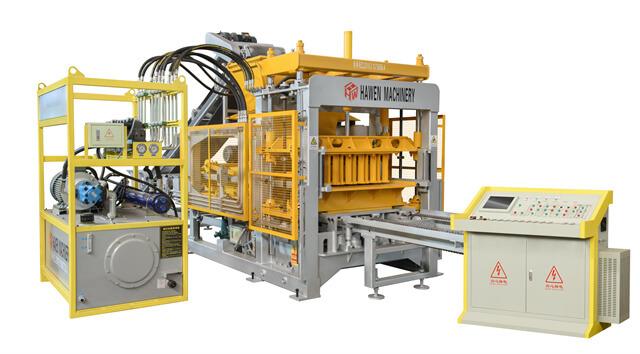
At Hawen Machinery, mold manufacturing follows the same engineering philosophy as our block machines: precision, durability, and production stability. By combining advanced CNC machining, high-quality alloy steel, and rigorous quality control throughout the manufacturing process, our molds are designed to deliver consistent block quality, reliable performance, and long service life for demanding concrete production applications.





 Tel: +86-13905968794
 Email: export@hwmachines.com
 MP/WhatsApp: +86-13905968794
 Manufacturer Address:Nanan,Quanzhou City,Fujian Province,China