Many buyers compare concrete block making machines by production capacity, pallet size, or quotation price. While these factors are important, they rarely determine how the machine performs after several years of continuous production. In practical operation, the quality of an automatic concrete block machine depends largely on the reliability of its hydraulic system, mechanical structure, vibration technology, and component selection.
A machine capable of producing thousands of concrete blocks every day operates under continuous vibration, high hydraulic pressure, abrasive aggregates, and frequent mold changes. Any weakness in the hydraulic station, vibration box, or structural frame may gradually reduce block quality, increase maintenance costs, and shorten equipment service life. Therefore, experienced buyers usually evaluate not only production capacity but also the engineering details hidden inside the machine.
At Hawen Machinery, our engineering philosophy focuses on long-term production stability rather than simply increasing theoretical output. The hydraulic system, mechanical structure, electrical control, and vibration technology are designed to work together as an integrated production system. Buyers who are comparing different automatic concrete block machines often pay close attention to these technical details because they directly influence block consistency, machine durability, and operating efficiency.
The following sections explain why premium hydraulic components and heavy-duty mechanical structures play such an important role in producing high-quality concrete blocks.
Why Component Selection Determines Block Machine Quality
Many machines may appear similar from the outside, but the internal components often determine whether the equipment can operate reliably for many years. Hydraulic pumps, proportional valves, electric motors, vibration boxes, bearings, guide columns, and synchronization mechanisms work together throughout every production cycle. If any critical component lacks precision or durability, the entire production line may suffer from unstable vibration, inconsistent pressure, or excessive wear.
Professional buyers usually review the machine configuration before confirming an order. Instead of comparing only prices, they examine hydraulic brands, electrical components, steel fabrication quality, vibration technology, mold fastening methods, and after-sales maintenance requirements. This evaluation approach provides a more realistic understanding of long-term operating costs than simply comparing hourly production figures.
One observation frequently made during factory acceptance is that two machines with similar production capacities may perform very differently after several years of operation. The difference is often not the PLC program or production speed, but the stability of the hydraulic system and the rigidity of the mechanical frame under continuous heavy-duty vibration.
The hydraulic system is often regarded as the "power center" of an automatic concrete block machine. During every production cycle, hydraulic pressure controls mold lifting, material feeding, pressing, demolding, and pallet transfer. Stable hydraulic pressure ensures every movement remains synchronized, reducing mechanical impact while improving block dimensional accuracy.
Rather than relying on low-cost standard hydraulic components, Hawen Machinery selects internationally recognized brands for key hydraulic parts. This configuration improves pressure stability, reduces oil temperature fluctuation, and allows smoother motion throughout continuous production.
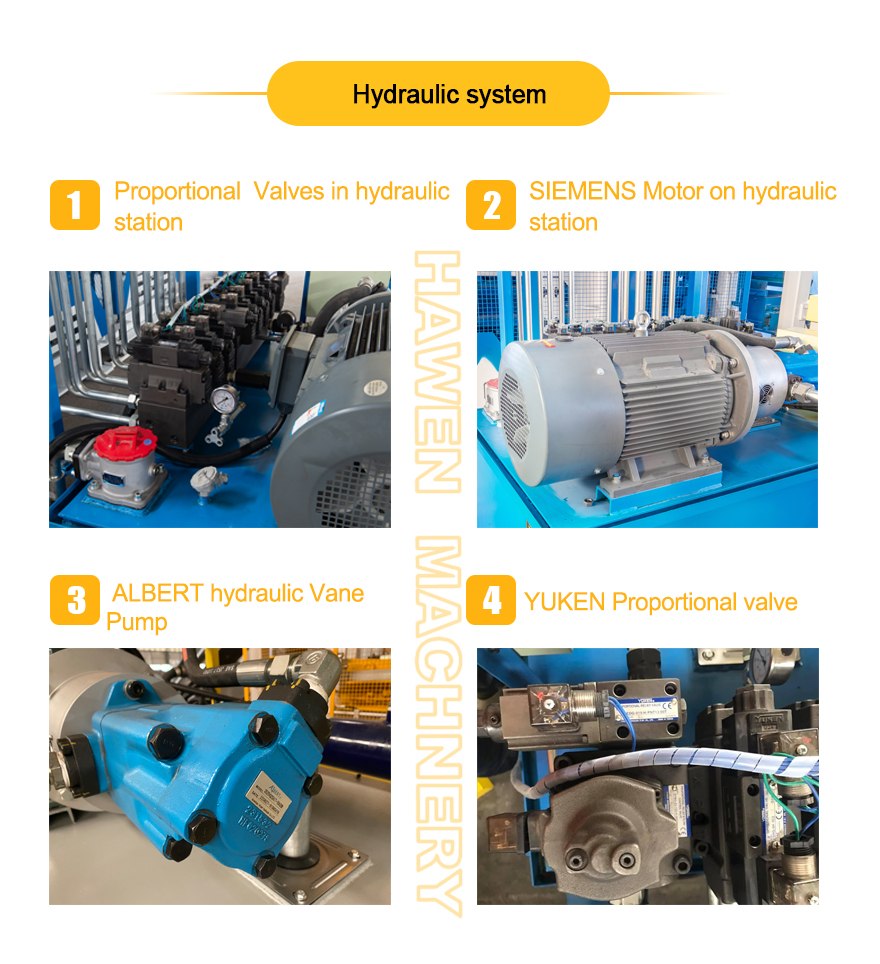
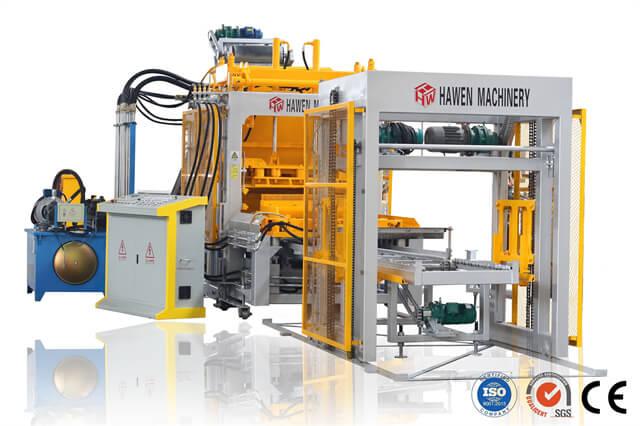
The hydraulic station shown below illustrates several important engineering choices that directly influence machine performance.
1. Double Proportional Valves for Accurate Hydraulic Control
The hydraulic station adopts proportional valves that continuously regulate oil flow according to the machine's operating requirements. Compared with conventional switching valves, proportional valves allow smoother acceleration and deceleration of hydraulic cylinders, reducing impact loads on the mold and machine frame. This improves dimensional consistency while extending component life.
2. SIEMENS Hydraulic Motor for Continuous Industrial Operation
The hydraulic power unit is equipped with a SIEMENS motor, providing reliable power output during long production shifts. Stable motor performance contributes to consistent hydraulic pressure, lower operating noise, improved energy efficiency, and reduced maintenance frequency under demanding working conditions.
3. ALBERT High-Performance Vane Pump
The ALBERT hydraulic vane pump delivers stable oil flow while maintaining high volumetric efficiency. Consistent oil delivery minimizes pressure fluctuations during vibration and pressing, helping every concrete block achieve more uniform density and surface quality.
4. YUKEN Proportional Valve for Precise Motion Control
YUKEN proportional valves further improve response accuracy by providing precise hydraulic flow regulation throughout the production cycle. This contributes to synchronized mold movement, smoother demolding, and reduced mechanical shock during repeated operation.
Another practical advantage of premium hydraulic components is maintenance efficiency. Internationally recognized hydraulic brands generally offer better spare parts availability, standardized specifications, and proven long-term reliability. For block manufacturers operating multiple production shifts every day, reducing unexpected downtime is often more valuable than achieving slightly higher theoretical production capacity.
From an engineering perspective, stable hydraulic pressure not only improves machine durability but also directly influences block strength, dimensional accuracy, surface appearance, and mold service life. These factors ultimately determine whether a concrete block production line can maintain consistent product quality over many years of operation.
Mechanical Structure Determines Block Density and Machine Service Life
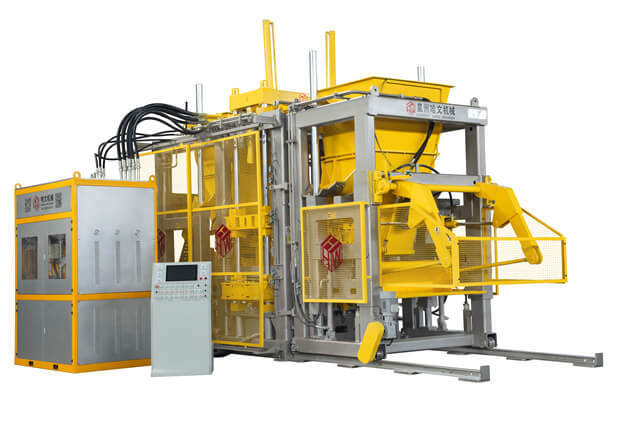
While the hydraulic system provides the driving force, the mechanical structure determines how effectively that power is converted into dense, dimensionally accurate concrete blocks. During every production cycle, the machine frame, vibration system, guide columns, feeding mechanism, and synchronization components are subjected to repeated impact loads. Their structural rigidity directly affects block quality, equipment stability, and long-term operating costs.
An experienced buyer rarely evaluates a concrete block machine by its appearance alone. Instead, attention is given to the internal mechanical design, including vibration technology, frame construction, synchronization mechanisms, and the durability of moving parts. These engineering details largely determine whether the machine can maintain stable production after years of continuous operation.
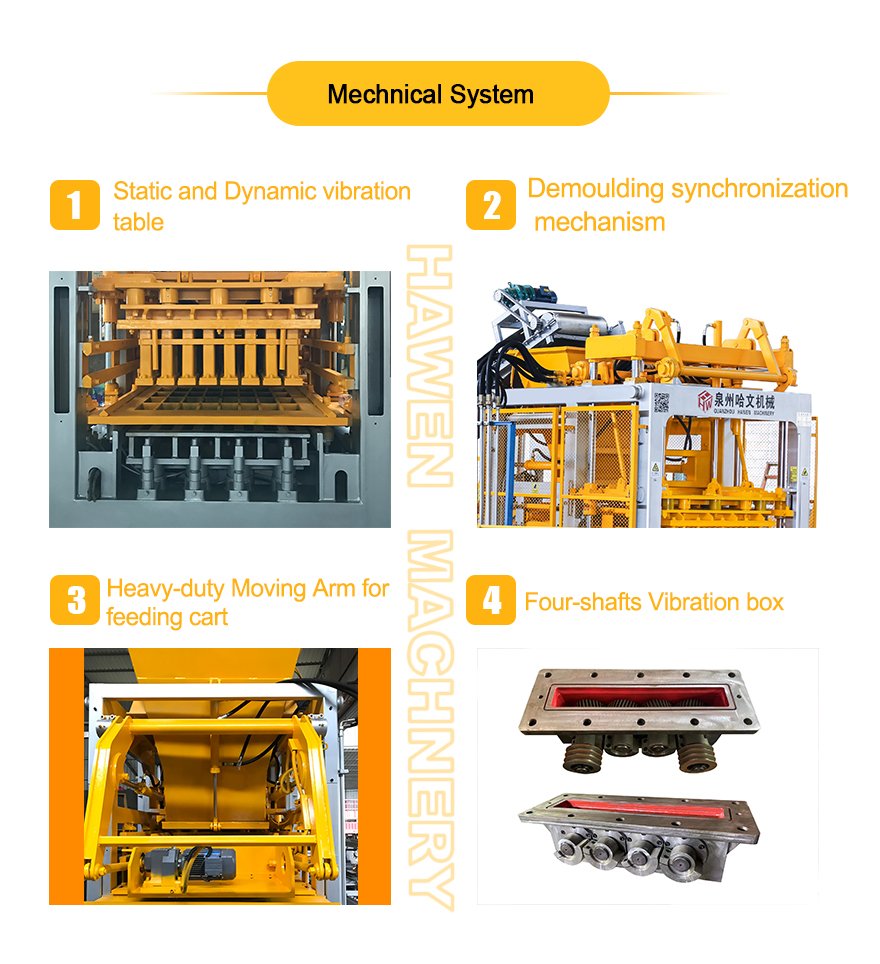
Static and Dynamic Vibration Table
One of the key structural features is the combination of a static table and a dynamic vibration table. Unlike conventional single-table vibration systems, this design distributes vibration energy more efficiently while reducing unnecessary stress on the main frame.
The dynamic vibration table delivers high-frequency vibration directly to the mold, allowing concrete materials to achieve better compaction within a shorter forming cycle. Meanwhile, the static table absorbs structural loads and minimizes vibration transmission to the surrounding machine frame. This engineering arrangement improves block density, reduces equipment fatigue, and enhances production stability.
Demoulding Synchronization Mechanism
Demoulding is one of the most critical stages in block production. If the mold and tamper head are not perfectly synchronized, freshly formed blocks may suffer from damaged corners, uneven height, or surface cracks before entering the curing process.
The synchronized demoulding mechanism ensures that hydraulic movement remains coordinated throughout the lifting process. This significantly reduces mechanical shock while improving the dimensional consistency of hollow blocks, solid bricks, paving blocks, and other concrete products.
Heavy-Duty Feeding Cart with Reinforced Moving Arms
Uniform material distribution is essential for producing concrete blocks with consistent compressive strength. The heavy-duty feeding cart uses reinforced moving arms to deliver mixed concrete evenly across the mold cavity before vibration begins.
Balanced feeding reduces segregation of aggregates and minimizes density differences between individual blocks on the same pallet. This becomes particularly important when manufacturing large-format hollow blocks or decorative paving products that require excellent dimensional accuracy.
Four-Shaft High-Efficiency Vibration Box
The vibration box is widely recognized as one of the most important components in a concrete block making machine. Hawen Machinery adopts a four-shaft vibration box capable of generating balanced excitation forces across the entire mold surface.
Compared with conventional vibration systems, the four-shaft design produces more uniform vibration distribution while reducing unnecessary vibration loss. This allows concrete particles to rearrange more efficiently during compaction, resulting in higher block density, smoother surfaces, and stronger compressive strength after curing.
Another practical advantage is longer bearing life. Because vibration forces remain balanced during operation, mechanical stress on rotating components is reduced, contributing to lower maintenance requirements and longer service intervals.
During factory acceptance inspections, engineers often pay close attention to vibration consistency rather than simply measuring cycle time. Stable vibration characteristics usually indicate better manufacturing precision and improved long-term reliability.
Why a Complete Production Line Performs Better Than an Isolated Machine
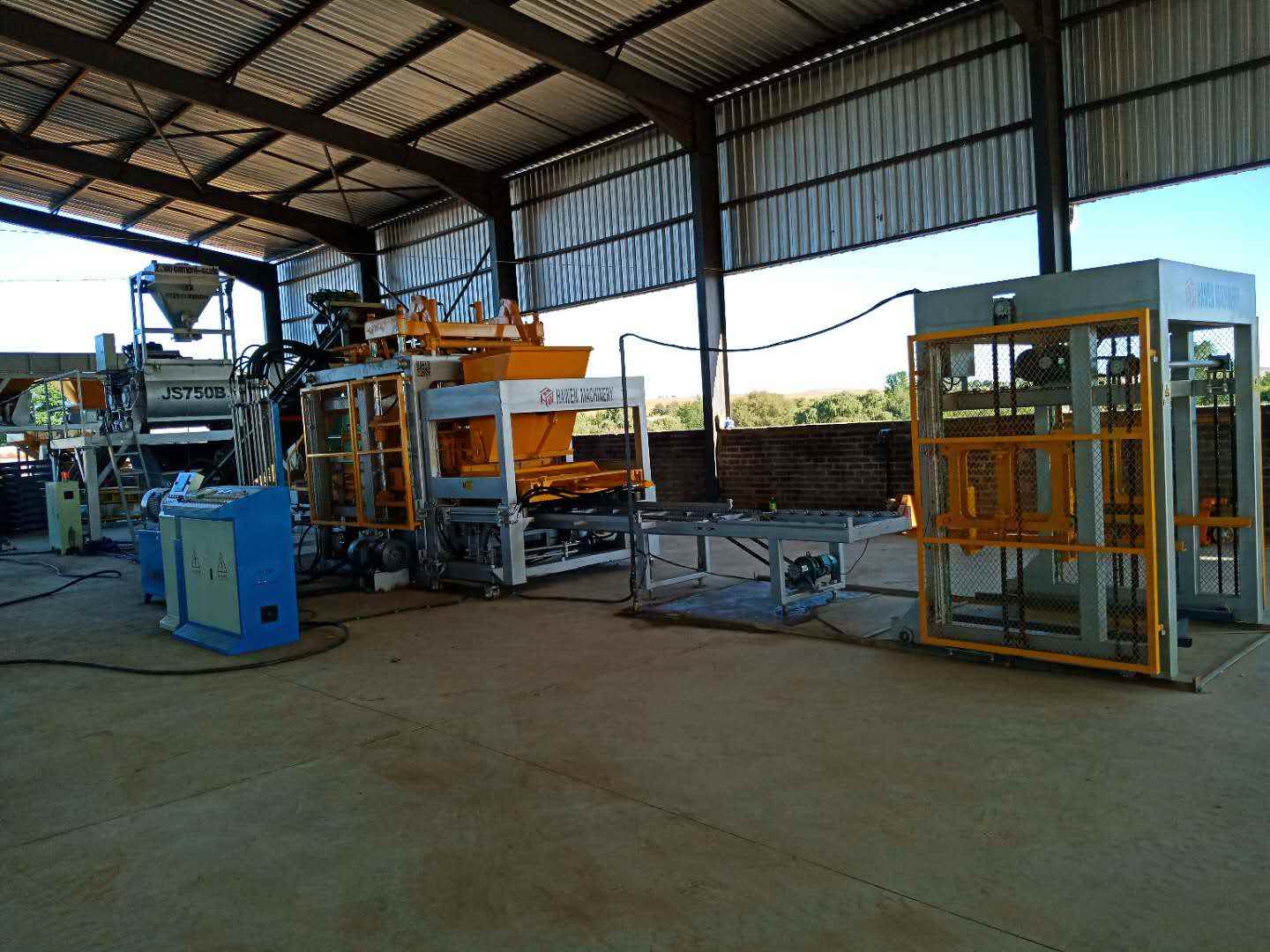
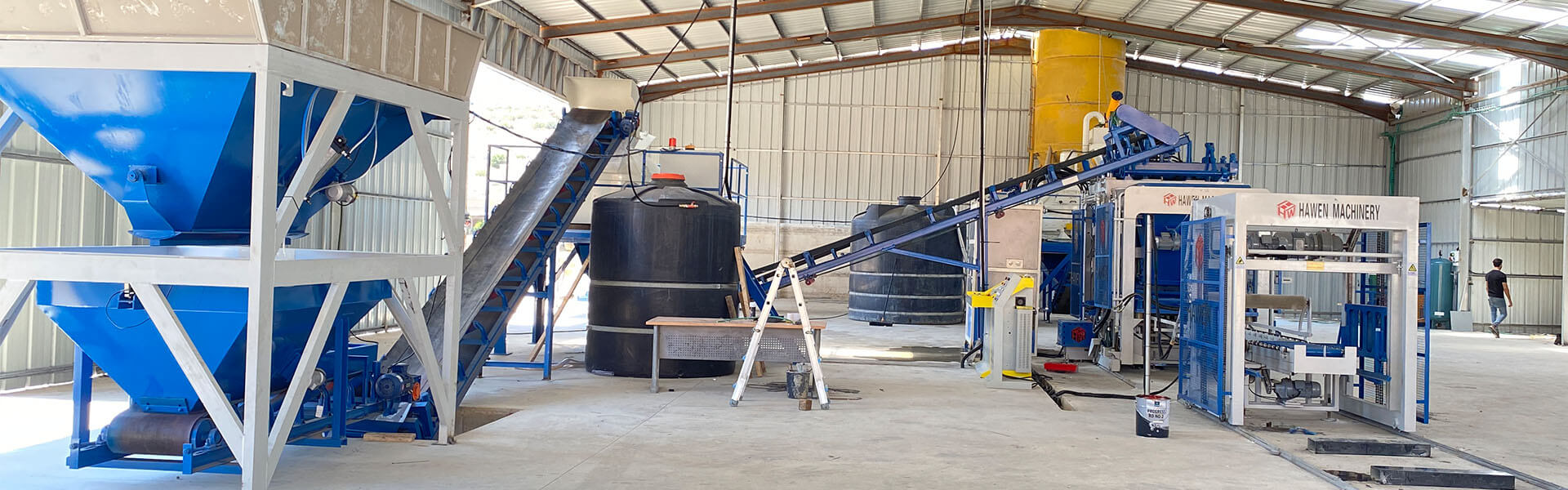
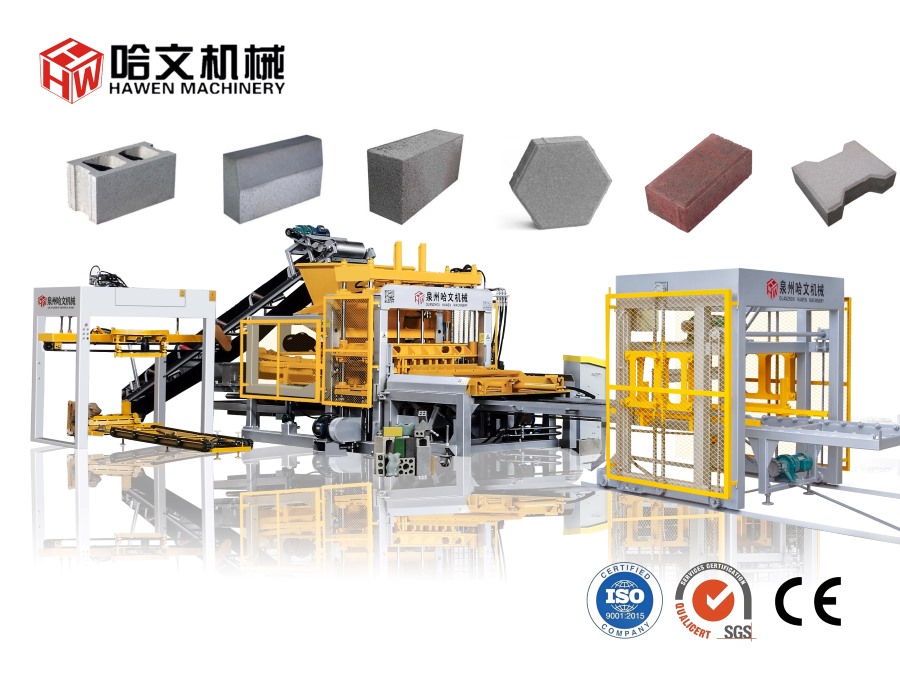
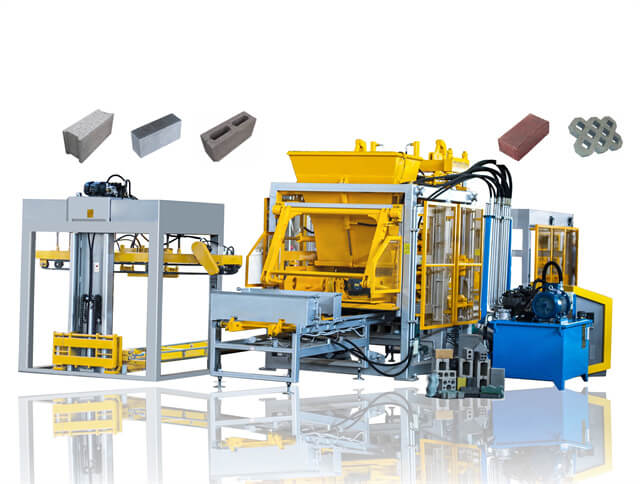
A concrete block making machine should never be evaluated as an independent piece of equipment. Instead, it functions as the core of an integrated production system consisting of raw material batching, concrete mixing, hydraulic forming, pallet conveying, block transportation, curing, and finished product handling.
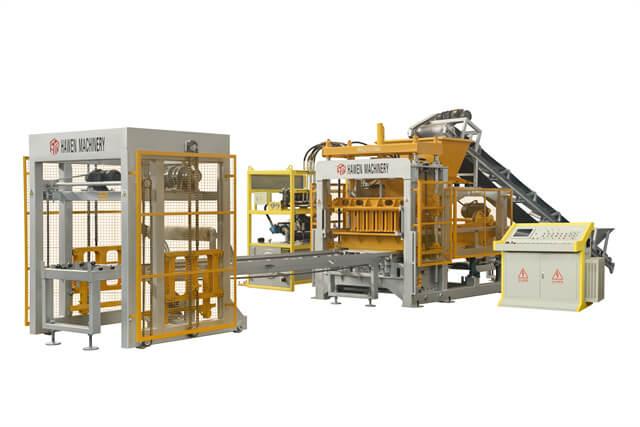
The production line illustrated above demonstrates how these systems operate together. Aggregate materials are first weighed and transferred into the JS750 concrete mixer, where cement, sand, crushed stone, water, and optional fly ash are mixed into a homogeneous concrete mixture. Consistent batching accuracy at this stage is essential because variations in moisture content or aggregate proportions will directly affect block strength and dimensional stability.
After mixing, the concrete is transported to the block machine through the feeding system. The hydraulic station controls mold pressing and demoulding, while the vibration system compacts the concrete inside the mold. Newly formed green blocks are immediately transferred by conveyor to the next handling stage without interrupting the production cycle.
The pallet circulation system also plays an important role in maintaining production efficiency. Stable pallet transfer reduces unnecessary waiting time between cycles and minimizes the risk of fresh block deformation during transportation. Many production bottlenecks observed during installation are caused not by the forming machine itself, but by insufficient pallet circulation or poor downstream logistics planning.
Another important consideration is equipment compatibility. Hydraulic stations, mixers, conveyors, electrical control systems, and block handling equipment should be designed as one coordinated production line rather than assembled from unrelated components. Proper integration improves communication between each subsystem, simplifies maintenance, and enhances long-term operating stability.
When reviewing quotations from different suppliers, buyers are encouraged to compare the complete production configuration instead of focusing solely on the host machine. Machines with similar production capacities may differ significantly in hydraulic components, vibration technology, material handling systems, and automation levels, leading to considerable differences in maintenance costs over the equipment's lifetime.
A practical observation during pre-shipment factory testing is that a well-balanced production line operates smoothly from material feeding to block discharge without frequent manual intervention. Operators can monitor the entire process through the PLC control system while each subsystem maintains synchronized operation. Such consistency is often a more meaningful indicator of machine quality than the theoretical hourly output listed in a product brochure.
Inspection Checklist Before Purchasing a Concrete Block Machine
For most buyers, the true quality of a concrete block machine becomes evident during factory acceptance testing rather than in a product catalog. A systematic inspection helps verify whether the supplied equipment matches the technical specification and whether it is capable of stable long-term production.
Instead of focusing only on production capacity, buyers should evaluate the machine from the perspectives of hydraulic stability, mechanical precision, electrical control, and production consistency. These factors have a greater influence on future operating costs than a small difference in purchase price.
One practical observation made during factory inspections is that a high-quality production line runs continuously through multiple production cycles with smooth hydraulic movement, uniform vibration, and stable material feeding. Frequent manual adjustments or irregular machine movements often indicate that further commissioning is required before shipment.
Key Components Buyers Should Compare Before Making a Decision
| Inspection Item | Engineering Importance | Buyer Verification Method |
|---|
| Hydraulic proportional valves | Maintain smooth hydraulic motion and stable pressure control. | Observe hydraulic response, leakage, and movement consistency during testing. |
| Hydraulic motor | Provides continuous power for the hydraulic station. | Monitor operating temperature, vibration, and noise level. |
| Hydraulic vane pump | Ensures stable oil flow and pressure throughout production. | Check pressure stability during repeated production cycles. |
| Four-shaft vibration box | Produces uniform concrete compaction and higher block density. | Inspect vibration consistency and finished block appearance. |
| Static & Dynamic vibration table | Reduces structural stress while improving vibration efficiency. | Observe machine stability during continuous operation. |
| Demould synchronization system | Protects block edges and dimensional accuracy. | Inspect freshly demoulded blocks for cracks or corner damage. |
| Feeding system | Provides uniform concrete distribution inside the mold. | Compare block density across different positions on the pallet. |
| Overall production line coordination | Determines long-term production efficiency. | Observe whether batching, mixing, forming, conveying, and pallet circulation operate continuously. |
A comprehensive inspection should always consider the entire production line rather than individual components. Reliable performance depends on how effectively every subsystem works together under continuous production conditions.
FAQ
Why are premium hydraulic components important for a concrete block machine?
Premium hydraulic components provide more stable oil pressure, smoother cylinder movement, and more accurate hydraulic control. This contributes directly to better block dimensional accuracy, lower maintenance costs, and longer equipment service life.
Does the vibration system influence block strength?
Yes. Proper vibration technology allows concrete particles to compact more uniformly inside the mold. Balanced vibration improves block density, compressive strength, and surface finish while reducing internal voids.
Why do many manufacturers use internationally recognized hydraulic brands?
Well-established hydraulic component manufacturers generally offer higher manufacturing precision, better durability, standardized spare parts, and proven reliability during continuous industrial operation.
Is production capacity the most important factor when selecting a block machine?
Not necessarily. Production capacity should be evaluated together with hydraulic quality, vibration technology, frame rigidity, automation level, maintenance requirements, spare parts availability, and long-term operating costs.
What should buyers inspect during factory acceptance testing?
Buyers should observe hydraulic pressure stability, vibration consistency, synchronization of moving mechanisms, finished block quality, PLC operation, electrical safety, and the overall coordination of the complete production line.
Can a high-quality machine reduce maintenance costs?
In many cases, yes. Machines equipped with durable hydraulic components, heavy-duty mechanical structures, and precision manufacturing generally experience fewer unexpected failures and require less corrective maintenance throughout their operating life.
Conclusion
The long-term performance of an automatic concrete block machine depends on far more than its rated production capacity. Hydraulic stability, vibration technology, mechanical rigidity, component quality, and system integration together determine whether the equipment can consistently produce high-quality concrete blocks while maintaining low operating costs over many years of service.
As discussed throughout this article, premium hydraulic components such as proportional valves, high-performance vane pumps, and reliable motors provide precise motion control and stable pressure throughout every production cycle. At the same time, heavy-duty mechanical systems—including static and dynamic vibration tables, synchronized demoulding mechanisms, reinforced feeding systems, and four-shaft vibration boxes—play a decisive role in achieving excellent block density, dimensional accuracy, and equipment durability.
For professional buyers, selecting a concrete block machine should always involve a comprehensive evaluation of the complete production system rather than focusing solely on hourly output or purchase price. Reviewing component specifications, observing factory testing, inspecting finished block quality, and understanding the integration between hydraulic, mechanical, and electrical systems provide a far more reliable basis for investment decisions.
By combining carefully selected international components with robust engineering design and complete production line integration, Hawen Machinery aims to provide equipment capable of supporting stable concrete block production under demanding industrial conditions. Buyers who evaluate these engineering details systematically are more likely to choose equipment that delivers consistent product quality, reduced maintenance requirements, and reliable long-term performance.





 Tel: +86-13905968794
 Email: export@hwmachines.com
 MP/WhatsApp: +86-13905968794
 Manufacturer Address:Nanan,Quanzhou City,Fujian Province,China