The number of shafts in a block machine vibration box is often used as a simple equipment comparison point. Buyers may hear that a four-shaft system produces denser blocks than a two-shaft system, while another supplier may emphasize motor power or vibration frequency. Shaft count does influence how excitation force can be generated and distributed, but it does not determine concrete block density by itself.
Block density is the result of a complete compaction process. The vibration system must mobilize the dry-cast concrete, reduce internal friction, release trapped air, and allow aggregate particles to rearrange while the tamper head controls height and applies pressure. The final result also depends on moisture, aggregate grading, mold filling, pallet support, vibration time, and machine condition. Understanding the role of shaft count helps buyers evaluate engineering design without relying on one specification number.
Why Vibration Controls Block Density
Fresh concrete for machine-made blocks is normally a zero-slump or low-slump mixture. It cannot flow through a mold like conventional cast concrete. Before vibration, aggregate particles touch each other in a loose arrangement, with friction and air spaces preventing efficient packing. Vibration introduces repeated acceleration that temporarily reduces resistance between particles and allows them to move into a tighter structure.
As particles rearrange, smaller grains enter spaces between larger grains and trapped air moves toward exposed surfaces. The tamper head then helps maintain contact and controls the final product height. When material distribution and vibration are uniform, the block develops a more consistent mass, lower internal void content, better surface closure, and improved strength potential.
Insufficient useful vibration can leave open texture, weak corners, poorly formed hollow-block webs, low mass, and density differences across one pallet. Excessive or poorly controlled vibration can also be harmful. It may increase cycle time, loosen fasteners, accelerate bearing wear, or cause paste migration and sticking when the mixture is too wet. The target is controlled energy transfer, not maximum visible shaking.
Density should be interpreted with product dimensions and moisture condition. A heavier unit is not automatically better if it contains excess material, exceeds height tolerance, or has an unsuitable water balance. A stable production process defines an acceptable mass and dimension range, then confirms performance through absorption and compressive-strength testing.
What Shaft Count Means in a Vibration Box
A vibration shaft carries eccentric masses. When the shaft rotates, the offset mass creates a periodic centrifugal force. Multiple shafts can be arranged so unwanted horizontal force components oppose each other while useful vertical components combine. The resulting force is transmitted through the vibration box, table, pallet, mold, and concrete mixture.
Shaft count therefore affects the number and position of excitation sources available to the designer. It can influence force balance, distribution over the forming area, achievable frequency, bearing loads, transmission layout, and control strategy. However, the result depends on how the shafts are positioned and phased. Four poorly synchronized shafts do not automatically provide better compaction than two well-engineered shafts.
The eccentric moment, rotational speed, and phase relationship determine excitation behavior. Motor nameplate power only indicates the capability to drive the system; it does not directly state the useful force reaching the concrete. Structural stiffness and mechanical losses between the vibration box and mold also affect delivered energy.
Some designs place eccentric masses inside the housing, while others position them externally. External positioning can simplify adjustment or reduce internal resistance in a particular design, but buyers should evaluate the complete arrangement, including sealing, guarding, lubrication, bearing selection, access, and long-term alignment. A design feature should be judged by measured production stability rather than description alone.
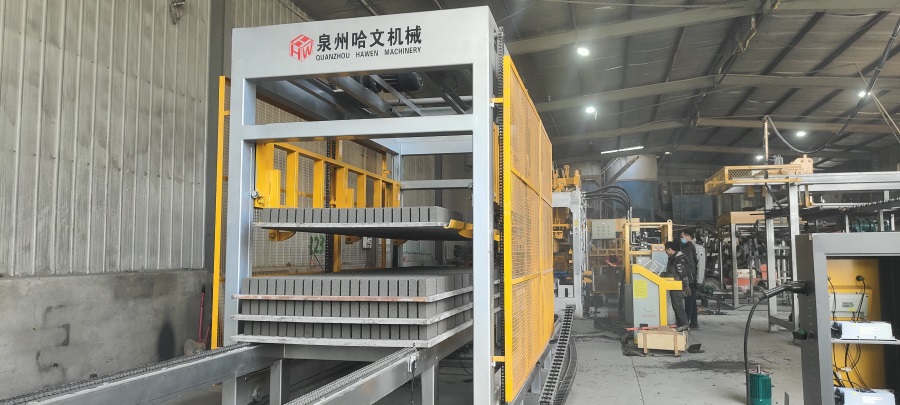
Two-Shaft and Four-Shaft System Comparison
A typical two-shaft vibration arrangement uses two counter-rotating shafts. When their eccentric masses are correctly phased, horizontal forces can largely cancel and vertical forces can reinforce each other. This is a practical configuration for many machines because it has fewer rotating assemblies, a relatively straightforward transmission path, and fewer bearings requiring inspection.
Its performance depends on table dimensions, shaft spacing, eccentric moment, speed stability, and frame stiffness. If the forming area is large or force transmission is not sufficiently uniform, the center and edges of the mold may respond differently. This is not an unavoidable fault of every two-shaft system; it is a design and application issue that should be verified through measurements and product results.
A four-shaft arrangement provides additional excitation points and more options for distributing force across a larger vibration table. When properly synchronized, the system can support balanced vertical excitation and more uniform energy distribution over the mold area. This can be valuable for high-output machines, larger pallets, multi-cavity molds, and products requiring short, intensive compaction cycles.
The additional shafts also introduce more components and control requirements. Bearings, couplings or gears, eccentric settings, lubrication points, and synchronization must remain within specification. The benefit of four shafts appears only when the machine structure, transmission, controls, and maintenance program preserve the intended phase relationship.
| Evaluation point | Two-shaft arrangement | Four-shaft arrangement |
|---|
| Excitation layout | Two counter-rotating excitation sources | More excitation points and distribution options |
| Potential application | Effective for appropriately sized tables and product ranges | Useful for larger forming areas and demanding high-output cycles |
| Maintenance scope | Fewer rotating components and bearings | More components requiring alignment and condition control |
| Main technical risk | Uneven table response if layout and stiffness are unsuitable | Loss of benefit if shafts are not accurately synchronized |
| Correct buying question | How uniform is measured compaction across the exact mold and pallet? |
How Shaft Synchronization Affects Compaction
Synchronization means maintaining the designed angular relationship between rotating eccentric masses. When shafts remain correctly phased, useful force components combine at the intended moment. When phase relationships drift, part of the force can cancel, shift direction, or create unwanted torsional and horizontal loads.
Poor synchronization may appear as abnormal noise, unstable current, excessive frame movement, loose bolts, inconsistent cycle behavior, or different density at opposite sides of the pallet. Operators may respond by increasing vibration time, but longer operation cannot correct an incorrect force pattern. It may instead accelerate wear.
Synchronization can be maintained mechanically through suitable gear or belt arrangements, electronically through controlled motors, or through a combined system, depending on machine design. Each method has its own inspection points. Gear wear and backlash, belt tension, coupling condition, encoder feedback, motor response, and control parameters can all affect timing.
The system must also reach operating speed quickly and stop in a controlled manner because production cycles are short. A vibration system that eventually reaches the correct frequency may still deliver inconsistent energy if acceleration occupies too much of the compaction period. Buyers should ask how rapidly the vibration command is established and how repeatability is monitored from cycle to cycle.
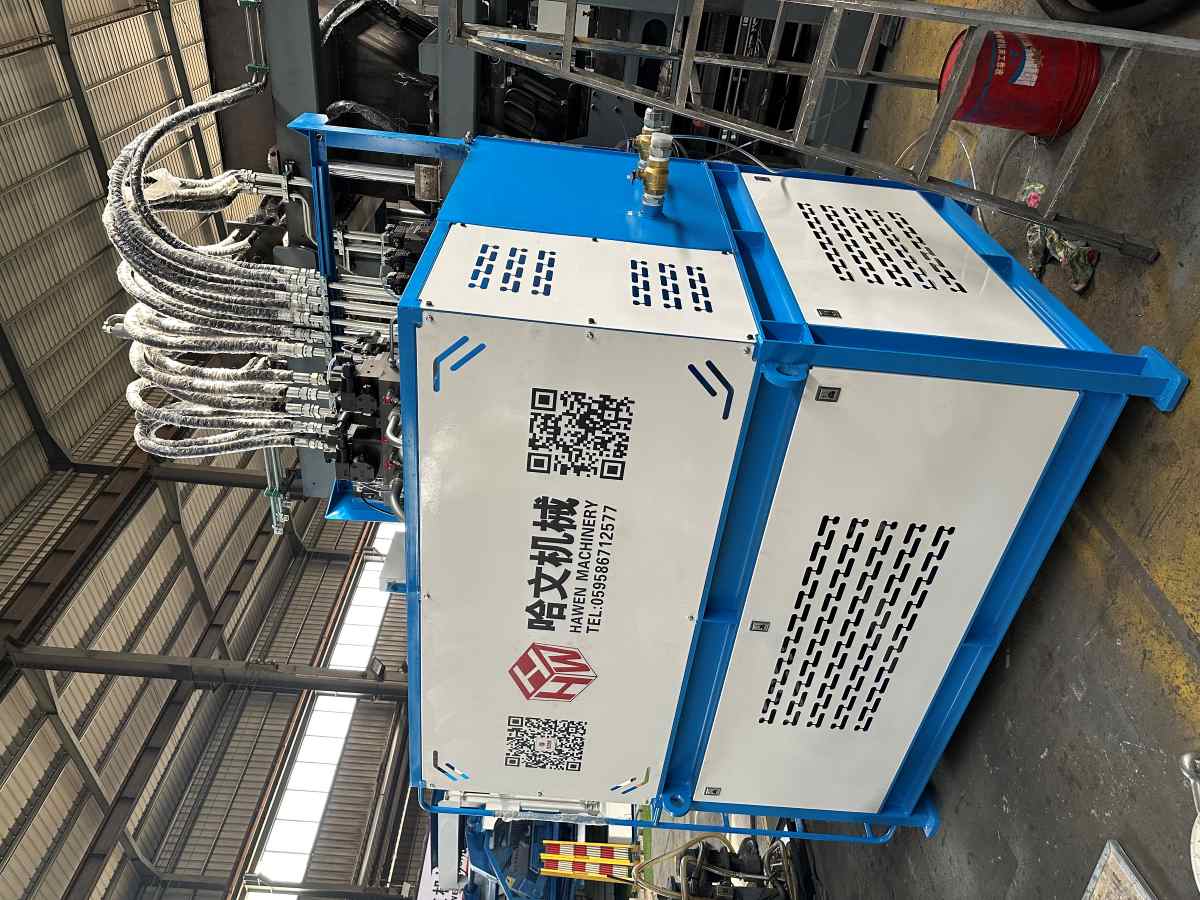
Why More Shafts Do Not Automatically Mean Higher Density
Shaft count is only one variable in the vibration system. Frequency determines how often force cycles occur, amplitude describes movement magnitude, and eccentric moment affects generated force. The mass of the vibrating assembly and the stiffness of the table and frame determine the actual response. Two machines with four shafts can therefore behave very differently.
Force that moves the machine frame or foundation is not fully available for compacting concrete. Weak anchoring, structural flexibility, loose connections, worn isolation elements, and poor table contact can redirect energy. A machine that feels more aggressive to an observer may be losing useful energy through uncontrolled movement.
Compaction also reaches a practical limit. Once particles have achieved a stable packing condition for a given mixture, additional energy may provide little density gain. If the mix lacks suitable fines or effective moisture, stronger vibration cannot create the missing paste or correct grading. If the mold is underfilled, pressure and vibration cannot produce the intended block mass.
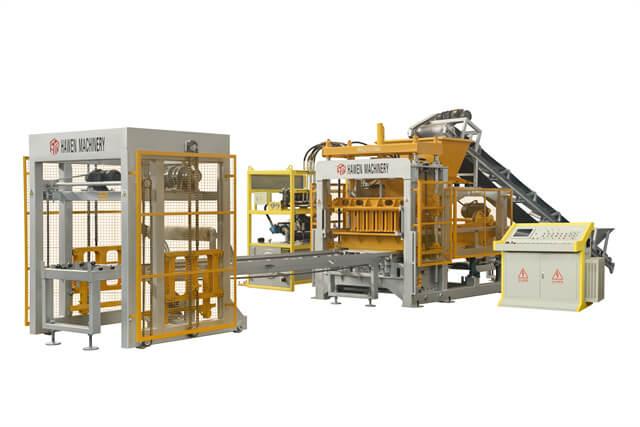
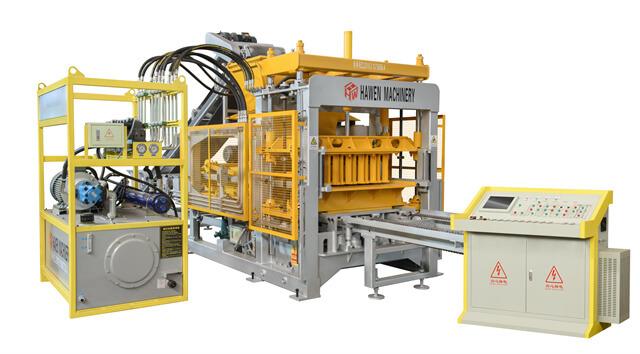
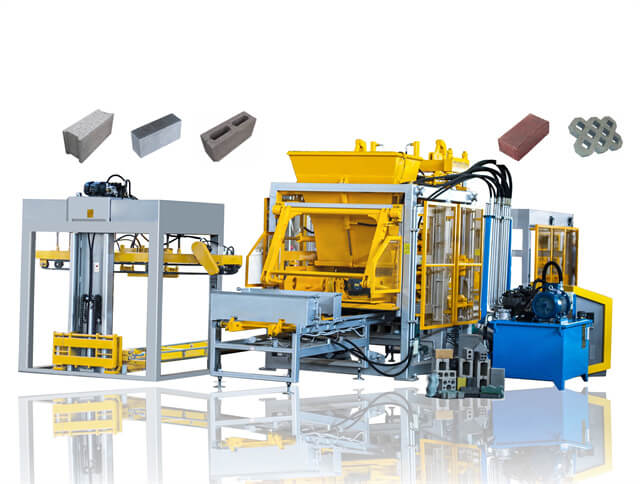
For these reasons, a professional block making machine comparison should include shaft arrangement but not stop there. Buyers should review table size, vibration frequency range, control method, eccentric adjustment, synchronization, cycle data, foundation requirements, maintenance access, and trial-block consistency.
Material, Mold, and Pallet Factors
Moisture determines how readily aggregate particles move under vibration. A mixture that is too dry may resist rearrangement and leave open texture even when vibration energy is high. A mixture that is too wet may appear dense but stick to the mold, deform after demolding, or develop higher hardened porosity. Each product needs a verified moisture window.
Aggregate grading controls packing efficiency. Well-graded particles can form a dense skeleton with fewer voids. Excessively coarse, gap-graded, or high-dust material changes the vibration response. When raw materials vary, operators may incorrectly blame shaft count for density changes that actually begin in the stockpile or batching system.
Mold geometry affects how material fills and how vibration reaches each section. Thin hollow-block webs, deep cavities, complex paver edges, and large kerbstones do not compact identically. Mold seating, tamper clearance, feed uniformity, and fastening condition should be checked whenever one cavity repeatedly produces a lighter or weaker product.
The production pallet forms part of the vibration path. Pallets with different stiffness, thickness, damage, or surface buildup can change energy transfer and bottom-face quality. If density problems follow particular pallets, adjusting the vibration box will not solve the root cause. Pallets should be identified and compared during diagnosis.
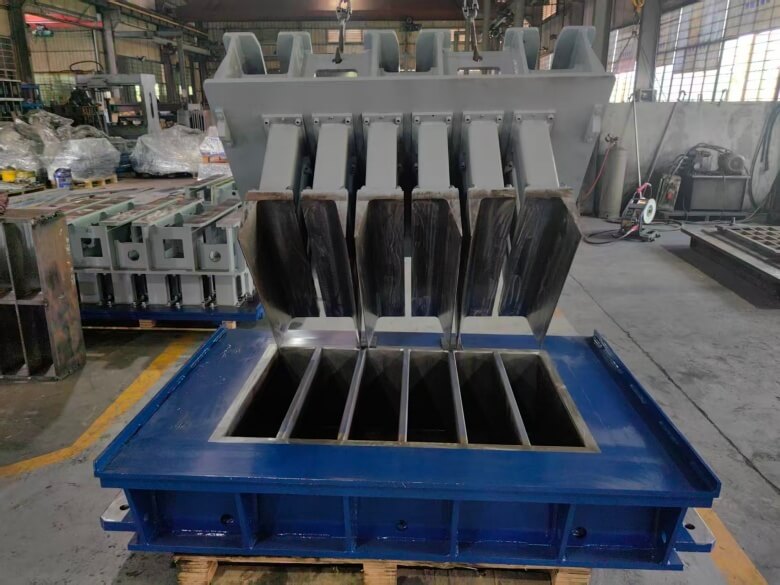
Practical Density Evaluation for Buyers and Factories
The most useful evaluation is a controlled production trial with the intended product. Keep raw materials, moisture, batch size, mold, pallet type, and curing method stable. Record vibration frequency, duration, current, product height, and cycle time. Weigh units according to their cavity positions rather than combining all blocks into one average.
A cavity map can reveal whether the vibration field and feeding are uniform. Compare block mass, dimensions, surface texture, corners, and hollow webs at the center and edges of the pallet. After controlled curing, compare density, water absorption, and compressive strength using the applicable test method. Repeat several cycles because one good pallet does not demonstrate stable production.
When comparing shaft configurations, use the same product geometry and similar material condition. A four-shaft machine producing small pavers cannot be fairly compared with a two-shaft machine producing large hollow blocks by piece count or block mass alone. The meaningful question is whether each machine achieves the required quality consistently at a practical cycle time and acceptable maintenance demand.
Factories should establish baseline records after commissioning. Changes in cavity mass spread, motor current, vibration noise, cycle time, fastener condition, and bearing temperature can provide early warning of deterioration. Preventive inspection preserves the advantage of a correctly designed multi-shaft system and reduces random parameter adjustment.
Frequently Asked Questions
Does a four-shaft vibration box always make denser blocks than a two-shaft box?
No. Four shafts provide more options for force distribution, especially over a larger forming area, but density depends on synchronization, eccentric force, table stiffness, material, filling, mold, pallet, and settings. Both arrangements can perform well when correctly engineered for their application.
Can shaft count compensate for a dry concrete mixture?
No. Additional excitation cannot fully correct insufficient effective moisture or unsuitable aggregate grading. The mixture must first be capable of rearranging and bonding under the available vibration conditions.
Why are blocks at one side of the pallet lighter?
Possible causes include uneven feeding, local vibration response, shaft synchronization, mold seating, table level, pallet stiffness, or tamper alignment. Map mass by cavity before increasing vibration time.
Is stronger vibration always better for block density?
No. Useful vibration must be controlled and matched to the mixture. Excessive energy may increase wear, sticking, segregation, noise, and cycle time without producing a meaningful density gain.
What should a buyer request during a machine trial?
Request the exact product dimensions, pieces per mold, cycle settings, cavity-by-cavity block weights, height measurements, raw-material condition, and cured test results. Also ask how shaft synchronization and maintenance are managed.
Conclusion
Vibration-box shaft count influences the way excitation force can be generated, balanced, and distributed across a block machine forming table. A properly engineered four-shaft system can provide more excitation points and support uniform compaction over a large mold area. A well-designed two-shaft system can also achieve stable density within an appropriate machine and product range.
The decisive issue is not the number of shafts in isolation. Block density depends on synchronized force, frequency, amplitude, structural stiffness, mold and pallet contact, feeding, mixture moisture, aggregate grading, and controlled vibration time. Buyers and factories should evaluate shaft design through measured product consistency and long-term operating stability. This evidence-based approach provides a more reliable equipment decision than assuming that more shafts automatically produce better blocks.






 Tel: +86-13905968794
 Email: export@hwmachines.com
 MP/WhatsApp: +86-13905968794
 Manufacturer Address:Nanan,Quanzhou City,Fujian Province,China