Introduction
Concrete blocks have become one of the most indispensable construction materials in modern infrastructure development. From residential housing and municipal paving to industrial facilities and commercial complexes, concrete masonry products are valued for their structural reliability, cost efficiency, and scalable production capability.
Yet behind every well-formed block lies a highly coordinated manufacturing sequence. Concrete block production is not merely a matter of mixing cement and pressing materials into shape. It is an integrated industrial process involving raw material proportioning, controlled mixing, vibration compaction, hydraulic forming, curing management, and quality control.
For investors entering the construction materials sector, understanding the complete production workflow is essential before selecting a suitable block machine, brick machine, or automated block making machine system.
This article provides a systematic introduction to the concrete block production process, explaining how each stage influences product quality, operational efficiency, and long-term manufacturing stability.
1. Raw Material Preparation: The Foundation of Product Quality
Every concrete block begins with raw materials. The stability of the final product depends heavily on the consistency of these inputs.
Typical raw materials include:
Cement
Sand
Stone aggregates
Fly ash
Industrial solid waste materials
Water
Optional pigments or additives
In many modern factories, industrial by-products such as fly ash, slag, and construction waste are increasingly incorporated into the production process. This not only reduces raw material costs but also improves environmental sustainability.
In contemporary manufacturing, waste utilization is gradually evolving from an economic option into an industrial necessity.
Before entering the production line, aggregates are generally screened to ensure proper particle gradation. Excessively large particles may damage molds or reduce compaction efficiency, while excessive fine powder can negatively affect block strength.
Stable raw materials are the first prerequisite for producing high-quality concrete blocks.
2. Automatic Batching System: Precision Determines Consistency
After raw material preparation, the next stage involves proportioning.
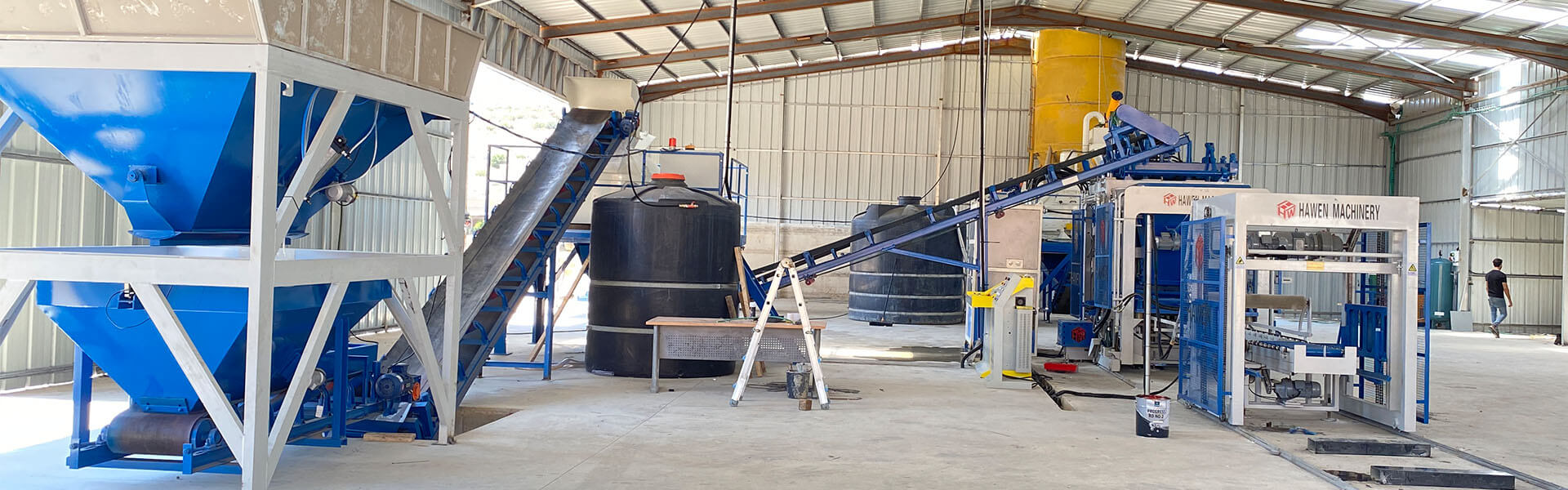
Modern block making machine systems commonly utilize automatic batching equipment to measure aggregates, cement, and additives according to preset formulas.
The batching process directly influences:
Compressive strength
Product density
Color consistency
Cement consumption
Production stability
Even slight deviations in water-cement ratio can substantially alter block performance.
In a professional brick making machine production line, computerized batching minimizes human error while improving repeatability between production cycles.
This stage is particularly critical in large-scale factories where manual measurement becomes increasingly unreliable.
3. Mixing Process: Achieving Material Homogeneity
Once proportioned, materials enter the mixing system.
The objective of mixing is not simply blending materials together. Rather, it is achieving homogeneous distribution of cement paste throughout the aggregate matrix.
Inadequate mixing frequently causes:
Uneven block density
Surface discoloration
Weak compressive strength
Cracking after curing
Planetary mixers and twin-shaft mixers are widely used in modern concrete block factories due to their superior mixing efficiency.
A well-designed mixing system ensures:
Uniform moisture distribution
Stable material consistency
Improved vibration performance during forming
For a block machine to operate efficiently, material consistency must remain stable from batch to batch.
4. Material Conveying and Feeding
After mixing, concrete materials are transported to the storage hopper above the forming machine.
At this stage, conveyor systems and feeding mechanisms play a surprisingly important role. Poor material flow often results in:
Uneven mold filling
Density variation
Edge defects
Reduced production speed
Professional brick machine systems use synchronized feeding devices to distribute materials evenly across the mold cavity.
This ensures balanced compaction during vibration and compression.
Although frequently overlooked, feeding stability significantly affects final block appearance and structural integrity.
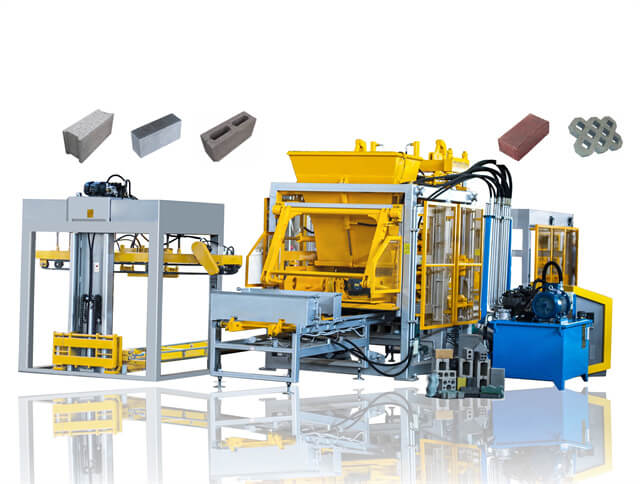
5. Vibration and Hydraulic Forming: The Core of Block Production
The forming stage represents the technological core of the entire concrete block production process.
During operation, materials enter the mold cavity where vibration and hydraulic compression occur simultaneously. This process eliminates internal voids and compacts aggregates into dense structural units.
The efficiency of vibration directly affects:
Block strength
Surface smoothness
Dimensional accuracy
Cement utilization efficiency
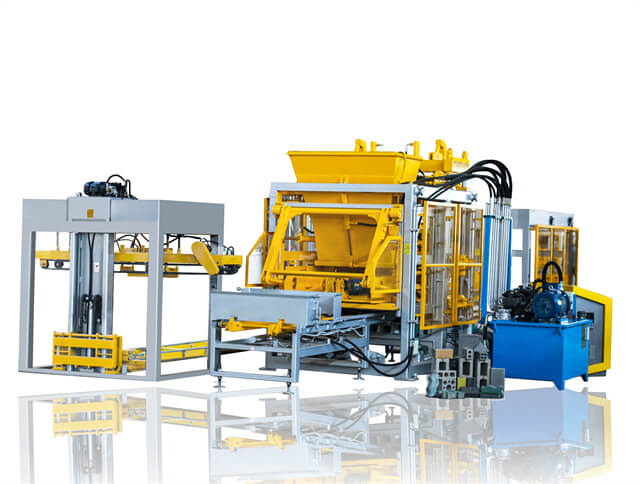
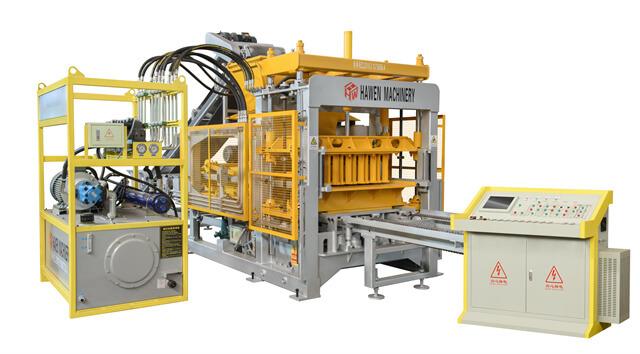
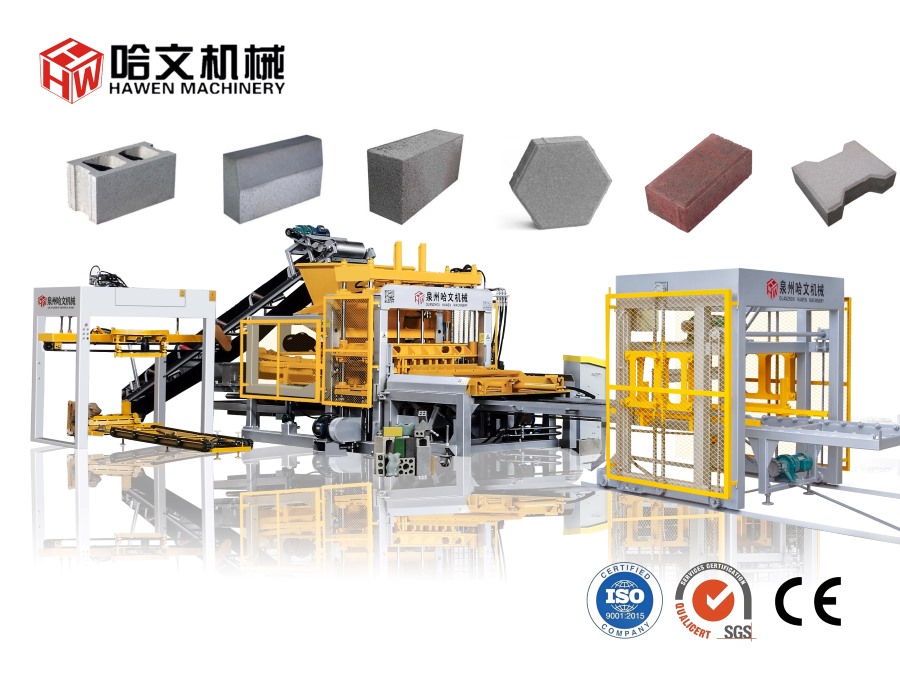
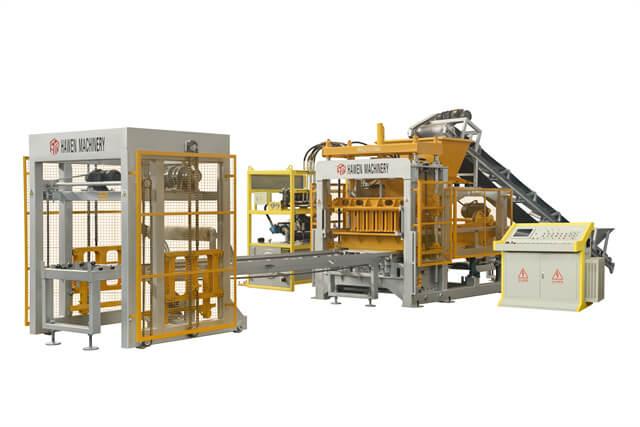
Hawen Machinery adopts a four-shaft vibration box structure with eccentric blocks positioned externally. This design reduces vibration resistance while improving force transmission efficiency. As a result, materials are compacted more uniformly, cement consumption is reduced, and production efficiency is improved.
Compared with conventional vibration systems, optimized vibration technology enables the block machine to achieve higher compaction performance with lower energy loss.
At the same time, the hydraulic system must maintain highly stable pressure output.
Hawen Machinery integrates Japanese YUKEN proportional and directional valve systems together with durable American hydraulic pump components. This hydraulic configuration ensures precise motion control, stable pressure regulation, and reliable long-term operation even under intensive industrial workloads.
In modern block making machine production, vibration and hydraulic synchronization determine whether the final product achieves industrial-grade consistency.
6. Mold System: Precision Engineering Behind Every Block
Molds are often underestimated by inexperienced investors. In reality, mold quality directly determines:
Block dimensions
Surface finish
Edge precision
Product uniformity
Hawen Machinery designs molds compatible with internationally recognized equipment brands including Masa, Hess, Zenith, Poyatos, Besser, Tiger, Columbia, Quadar, Omag, and others.
By following original dimensional specifications, these molds ensure:
Accurate installation
Stable operation
Reduced commissioning time
Cross-platform compatibility
To improve durability, all molds undergo specialized heat treatment processes. Hardness testing is maintained within the HRC60–62 range, enhancing wear resistance while preserving structural toughness.
A high-quality mold does not merely shape concrete. It stabilizes the entire manufacturing process.
7. Pallet Transfer and Curing Process
After forming, freshly produced blocks remain structurally fragile. Proper curing therefore becomes essential.
Green blocks are transferred through:
Elevators
Lowerators
Finger carts
Conveyor systems
They are then transported into curing chambers where controlled temperature and humidity conditions promote cement hydration.
Improper curing may lead to:
Cracking
Surface chalking
Reduced compressive strength
Dimensional instability
Professional curing management allows concrete blocks to gradually achieve their designed structural performance.
In industrial-scale brick machine factories, curing efficiency significantly affects overall production throughput.
8. Automatic Stacking and Packaging
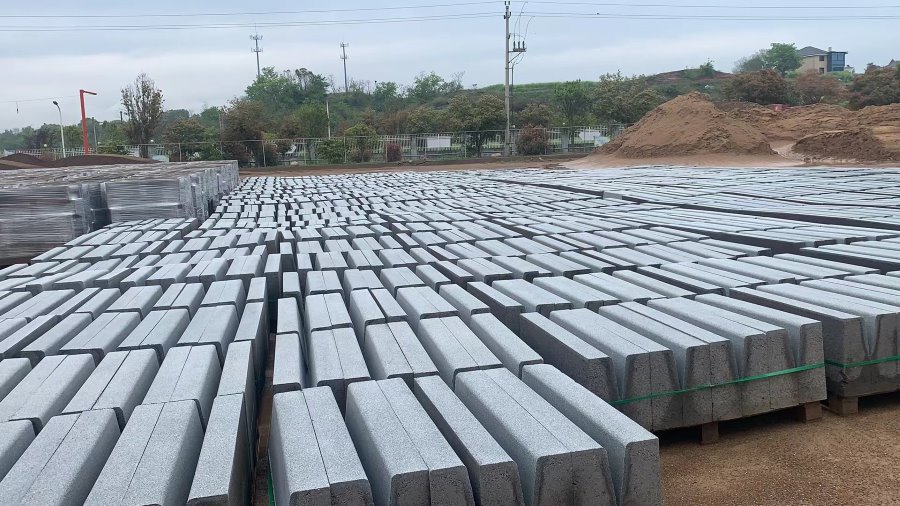
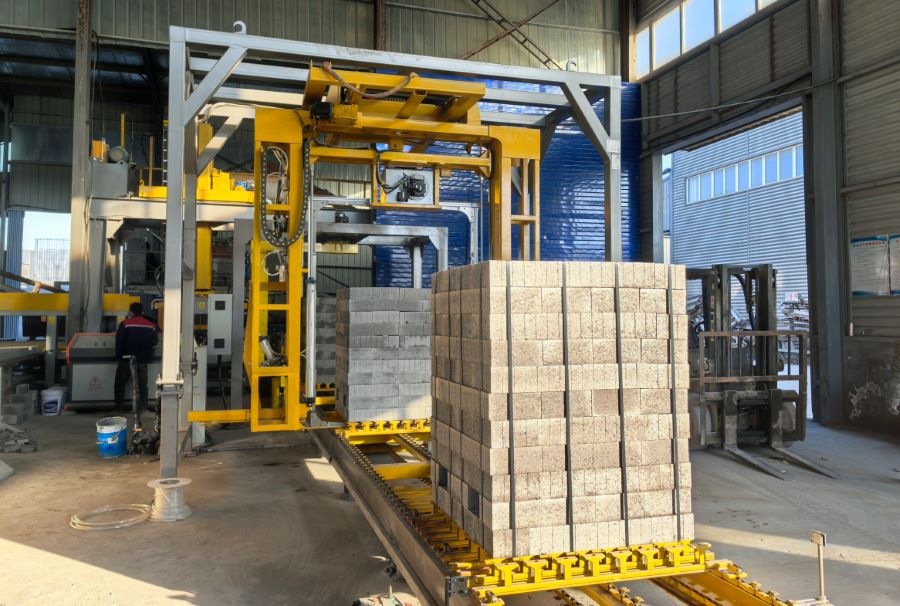
Once curing is completed, finished blocks are automatically stacked, strapped, and prepared for storage or transportation.
Modern block machine production lines commonly integrate:
Automatic cuber systems
Automatic strapping systems
Forklift handling systems
Automation at this stage reduces labor intensity while improving packaging consistency and transportation safety.
Efficient packaging also minimizes product damage during logistics operations.
9. Intelligent Control Systems Improve Production Stability
Today’s advanced concrete block factories increasingly rely on intelligent automation systems to optimize production efficiency.
Hawen Machinery integrates SIEMENS S7-200 PLC systems combined with touchscreen interfaces and remote monitoring functionality. Through this intelligent control architecture, operators can monitor real-time machine status, remotely optimize operational parameters, and maintain stable product consistency across different production shifts.
For large-scale block making machine operations, intelligent control reduces:
Human error
Downtime risk
Parameter fluctuation
Maintenance inefficiency
Digitalized production management is gradually becoming the standard rather than the exception.
Conclusion
The concrete block production process is far more sophisticated than many newcomers initially assume. Behind each finished concrete block lies a carefully coordinated sequence of engineering decisions, mechanical systems, and material science principles.
From raw material proportioning and precision mixing to vibration compaction, hydraulic forming, curing, and intelligent automation, every stage contributes to the final product’s structural reliability and commercial value.
A modern brick machine is not simply manufacturing equipment. It is a synthesis of mechanical engineering, industrial automation, and production economics.
As urbanization accelerates across emerging and developed markets alike, demand for reliable infrastructure materials will continue to expand. In this context, efficient block production is no longer merely an industrial activity. It is part of a broader process of building roads, housing communities, industrial zones, and future cities.
Concrete blocks may appear ordinary.
Yet in countless developing regions around the world, they quietly form the physical framework upon which economic growth, social mobility, and urban transformation are constructed — one precisely manufactured block at a time.
FAQ
1. What raw materials are commonly used in concrete block production?
Typical materials include cement, sand, stone aggregates, fly ash, water, and industrial waste materials such as slag or recycled concrete.
2. Why is vibration important in a block machine?
Vibration improves material compaction, increases block density, enhances compressive strength, and reduces internal voids within concrete products.
3. What is the purpose of the curing process?
Curing allows cement hydration to develop properly, ensuring the concrete blocks achieve sufficient strength and dimensional stability.
4. How does automation improve block production efficiency?
Automation improves:
Production consistency
Labor efficiency
Parameter accuracy
Operational stability
Packaging efficiency
It also reduces human error during manufacturing.
5. Why is mold quality important in a brick making machine?
High-quality molds improve:
Dimensional precision
Surface finish
Production stability
Mold lifespan
Compatibility with different block machine platforms
Heat-treated molds with HRC60–62 hardness offer significantly better wear resistance in long-term industrial production.





 Tel: +86-13905968794
 Email: export@hwmachines.com
 MP/WhatsApp: +86-13905968794
 Manufacturer Address:Nanan,Quanzhou City,Fujian Province,China