What Leads to Weak Concrete Blocks and How to Improve Them
Author:HAWEN Block MachineFROM:Brick Production Machine Manufacturer
TIME:2026-05-14
In the concrete products industry, strength is not merely a technical specification. It is the foundation of structural reliability, customer trust, and long-term commercial credibility.
When concrete blocks begin to crack easily, absorb excessive water, or fail compression tests, the consequences extend far beyond material loss. Weak blocks can damage a manufacturer’s reputation, increase project risks, and gradually erode market competitiveness.
For factories operating a block machine or brick making machine, understanding the causes of weak concrete blocks is therefore not optional. It is essential for sustainable production.
The encouraging reality, however, is that most block quality problems are preventable. Weak concrete blocks rarely result from a single catastrophic mistake. More often, they emerge from multiple small inefficiencies accumulating throughout the production process.
This article explores the major causes of low-strength concrete blocks and explains how manufacturers can systematically improve product quality and production stability.
1. Poor Raw Material Quality
No block making machine, regardless of sophistication, can compensate for fundamentally poor raw materials.
Inferior aggregates often contain excessive clay, organic contaminants, or inconsistent particle grading. These impurities weaken internal bonding within the concrete matrix and reduce compressive strength.
Similarly, low-grade cement or improperly stored cement may lose hydration activity before production even begins.
High-quality concrete blocks require:
Properly graded aggregates
Stable cement quality
Controlled moisture content
Clean water supply
In many factories, raw material inconsistency remains one of the most underestimated causes of weak blocks.
Note: Even slight fluctuations in aggregate moisture can significantly affect compaction density and curing performance.
2. Incorrect Water-to-Cement Ratio
Water management is one of the most critical variables in concrete block production.
Excessive water creates higher porosity inside the block after curing, leading to lower density and reduced structural integrity. Conversely, insufficient water prevents complete cement hydration and weakens bonding strength.
Many inexperienced operators attempt to improve workability by adding extra water during mixing. While this may temporarily improve material flow, it frequently damages final block strength.
A properly calibrated brick machine should maintain a balanced mix design that ensures both compaction efficiency and adequate hydration.
Modern batching and mixing systems help maintain this consistency far more effectively than manual judgment alone.
3. Insufficient Vibration and Compaction
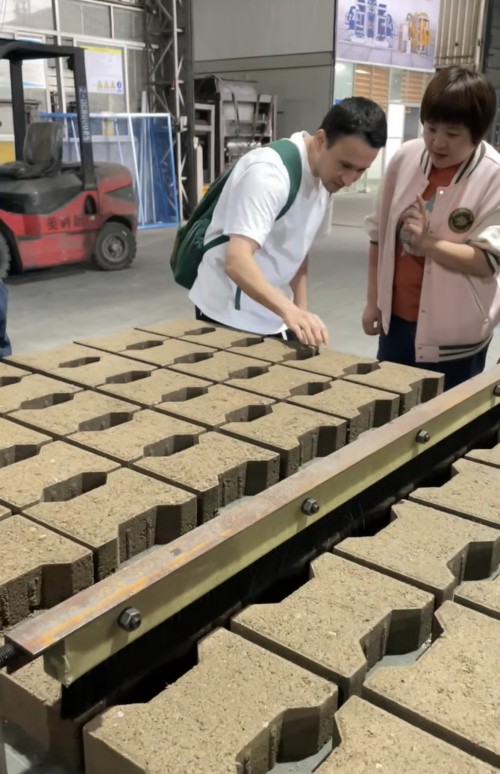
Compaction quality directly determines internal density.
If vibration force is unstable or unevenly distributed, air voids remain trapped inside the block structure. These voids weaken compressive performance and increase the risk of cracking during transportation or construction.
This is why vibration technology is central to every high-performance block machine.
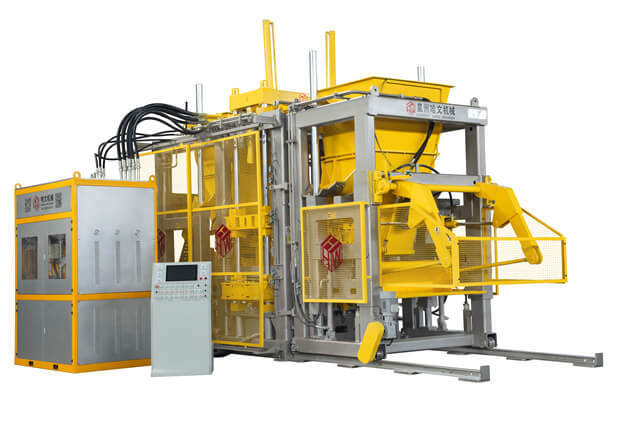
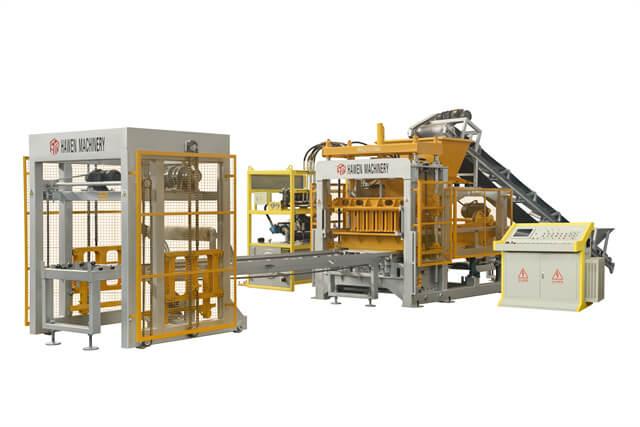
Hawen Machinery adopts a four-shaft vibration box configuration with eccentric blocks positioned outside the housing structure. This design reduces operational resistance during vibration, improves force transmission efficiency, and ensures more uniform material compaction throughout the mould cavity.
As a result, concrete density becomes more stable while cement consumption can be reduced without compromising strength.
In practical production environments, uniform vibration often matters more than simply increasing vibration intensity.
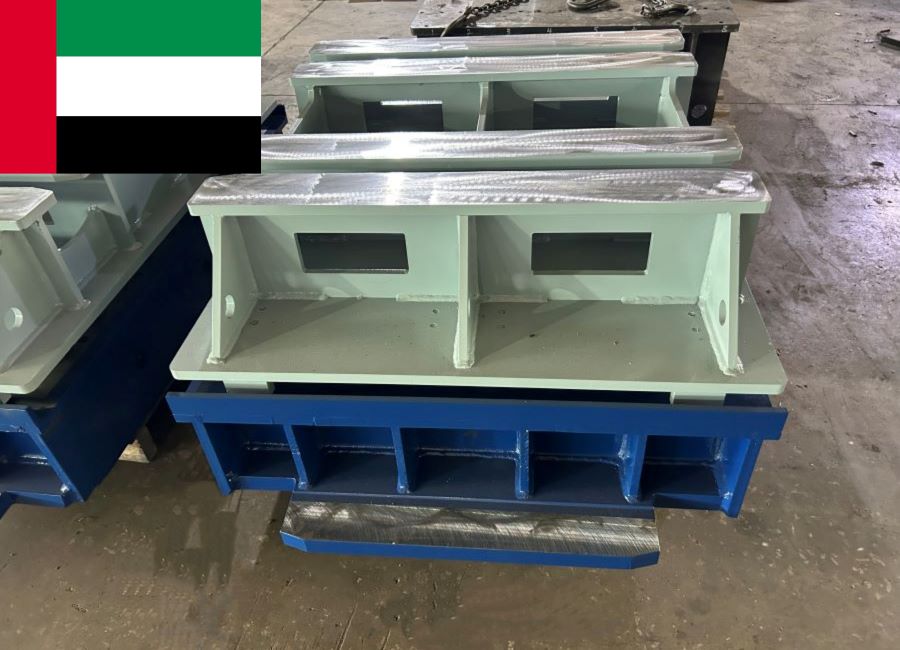
4. Worn or Low-Precision Moulds
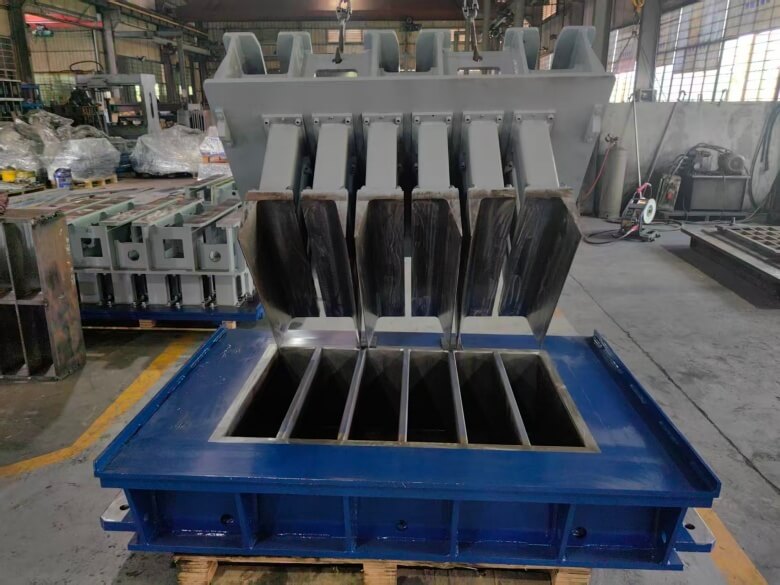
Mould condition has a direct influence on block density, dimensional accuracy, and surface integrity.
When mould components become worn, several issues may occur simultaneously:
Uneven material distribution
Inconsistent block dimensions
Poor edge formation
Reduced compaction efficiency
Surface cracking during demoulding
At Hawen Machinery, moulds are manufactured according to the original specifications of globally recognized block machine brands, including Masa, Hess, Zenith, Poyatos, Besser, Tiger, Columbia, Quadar, Omag, and others.
This ensures:
Accurate installation compatibility
Stable operational alignment
Smooth demoulding performance
Consistent block geometry across platforms
To improve wear resistance, all moulds undergo professional heat treatment processes. Hardness testing reaches approximately HRC 60–62, balancing abrasion resistance with structural toughness.
In industrial block production, mould precision is not simply a mechanical detail. It is a decisive factor in product consistency.
5. Inadequate Curing Conditions
Even perfectly compacted blocks can become weak if curing conditions are poorly managed.
Concrete strength develops through hydration, not merely through drying. When blocks lose moisture too quickly, cement hydration becomes incomplete, resulting in brittle internal structure.
Common curing mistakes include:
Exposure to direct sunlight immediately after production
Insufficient curing time
Poor humidity control
Irregular water spraying
For this reason, curing management should be considered an extension of the production process itself rather than a separate stage.
Factories that prioritize curing discipline typically achieve more stable compressive strength and lower rejection rates.
6. Unstable Hydraulic Performance
Hydraulic instability can indirectly weaken concrete blocks by affecting pressing pressure, mould synchronization, and vibration coordination.
Inconsistent pressure output often produces uneven density distribution inside the block.
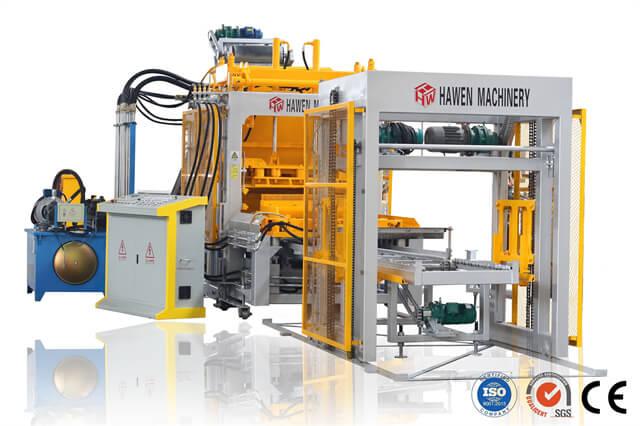
At Hawen Machinery, the hydraulic station combines Japanese YUKEN proportional control valves with durable ALBERT hydraulic pumps from the United States. This integrated system allows more accurate pressure regulation, smoother cycle transitions, and stronger operational stability during continuous production.
For factories operating in high-temperature climates, optional oil cooling systems help maintain hydraulic oil stability and prevent overheating-related pressure fluctuation.
Reliable hydraulic control is particularly important for fully automatic brick making machine systems running under heavy daily workloads.
7. Lack of Process Monitoring and Operator Training
Many production problems originate not from equipment failure, but from inconsistent operational management.
Operators may unintentionally modify vibration duration, feeding volume, or water ratio without fully understanding the long-term consequences.
This is where intelligent automation becomes increasingly valuable.
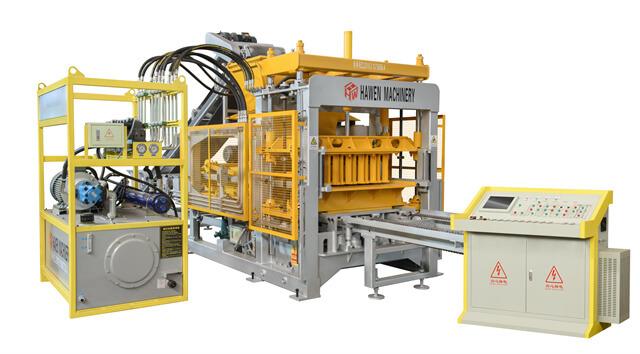
Hawen Machinery integrates a SIEMENS S7-200 PLC control system together with a user-friendly touch panel and remote monitoring functionality. Through this intelligent platform, machine operating conditions can be monitored in real time, while production parameters can be optimized remotely to maintain stable block quality.
Data-driven production management significantly reduces human error and improves operational consistency.
In modern block manufacturing, experience alone is no longer sufficient. Precision increasingly depends on measurable process control.
How to Improve Concrete Block Strength Effectively
Manufacturers seeking stronger concrete blocks should focus on systematic optimization rather than isolated adjustments.
Practical improvement strategies include:
Using stable, high-quality aggregates
Maintaining accurate water-cement ratios
Improving vibration consistency
Regularly inspecting mould wear
Strengthening curing management
Monitoring hydraulic stability
Standardizing operator procedures
Long-term product quality is usually the result of disciplined process control rather than short-term correction measures.
Conclusion
Weak concrete blocks are rarely caused by bad luck. In most cases, they are the visible outcome of hidden inconsistencies within the production system.
Every stage of manufacturing matters: raw material selection, vibration efficiency, mould precision, hydraulic coordination, curing discipline, and operational control. When even one link becomes unstable, block quality inevitably suffers.
For manufacturers operating a block making machine in increasingly competitive markets, quality is no longer a secondary advantage. It is the core of commercial survival.
The factories that thrive over time are not necessarily those producing the fastest or the cheapest blocks. They are the ones capable of delivering consistent strength, reliable dimensions, and dependable performance day after day.
Because in the construction industry, concrete blocks are more than building materials. They are silent carriers of structural responsibility.
And behind every strong block stands an equally strong production philosophy.
FAQ
1. What is the most common cause of weak concrete blocks?
Incorrect water-to-cement ratio and insufficient compaction are among the most common causes. Poor raw materials and inadequate curing also significantly reduce block strength.
2. Can mould wear affect concrete block strength?
Yes. Worn moulds reduce compaction consistency and dimensional accuracy, which can create internal weakness and surface defects in the finished blocks.
3. Why is vibration important in a block machine?
Proper vibration removes trapped air and increases concrete density. Uniform compaction improves compressive strength and reduces cracking risk.
4. How long should concrete blocks be cured?
Curing duration depends on material composition and environmental conditions, but proper moisture retention during the early curing stage is critical for strength development.
5. Does automation improve block quality?
Yes. Intelligent PLC systems and real-time monitoring help maintain stable production parameters, reduce human error, and improve consistency in block manufacturing.





 Tel: +86-13905968794
 Email: export@hwmachines.com
 MP/WhatsApp: +86-13905968794
 Manufacturer Address:Nanan,Quanzhou City,Fujian Province,China