How PLC Systems Control Modern Block Machines
Author:HAWEN Block MachineFROM:Brick Production Machine Manufacturer
TIME:2026-04-21
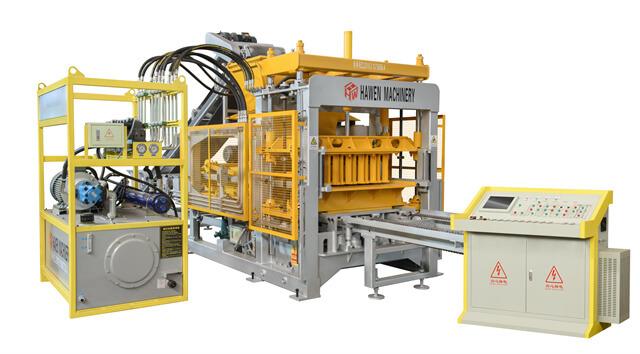
In contemporary concrete block manufacturing, mechanical robustness alone is no longer sufficient to guarantee stable production. What differentiates a modern block machine from a conventional one is its control intelligence—and at the core of this intelligence lies the PLC (Programmable Logic Controller).
A PLC system does not merely execute commands; it orchestrates the entire production cycle, ensuring that each operation—feeding, vibration, pressing, and pallet transfer—occurs with calibrated precision. Without such coordination, even the most advanced mechanical structure would struggle to deliver consistent results.
1. The Role of PLC in Block Machine Automation
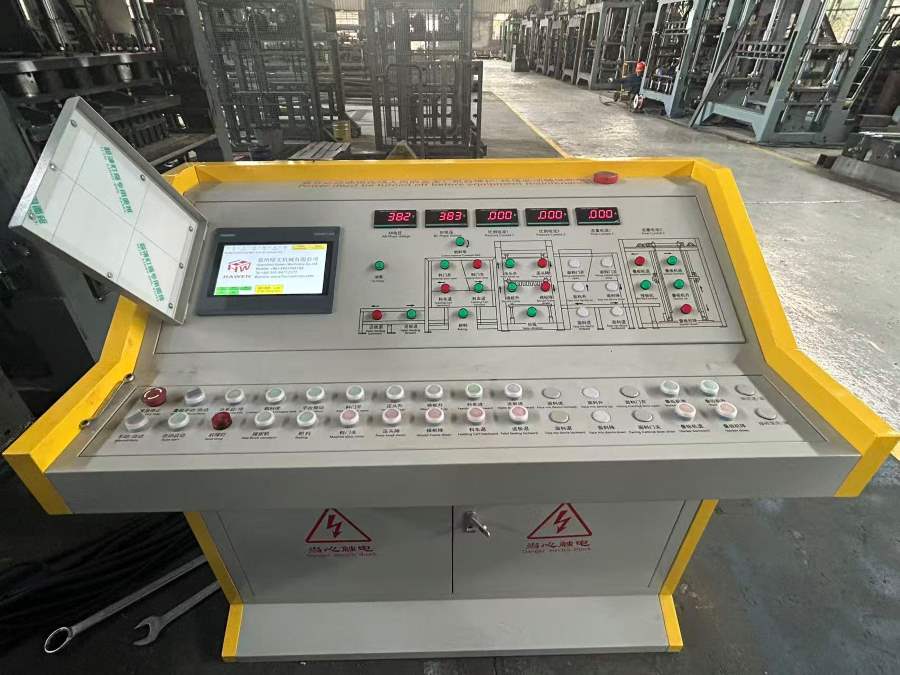
At its essence, a PLC functions as the central processing unit of the production line, translating programmed logic into real-time mechanical actions. It continuously receives input signals from sensors and converts them into output commands that regulate motors, valves, and actuators.
In a block machine, this translates into:
Synchronizing feeding, vibration, and pressing cycles
Regulating hydraulic pressure timing
Controlling pallet movement and positioning
The result is a production process that is not only automated, but also predictable and repeatable—two attributes that are indispensable for industrial-scale manufacturing.
2. Real-Time Monitoring and Adaptive Control
One of the defining advantages of PLC systems is their ability to process data instantaneously. Unlike manual or semi-automatic systems, a PLC-driven machine can detect deviations and adjust parameters in real time.
For instance:
If material feeding is slightly uneven, the system can recalibrate timing
If vibration intensity fluctuates, corrective signals are issued immediately
If hydraulic pressure deviates, the system stabilizes output before defects occur
Note: This feedback loop is crucial for maintaining uniform block density, especially in high-speed production environments.
3. Integration with Hydraulic Systems: Precision Under Pressure
The hydraulic system provides القوة, but the PLC determines how and when that force is applied.
In advanced configurations, the hydraulic station incorporates high-precision proportional and directional valves from Japan, paired with a durable pump manufactured in the United States. Under PLC control, these components enable:
Fine-tuned pressure modulation
Stable force application during mold pressing
Smooth operation of feeding carts and lifting mechanisms
This integration ensures that hydraulic performance is not static, but dynamically optimized according to production conditions.
4. Coordinating Vibration for Optimal Compaction
Compaction quality depends heavily on vibration, yet vibration must be precisely timed and controlled to be effective.
Hawen Machinery adopts a four-shaft vibration box structure with eccentric blocks positioned externally, reducing internal resistance during operation. When governed by the PLC system, vibration parameters—such as frequency and duration—are synchronized with material feeding and pressing cycles.
This coordination leads to:
Uniform compaction across all blocks
Reduced internal voids
Lower cement consumption without compromising strength
5. Human-Machine Interface: Simplifying Complex Operations
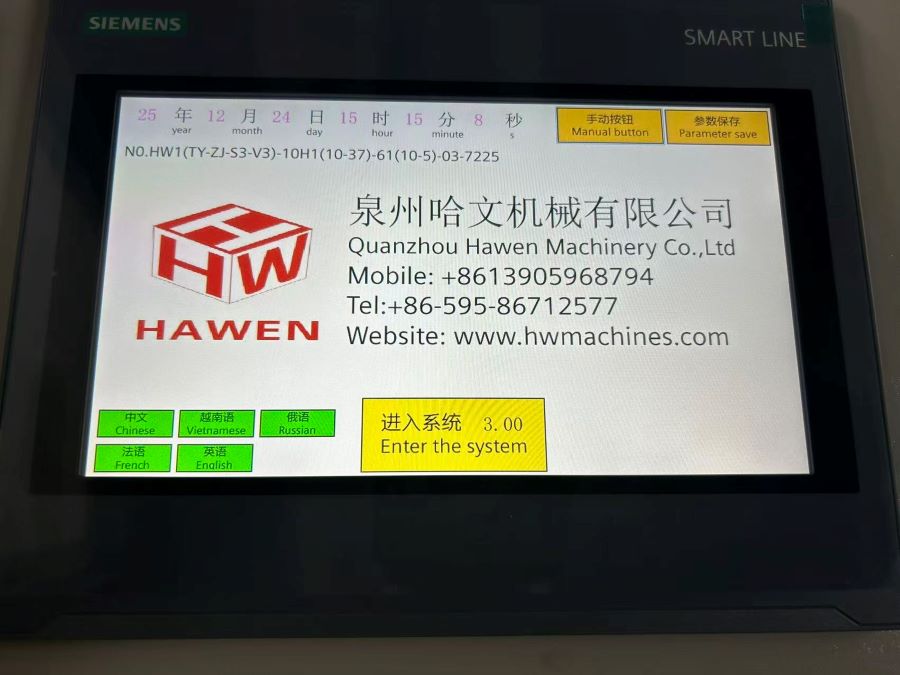
While the PLC handles complex logic, operators interact with the system through a touch-based human-machine interface (HMI). This interface translates technical parameters into accessible controls, allowing operators to:
Adjust production settings with minimal training
Monitor machine status in real time
Identify and respond to system alerts efficiently
At Hawen Machinery, the control architecture integrates a SIEMENS S7-200 PLC combined with an intuitive touch panel and remote monitoring functionality. This enables not only on-site control but also remote diagnostics and parameter optimization, enhancing operational flexibility.
6. Ensuring Mold Compatibility and Process Stability
Even the most sophisticated control system must operate in harmony with the physical tooling.
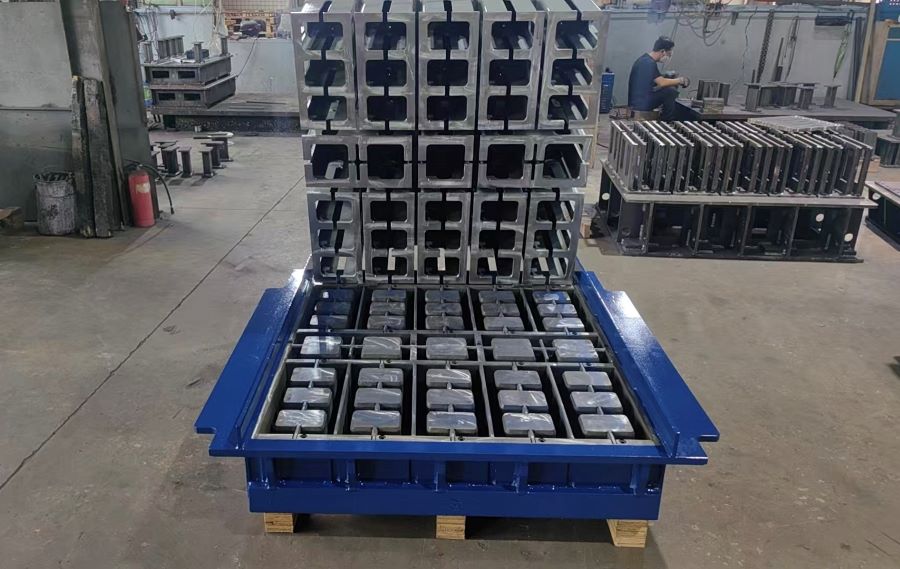
Hawen Machinery designs molds compatible with leading brands such as MASA, HESS, ZENITH, POYATOS, BESSER, and TIGER. Manufactured according to original specifications and subjected to heat treatment processes to enhance wear resistance, these molds ensure:
Accurate dimensional consistency
Smooth demolding
Reduced mechanical stress during operation
When integrated with PLC-controlled cycles, the result is a highly stable and repeatable forming process.
7. From Automation to Intelligence: The Evolution of PLC Systems
Modern PLC systems are no longer confined to basic automation. They are evolving toward data-driven intelligence, incorporating features such as:
Remote monitoring and cloud-based diagnostics
Historical data analysis for performance optimization
Predictive maintenance alerts
Annotation: This transition reflects a broader industrial trend toward smart manufacturing, where machines not only execute tasks but also generate actionable insights.
Conclusion: Control as the Foundation of Consistency
In block manufacturing, consistency is the ultimate benchmark of quality. Yet consistency cannot be achieved through mechanical strength alone; it requires precise, coordinated, and intelligent control.
PLC systems provide this control by aligning every component—hydraulics, vibration, feeding, and molding—into a unified operational framework. They transform complex processes into structured, repeatable sequences, thereby minimizing variability and maximizing efficiency.
In this sense, a modern block machine is not merely a piece of equipment. It is a cyber-physical system, where software logic and mechanical execution converge. And it is precisely this convergence that defines the future of industrial manufacturing—
a future where reliability is engineered, efficiency is optimized, and quality is no longer incidental, but inevitable.
FAQ
1. What does a PLC do in a block machine?
A PLC controls and coordinates all machine operations, including feeding, vibration, hydraulic pressure, and pallet movement, ensuring synchronized and stable production.
2. How does a PLC improve block quality?
By enabling real-time monitoring and precise parameter adjustment, a PLC reduces variability and ensures consistent compaction and strength.
3. Can PLC systems reduce machine downtime?
Yes. Through diagnostic functions and remote monitoring, PLC systems help identify issues early, allowing preventive maintenance and minimizing unexpected downtime.
4. Is PLC control difficult to operate?
No. Modern systems use user-friendly touch interfaces, making operation intuitive even for operators with limited technical experience.





 Tel: +86-13905968794
 Email: export@hwmachines.com
 MP/WhatsApp: +86-13905968794
 Manufacturer Address:Nanan,Quanzhou City,Fujian Province,China