How HAWEN Block Machines Achieve Stable Long-Term Operation
Author:HAWEN Block MachineFROM:Brick Production Machine Manufacturer
TIME:2026-03-10
How HAWEN Block Machines Achieve Stable Long-Term Operation
In the block manufacturing industry, stability is not merely a technical preference; it is an operational necessity. A block machine that runs smoothly for years without significant downtime directly influences production efficiency, cost control, and product consistency. For manufacturers operating in demanding environments—where machines often run for extended shifts and process abrasive aggregates—long-term operational stability becomes the decisive benchmark of engineering quality.
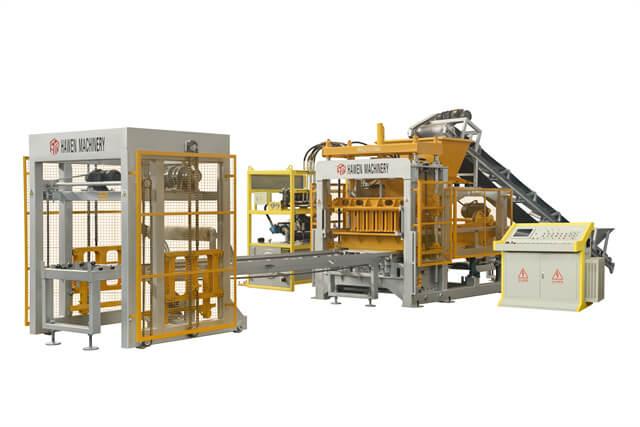
Against this backdrop, the design philosophy behind HAWEN block machines focuses on durability, structural integrity, and intelligent control. Rather than pursuing short-term output gains, the engineering approach prioritizes balanced mechanical performance and system reliability. Through meticulous component selection, optimized vibration structures, advanced hydraulic systems, and intelligent automation, HAWEN machines are engineered to maintain stable performance over extended operational cycles.
1. Structural Integrity as the Foundation of Stability
Stable long-term operation begins with the structural framework of the machine. In heavy industrial equipment such as concrete block machines, the frame must withstand continuous vibration, dynamic loads, and repetitive mechanical stress.
HAWEN machines employ reinforced steel structures manufactured through precision welding and stress-relief processes. This design minimizes deformation during prolonged operation. The rigid frame provides a stable mechanical platform for all subsequent processes, including vibration compaction, mold movement, and pallet handling.
Moreover, critical load-bearing components undergo careful machining to maintain dimensional accuracy. Such precision ensures that moving assemblies operate with minimal friction and misalignment, which significantly reduces mechanical wear over time.
From an engineering perspective, this approach reflects a fundamental principle: long-term reliability is largely determined by structural stability at the earliest stage of design.
2. Optimized Vibration Technology for Consistent Compaction
Vibration is the core process in block production. The uniformity of vibration directly affects block density, strength, and appearance. However, poorly designed vibration systems can cause uneven compaction, excessive energy consumption, and accelerated machine fatigue.
Hawen Machinery adopts a four-shaft vibration box configuration, with eccentric blocks positioned outside the housing. This arrangement reduces internal resistance during vibration and allows the energy generated by the vibration motors to be transmitted more efficiently to the mold.
As a result, the system achieves several operational advantages:
Uniform material compaction, improving block density
Lower cement consumption, due to more efficient vibration energy distribution
Reduced mechanical stress, extending the lifespan of the vibration components
The external eccentric configuration also simplifies maintenance access and improves heat dissipation, both of which contribute to the machine’s ability to operate relia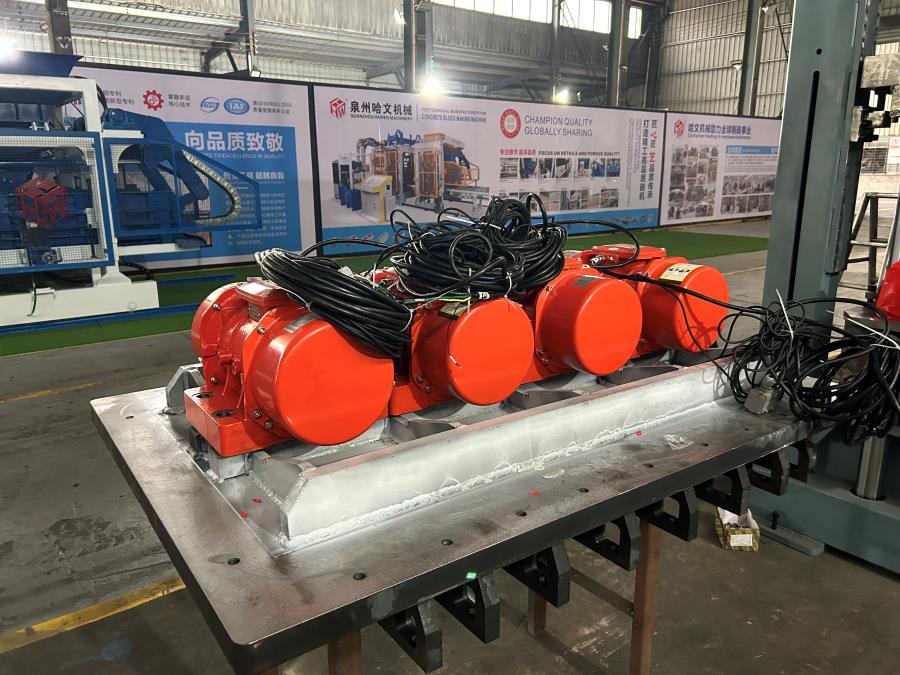 bly over long production cycles.
3. High-Performance Hydraulic System for Reliable Motion Control
The hydraulic system functions as the dynamic power source of the block machine. It drives critical movements such as mold lifting, feeder operation, and pallet positioning. Inconsistent hydraulic performance can lead to unstable production rhythms or increased machine downtime.
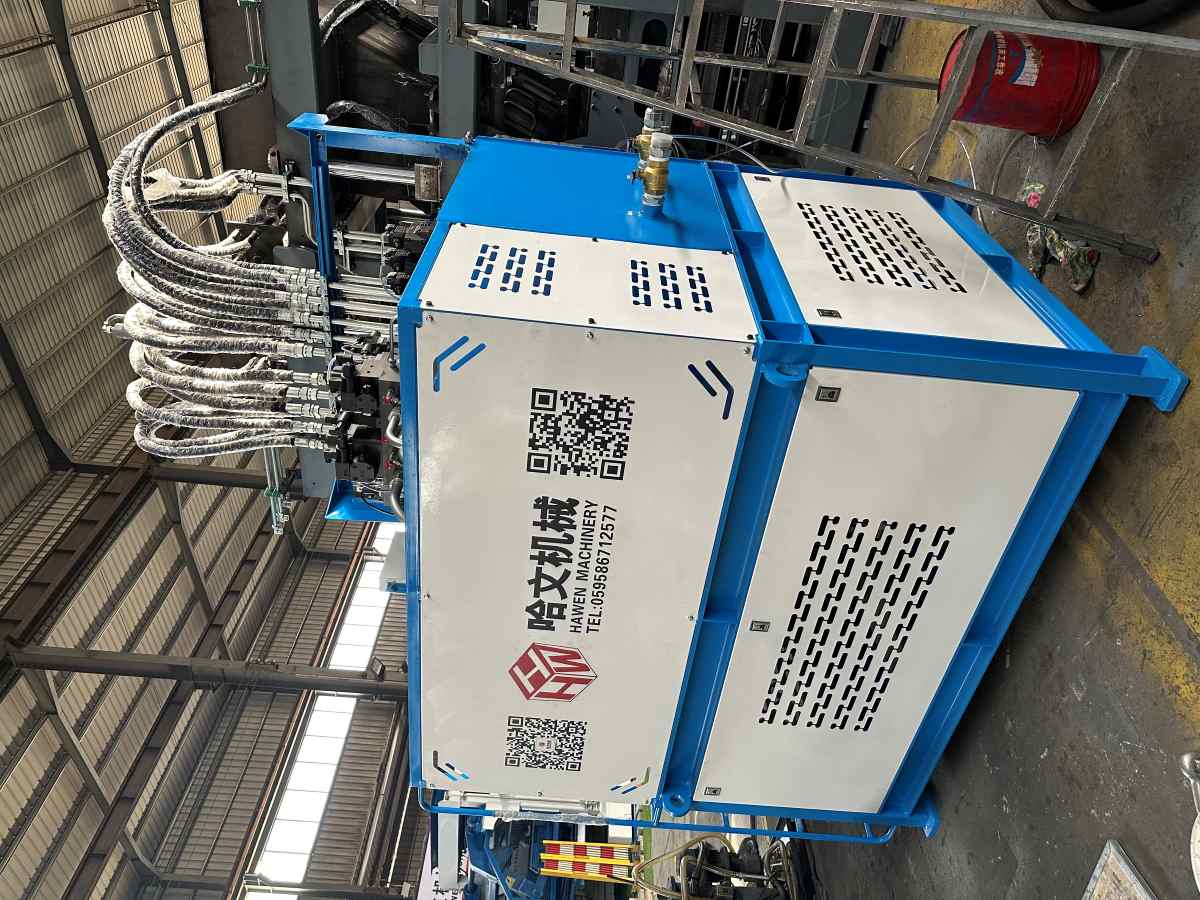
To ensure reliability, Hawen Machinery integrates a hydraulic station equipped with Japanese YUKEN proportional and directional valves together with an ALBERT hydraulic pump from the United States. This configuration provides both precise flow regulation and robust load capacity.
The benefits of this hydraulic architecture include:
Smooth and controlled movement of machine components
Reduced pressure fluctuations during operation
Improved durability under continuous industrial workloads
By maintaining stable oil pressure and responsive control, the hydraulic system enables the machine to operate consistently even under demanding production schedules.
bly over long production cycles.
3. High-Performance Hydraulic System for Reliable Motion Control
The hydraulic system functions as the dynamic power source of the block machine. It drives critical movements such as mold lifting, feeder operation, and pallet positioning. Inconsistent hydraulic performance can lead to unstable production rhythms or increased machine downtime.
To ensure reliability, Hawen Machinery integrates a hydraulic station equipped with Japanese YUKEN proportional and directional valves together with an ALBERT hydraulic pump from the United States. This configuration provides both precise flow regulation and robust load capacity.
The benefits of this hydraulic architecture include:
Smooth and controlled movement of machine components
Reduced pressure fluctuations during operation
Improved durability under continuous industrial workloads
By maintaining stable oil pressure and responsive control, the hydraulic system enables the machine to operate consistently even under demanding production schedules.
 4. Intelligent Control System for Operational Consistency
Mechanical reliability alone is insufficient for long-term stability. Modern block production also depends heavily on intelligent automation and accurate process control.
Hawen Machinery integrates a SIEMENS S7-200 PLC combined with an intuitive touch interface and remote monitoring functionality. Through this digital control architecture, operators can easily manage production parameters while engineers can monitor machine performance in real time.
This system enables several key capabilities:
Real-time monitoring of machine operating status
Remote adjustment of operational parameters
Early detection of abnormal conditions
Remote diagnostics allow technical teams to optimize machine settings without requiring on-site intervention, significantly reducing downtime and ensuring consistent block quality.
In practical terms, the control system transforms the block machine from a purely mechanical device into an intelligent production unit capable of adaptive optimization.
5. Precision Molds as a Guarantee of Product Consistency
Even the most advanced machine cannot produce consistent blocks without high-quality molds. Mold precision directly determines block dimensions, surface finish, and structural integrity.
Hawen Machinery manufactures molds that are compatible with major international block machine brands such as MASA, HESS, ZENITH, POYATOS, BESSER, and TIGER. By adhering closely to original technical specifications, these molds achieve precise alignment and smooth operation across multiple platforms.
Each mold undergoes heat treatment to enhance hardness and wear resistance. This process improves durability when handling abrasive aggregates and frequent vibration cycles.
Furthermore, careful mold design ensures:
Stable demolding performance
Reduced friction during production
Consistent block dimensions over long production runs
In essence, high-precision molds transform the mechanical energy of the machine into reliable product quality.
6. System Integration: The Key to Long-Term Stability
While each component contributes to operational reliability, the true strength of a block machine lies in the integration of all systems. Structural rigidity, vibration efficiency, hydraulic responsiveness, and intelligent control must work together in harmony.
HAWEN’s engineering approach focuses on balancing these elements. Instead of optimizing individual parts in isolation, the design philosophy emphasizes system coordination—ensuring that every component supports the overall stability of the machine.
This integrated strategy explains why machines operating under the HAWEN design framework can maintain consistent production performance across years of continuous operation.
4. Intelligent Control System for Operational Consistency
Mechanical reliability alone is insufficient for long-term stability. Modern block production also depends heavily on intelligent automation and accurate process control.
Hawen Machinery integrates a SIEMENS S7-200 PLC combined with an intuitive touch interface and remote monitoring functionality. Through this digital control architecture, operators can easily manage production parameters while engineers can monitor machine performance in real time.
This system enables several key capabilities:
Real-time monitoring of machine operating status
Remote adjustment of operational parameters
Early detection of abnormal conditions
Remote diagnostics allow technical teams to optimize machine settings without requiring on-site intervention, significantly reducing downtime and ensuring consistent block quality.
In practical terms, the control system transforms the block machine from a purely mechanical device into an intelligent production unit capable of adaptive optimization.
5. Precision Molds as a Guarantee of Product Consistency
Even the most advanced machine cannot produce consistent blocks without high-quality molds. Mold precision directly determines block dimensions, surface finish, and structural integrity.
Hawen Machinery manufactures molds that are compatible with major international block machine brands such as MASA, HESS, ZENITH, POYATOS, BESSER, and TIGER. By adhering closely to original technical specifications, these molds achieve precise alignment and smooth operation across multiple platforms.
Each mold undergoes heat treatment to enhance hardness and wear resistance. This process improves durability when handling abrasive aggregates and frequent vibration cycles.
Furthermore, careful mold design ensures:
Stable demolding performance
Reduced friction during production
Consistent block dimensions over long production runs
In essence, high-precision molds transform the mechanical energy of the machine into reliable product quality.
6. System Integration: The Key to Long-Term Stability
While each component contributes to operational reliability, the true strength of a block machine lies in the integration of all systems. Structural rigidity, vibration efficiency, hydraulic responsiveness, and intelligent control must work together in harmony.
HAWEN’s engineering approach focuses on balancing these elements. Instead of optimizing individual parts in isolation, the design philosophy emphasizes system coordination—ensuring that every component supports the overall stability of the machine.
This integrated strategy explains why machines operating under the HAWEN design framework can maintain consistent production performance across years of continuous operation.
 Conclusion
In industrial manufacturing, longevity is rarely accidental. It is the result of deliberate engineering decisions, disciplined material selection, and careful system integration.
HAWEN block machines embody this philosophy. From robust structural frameworks and efficient vibration systems to advanced hydraulic components and intelligent automation, every element is designed to support stable long-term operation.
Ultimately, the objective is not merely to build machines that work today, but to create equipment that continues to perform reliably year after year. In an industry where production continuity determines competitiveness, such stability is more than a technical advantage—it is the foundation of sustainable manufacturing success.
FAQ
1. Why is vibration system design critical for block machine stability?
The vibration system determines how effectively concrete materials are compacted. An optimized vibration structure ensures uniform density while reducing mechanical stress on the machine, which helps extend equipment lifespan.
2. How does the hydraulic system affect long-term operation?
Hydraulic components control key mechanical movements. High-quality valves and pumps ensure stable pressure, smooth motion, and reduced wear during continuous production.
3. Can intelligent control systems improve machine durability?
Yes. Modern PLC systems allow real-time monitoring and parameter optimization. Early detection of abnormal conditions helps prevent mechanical damage and reduce unexpected downtime.
4. Why is mold heat treatment important?
Heat treatment increases hardness and wear resistance. This allows molds to withstand repeated vibration and abrasive aggregates, ensuring consistent block dimensions over long production cycles.
5. What factors determine the overall lifespan of a block machine?
Machine lifespan depends on structural design, component quality, system integration, maintenance practices, and the stability of operational parameters.
Conclusion
In industrial manufacturing, longevity is rarely accidental. It is the result of deliberate engineering decisions, disciplined material selection, and careful system integration.
HAWEN block machines embody this philosophy. From robust structural frameworks and efficient vibration systems to advanced hydraulic components and intelligent automation, every element is designed to support stable long-term operation.
Ultimately, the objective is not merely to build machines that work today, but to create equipment that continues to perform reliably year after year. In an industry where production continuity determines competitiveness, such stability is more than a technical advantage—it is the foundation of sustainable manufacturing success.
FAQ
1. Why is vibration system design critical for block machine stability?
The vibration system determines how effectively concrete materials are compacted. An optimized vibration structure ensures uniform density while reducing mechanical stress on the machine, which helps extend equipment lifespan.
2. How does the hydraulic system affect long-term operation?
Hydraulic components control key mechanical movements. High-quality valves and pumps ensure stable pressure, smooth motion, and reduced wear during continuous production.
3. Can intelligent control systems improve machine durability?
Yes. Modern PLC systems allow real-time monitoring and parameter optimization. Early detection of abnormal conditions helps prevent mechanical damage and reduce unexpected downtime.
4. Why is mold heat treatment important?
Heat treatment increases hardness and wear resistance. This allows molds to withstand repeated vibration and abrasive aggregates, ensuring consistent block dimensions over long production cycles.
5. What factors determine the overall lifespan of a block machine?
Machine lifespan depends on structural design, component quality, system integration, maintenance practices, and the stability of operational parameters.





 Tel: +86-13905968794
 Email: export@hwmachines.com
 MP/WhatsApp: +86-13905968794
 Manufacturer Address:Nanan,Quanzhou City,Fujian Province,China