How to Prevent Condensation Drip Marks in Concrete Block Curing Chambers is a practical topic for buyers and plant managers who want a more stable block making machine workflow. The goal is not only to explain the issue, but to give a clear method that supports better output, cleaner operation, and stronger customer confidence.
In a professional concrete products factory, the block machine, material system, mold, pallet circulation, control system, and operator routine must work as one process. A good solution therefore looks at the whole line before changing one visible setting.
Curing quality begins with stable green products, clear batch identity, and a planned transfer into the chamber.
Read the mark as a location map
A falling droplet leaves a spatial clue. Circles on the upper course, a short vertical tail, or the same blemish at one rack coordinate should be plotted before any recipe is touched. Number the bay, level, pallet orientation, and individual unit. Then mark the point directly overhead on a simple chamber sketch.
Compare exposed top faces with sheltered units beneath them. Photograph the mark immediately after retrieval and after it dries. If several products from the block making machine show the same coordinate-based pattern, the fixed location is stronger evidence than mix composition.
Do not label every pale ring as efflorescence. Condensate may darken a young surface, wash pigment, carry rust, or later highlight soluble salts. Rain entry, cleaning water, oil, and dirty support pallets can look similar. Preserve an untreated reference unit so cleaning does not destroy the original evidence.
Trace the drop back to its collection point
The visible drop point may not be the origin. Water can run along a roof rib, fastener, pipe, cable tray, door frame, or exhaust hood before gravity releases it. Follow wet seams, corrosion lines, mineral traces, and paint discoloration in the reverse direction. Inspect only with authorized access and the chamber isolated where required.
Repeat the walk-through during start-up, the wettest part of the cycle, and cool-down. A joint may remain dry in steady operation yet sweat when cool equipment first meets humid air. Place non-contact witness cards in safe approved positions above an empty test rack; never introduce loose materials over production.
Align the overhead findings with the marked GMT pallet position and the loading orientation. When the trace follows one structural line rather than one batch, investigate the enclosure, not the brick machine range.
Level, clean pallets and orderly spacing help expose whether drip marks follow a chamber location rather than the mix recipe.
Avoid a dew-point shock at chamber entry
Condensate appears when a surface is colder than the dew point of the surrounding air. Newly loaded racks, metalwork near an outside wall, and fresh units can all provide that cold surface. A sudden admission of warm vapor therefore creates a risk even when the final setpoint is otherwise acceptable.
Review the approved ramp rather than simply lowering moisture. Bring the enclosure, its fittings, and incoming load through the transition without an abrupt vapor surge. Direct steam, atomized water, or a high-velocity jet must not strike green products. Check doors and returns for cold-air leakage that creates one chilled strip.
Compare entry times from the paver line and the solid-block line. Long waiting periods or irregular loading can change surface temperature before the rack enters. The cure schedule should reflect the actual transfer condition, not only the nominal production cycle.
Engineer a safe route for collected water
Ask the chamber specialist to correct missing insulation, unsealed penetrations, cold bridges, and failed roof joints. Surfaces that inevitably collect water need deliberate slope, drainage, or a designed interception channel that discharges away from the load. Repair the source instead of relying on operators to wipe the ceiling between cycles.
A shield or gutter must be fixed, cleanable, corrosion-resistant, and sized so it cannot overflow. It must not sag, touch products, obstruct the designed circulation path, or introduce a loose overhead hazard. Improvised plastic film can move the drop rather than eliminate it.
Keep specified clearance around racks and walls, and clear every floor drain. Confirm that clean supports arrive from the pallet supply system. If water enters on only one edge, inspect washdown and transfer routes serving the fully automatic line as well as the roof.
Affected curing lots should remain separated until dry appearance and product acceptance are confirmed.
Prove the repair with a position-controlled trial
Keep affected output identified by entry time, bay, level, and pallet orientation. After the repair, place comparison loads in the former problem position and in an unaffected control position. Inspect both at the same retrieval and drying stages. One dry ceiling check is not enough; the repair must survive the transition that previously produced the drop.
Judge held units against the factory test plan and customer specification. Check appearance and surface integrity, then complete any required dimensional or strength-related tests. Do not scrub, coat, or acid-treat the retained reference pieces before cause and disposition are agreed.
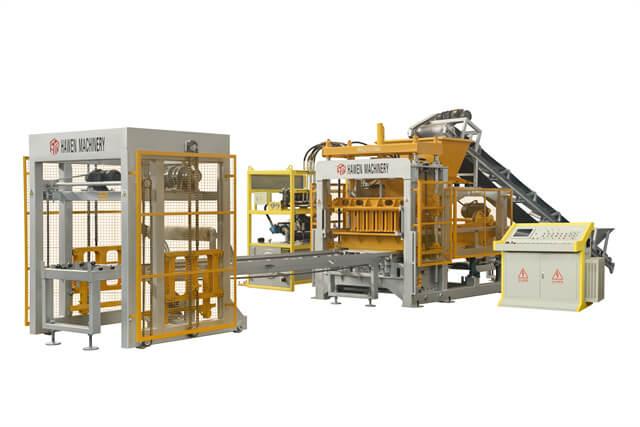
Hawen Machinery can coordinate block machine output, pallet identity, transfer timing, and segregation records during the investigation. Chamber climate measurement and overhead repair remain with the curing-system specialist. Once the comparison run stays clean and the lot is accepted, send it to the offline palletizing system without losing traceability.
Action checklist
Plot each blemish by bay, level, pallet orientation, and the exact unit position.
Keep wet-stage photographs and at least one untreated reference piece.
Trace seams, ribs, fittings, pipes, hoods, and doors during every cycle transition.
Review surface temperature, dew point, vapor ramp, leakage, and load-entry condition.
Repair cold bridges and route collected liquid to a controlled drain.
Repeat the former problem position beside a control position before releasing the lot.
A small ring on one paver can reveal an entire path through structure, vapor, temperature, and timing. When a plant follows that path instead of hiding the stain, it gains more than a cleaner surface. It gains a repeatable method for protecting young concrete, separating fact from assumption, and delivering products whose appearance reflects the same discipline as their strength.
FAQ
Why can the stain sit below a dry-looking roof area? Water may travel along a rib, fitting, pipe, or joint before it reaches the point where it falls.
What is the clearest sign of a fixed drip source? A mark that repeats at the same bay, rack level, and pallet coordinate across different production loads is strong spatial evidence.
Does a white ring prove efflorescence caused the original defect? No. A droplet can move salts and leave a pale edge, so source, residue, timing, and drying behavior must be evaluated together.
Why is the start of the cycle important? Cool metalwork and incoming loads can sit below the dew point when warm vapor first enters, causing rapid surface condensation.
Can operators hang plastic below a leaking joint? An improvised cover can sag, overflow, block circulation, contaminate products, or create an overhead hazard. Use an engineered repair.
How should a repaired position be tested? Run a labelled load at the former problem coordinate and a control load elsewhere, then compare them at equal retrieval and drying stages.
What can Hawen contribute to the investigation? Hawen can support production timing, pallet identity, forming records, and downstream segregation while the chamber specialist handles climate diagnosis and repair.





 Tel: +86-13905968794
 Email: export@hwmachines.com
 MP/WhatsApp: +86-13905968794
 Manufacturer Address:Nanan,Quanzhou City,Fujian Province,China