How to Design an Efficient Automatic Concrete Block Production Line? A Complete Plant Layout GuideBuilding a successful concrete block manufacturing plant requires more than choosing a high-quality block making machine. The efficiency of the entire factory depends on how the raw material system, concrete mixer, block machine, pallet handling system, curing area, and finished product storage are arranged and coordinated.
For investors planning a new automatic concrete block production line, factory layout is one of the most important factors to consider before equipment installation. A well-planned layout can reduce unnecessary material movement, improve production efficiency, simplify forklift operation, and leave sufficient space for future expansion.
The three photographs in this article show a complete automatic concrete block production plant, including the main block making machine, concrete mixing and batching equipment, cement silo, pallet handling system, and finished block area. Instead of looking at each machine separately, we can use this plant as an example to understand how different parts of a concrete block manufacturing plant work together.
What Equipment Is Included in an Automatic Concrete Block Production Line?
An automatic concrete block production line is a combination of several machines and material handling systems. The exact configuration depends on the required products, production capacity, automation level, factory space, and investment budget.
A typical production process can be summarized as:
Raw Material Storage → Batching → Mixing → Block Forming → Pallet Handling → Curing → Automatic Stacking → Finished Product Storage
Each stage has a specific function. The batching system controls the quantity of different aggregates and cement. The mixer produces uniform concrete. The block machine then forms the concrete into the required product shape through feeding, vibration, pressing, and demoulding.
After forming, the fresh blocks need to be transferred carefully to the curing area. Depending on the production line configuration, automatic pallet handling equipment can transport and organize the fresh products with less manual intervention. After curing, the finished blocks can be collected, stacked, and prepared for transportation to customers or construction sites.
The following photograph provides an overall view of how these systems can be integrated into one production facility.
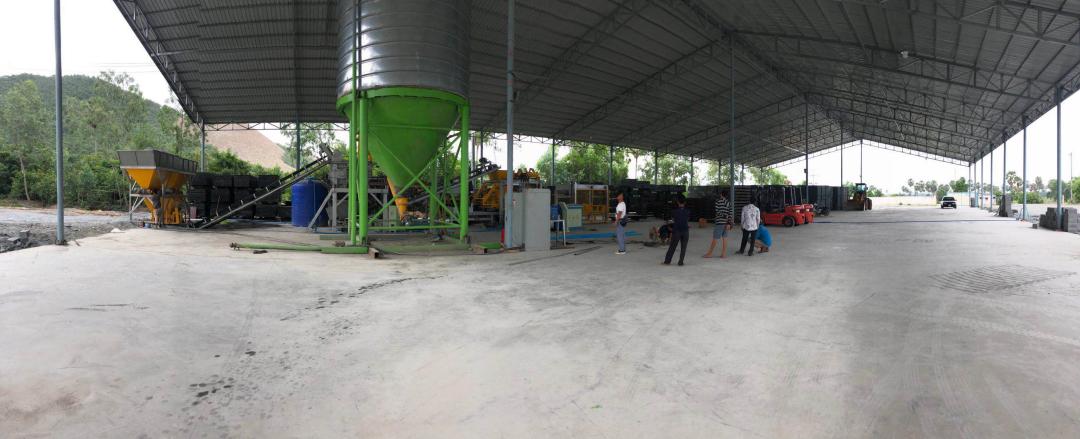
From the overall view, it is possible to see that the production equipment is not installed randomly. The raw material and mixing systems are positioned close to the block machine, while space is reserved around the machine for pallet movement, maintenance, and finished product handling.
This type of arrangement is important because concrete block production involves a continuous flow of materials. Aggregates and cement must reach the mixer, fresh concrete must reach the block machine, empty pallets must circulate through the forming process, and finished products must move to the curing or stacking area.
If these movements are poorly planned, forklifts and workers may have to cross production areas repeatedly. This can increase handling time and create unnecessary safety risks. A logical production flow, on the other hand, allows materials and products to move through the factory with fewer interruptions.
1. Raw Material Storage and Batching System
The first stage of concrete block production is raw material preparation. Common materials include cement, sand, stone, and other aggregates. The exact material ratio depends on the block type, required strength, local raw materials, and concrete mix design.
In an automatic production line, accurate batching is important because variations in material proportions can affect the consistency of the finished blocks. The batching system therefore acts as the starting point for stable production.
In the plant shown in the photographs, the aggregate batching equipment is positioned at one side of the factory, while the cement storage system is located near the mixing equipment. This arrangement helps shorten the transportation distance between raw materials and the mixer.
For a new factory, investors should consider several factors when planning the raw material area:
- Sufficient space for aggregate storage
- Easy access for trucks delivering raw materials
- Convenient connection between batching equipment and mixer
- Adequate space for loading and maintenance
- Good drainage and a suitable concrete floor
- Clear transportation routes for loaders and forklifts
The location of the aggregate storage area is especially important for factories using wheel loaders. The loader should be able to move between the aggregate piles and the batching system without interfering with the movement of finished products or other production equipment.
For larger plants, cement is commonly stored in a vertical silo. A silo can provide a centralized cement storage solution and can be connected to the weighing and feeding system through a screw conveyor or other conveying equipment.
2. Concrete Mixing System
After the aggregates and cement have been accurately measured, the materials are transferred to the concrete mixer. The mixing process is critical because the concrete must have suitable uniformity and moisture content before entering the block making machine.
Unlike conventional cast concrete, the semi-dry concrete used for many concrete blocks has relatively low water content. The mix therefore needs to be properly blended so that the material can fill the mold cavities evenly during vibration and pressing.
The mixing system should be positioned close enough to the block machine to maintain an efficient material flow. Excessive distance between the mixer and block machine may require additional conveying equipment or increase the complexity of the factory layout.
The following image shows the relationship between the raw material system, cement silo, mixing equipment, and block production area.
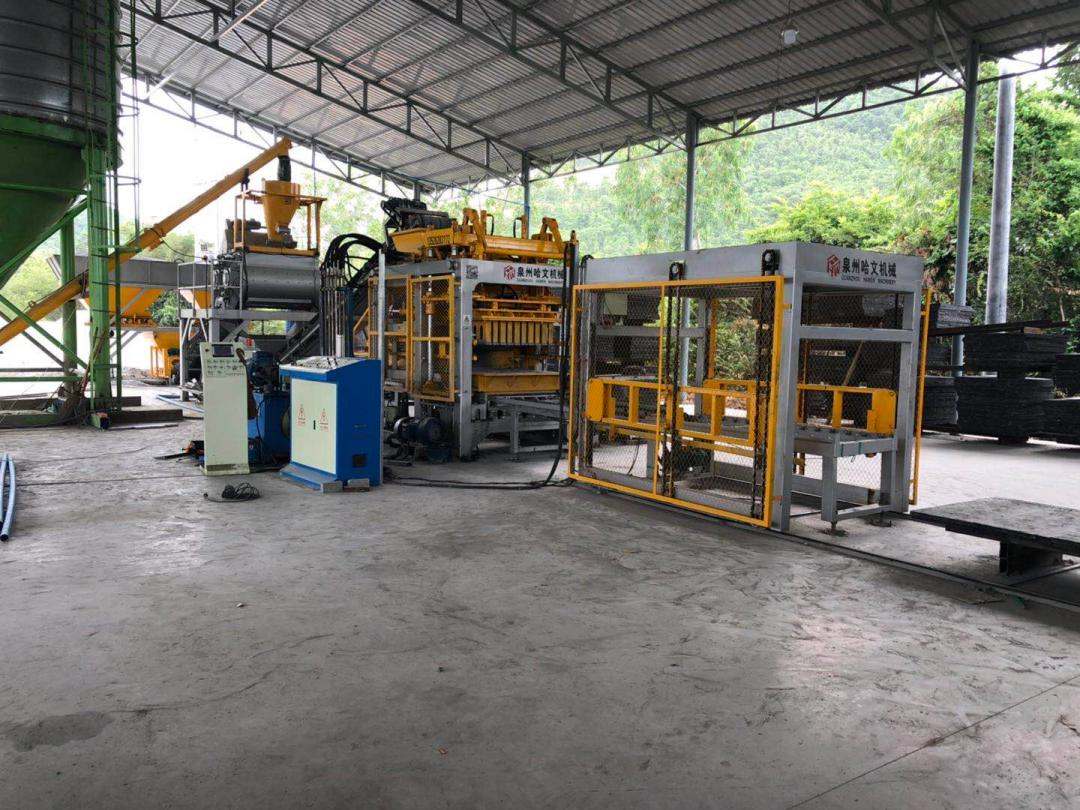
A well-designed production line should maintain a relatively straightforward material flow. Raw materials enter the batching system, measured materials are transferred to the mixer, and the finished concrete is then supplied to the block machine.
This simple principle becomes increasingly important as production capacity increases. When a factory produces thousands of blocks per day, even small inefficiencies in material transportation can accumulate into significant losses of time and labor.
For this reason, equipment layout should be considered together with production capacity. A machine with a high theoretical output cannot achieve its expected production if the upstream batching and mixing systems cannot supply concrete continuously.
The same principle applies to the downstream side. If the block machine produces fresh blocks faster than the pallet handling or curing system can process them, the machine may need to stop periodically. Therefore, a successful concrete block production line should be designed as a balanced system rather than as a collection of individual machines.
3. Automatic Concrete Block Making Machine: The Core of the Production Line
The block making machine is the central equipment of an automatic concrete block production line. It converts the prepared semi-dry concrete mixture into finished green blocks through a controlled sequence of feeding, filling, vibration, pressing, and demoulding.
However, the performance of the block machine should not be evaluated only by its maximum theoretical output. For a commercial concrete block factory, production stability, block quality, mold compatibility, vibration performance, hydraulic control, and ease of maintenance are equally important.
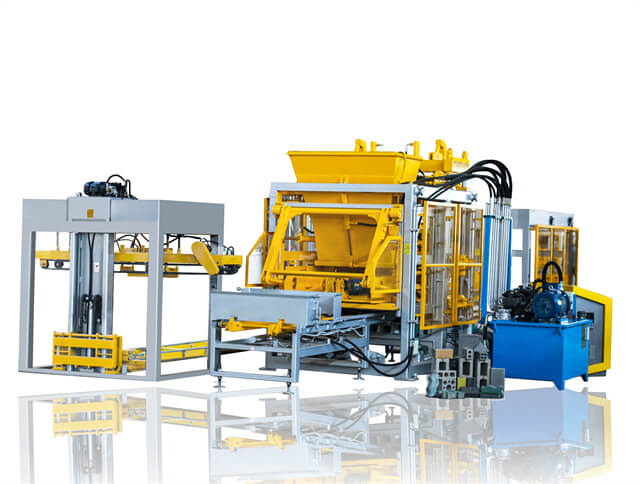
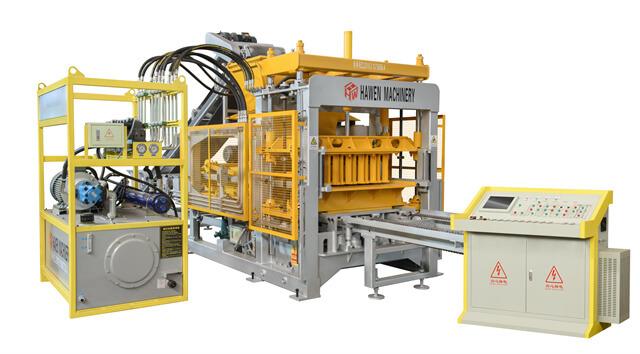
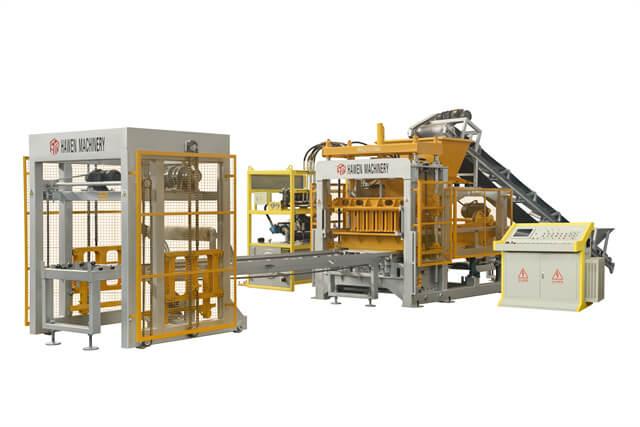
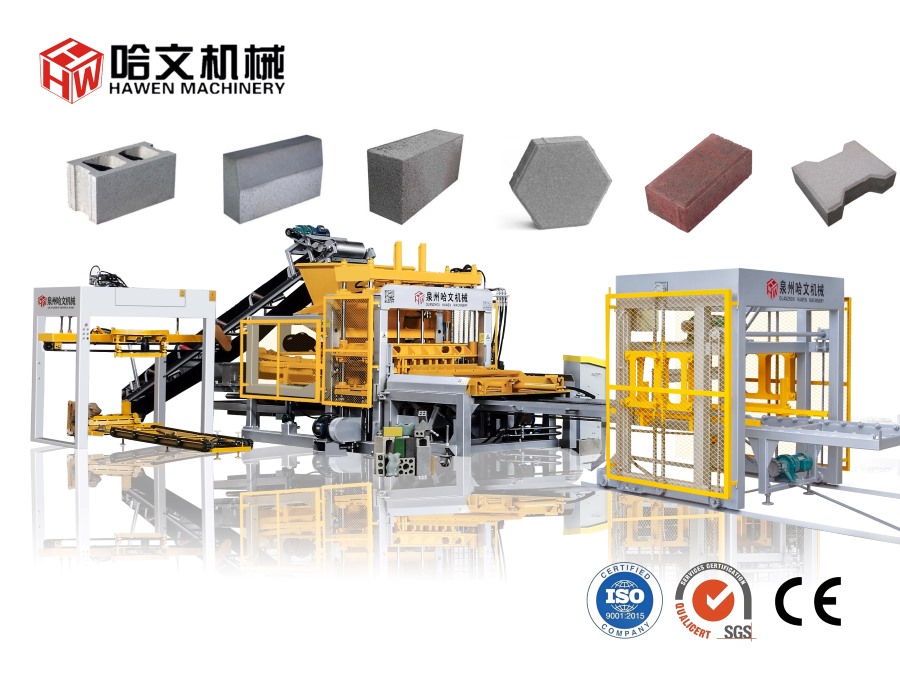
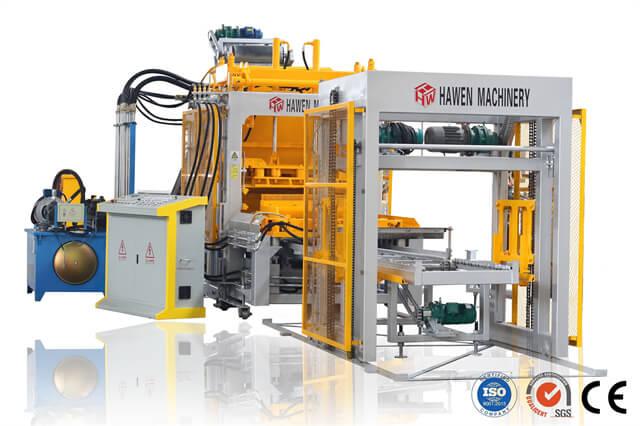
The QT10 block production plant shown in the photographs is a good example of how the main forming machine can be integrated with automatic material handling equipment. The machine is positioned between the concrete feeding system and the downstream pallet handling and stacking equipment, creating a relatively continuous production flow.
This arrangement allows the block machine to receive freshly mixed concrete from the upstream mixing system while the newly formed blocks can be transferred to the next stage without excessive manual handling.
The forming process normally includes several important stages.
- Concrete feeding: The mixed concrete is transferred into the feeding system of the block machine.
- Mold filling: The material is distributed into the mold cavities as evenly as possible.
- Vibration: Controlled vibration helps the concrete fill the mold and achieve the required density.
- Pressing: The pressing system works together with vibration to form the blocks.
- Demoulding: The mold and pressing components move in a coordinated sequence to release the newly formed blocks.
- Pallet transfer: The fresh blocks remain on the production pallet and are transferred to the following stage.
The coordination of these steps directly influences the dimensional consistency and appearance of the finished products. If the feeding system is unstable, the mold may not be filled evenly. If vibration is insufficient or inconsistent, the density of different areas of the block may vary. If demoulding is not properly synchronized, fresh blocks may be damaged during release.
For this reason, a high-quality concrete block machine should be considered as an integrated mechanical and hydraulic system rather than simply a mold-holding frame.
Why Vibration and Hydraulic Systems Matter
Vibration is one of the key processes in the production of pressed concrete blocks. Because the concrete mixture used for many concrete block products has relatively low moisture content, controlled vibration helps the material move into the mold cavities and improves the compactness of the formed products.
The vibration system therefore needs to provide sufficient force while maintaining a stable working cycle. Different products and molds may also require different vibration characteristics. A suitable machine design allows the vibration process to work together with material feeding and pressing rather than treating each operation separately.
The hydraulic system is another important part of the machine. Hydraulic power is commonly used for operations such as mold movement, pressing, demoulding, and other mechanical actions. Stable hydraulic pressure helps maintain repeatable machine movements during continuous production.
From a maintenance perspective, hydraulic components should also be positioned in a way that allows operators and technicians to inspect hoses, valves, pumps, filters, and other components conveniently. Good accessibility can reduce maintenance time when routine inspection or replacement is required.
For investors, these details are often more meaningful than simply looking at the external appearance of a machine. The internal mechanical design, vibration system, hydraulic components, control system, and manufacturing quality all influence the machine's long-term production performance.
4. Pallet Handling and Automatic Stacking
Once fresh concrete blocks have been formed, the next challenge is moving them efficiently without damaging their shape. This is where pallet handling and automatic stacking equipment become important.
Production pallets provide a stable surface for freshly molded blocks. After demoulding, the pallet carrying the green blocks needs to be transported to the curing area or another designated handling stage. Empty pallets must then return to the block machine for another production cycle.
In a manually operated factory, workers may need to move pallets and organize fresh blocks using forklifts or other equipment. As production capacity increases, however, manual handling can become a bottleneck.
The photographs in this project show an automated downstream handling system installed next to the main block machine. This type of arrangement can reduce unnecessary manual intervention and improve the continuity of the production process.
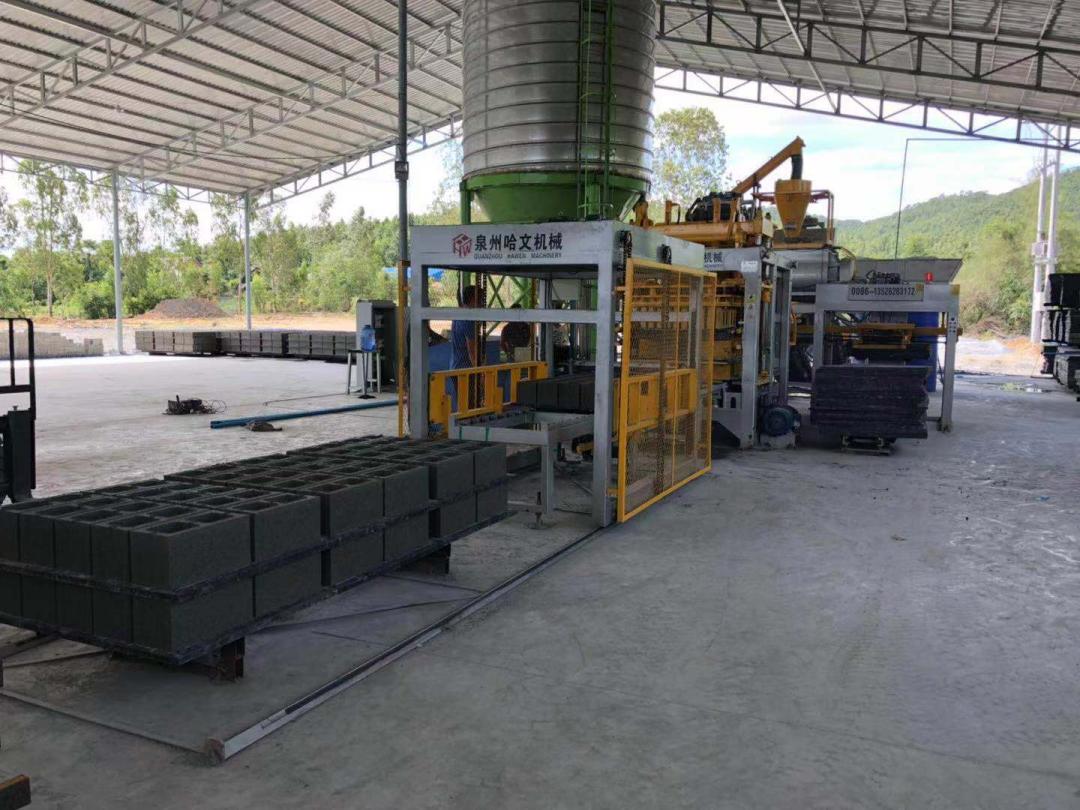
An automatic stacking system can be designed to collect or organize pallets according to the production line configuration. In a suitable setup, multiple pallets can be handled in an organized sequence, helping the factory maintain a predictable material flow between block forming and curing.
The benefit of automation is not simply that fewer workers are required. More importantly, automated handling can make the movement of products more consistent. This can help reduce unnecessary interruptions caused by manual pallet handling and make production scheduling easier.
However, automatic stacking equipment should always be matched with the capacity of the main block machine. If the downstream system is too slow, the block machine may have to stop. If the stacking system is significantly larger than the actual production requirement, the additional investment may not provide a corresponding economic benefit.
Therefore, the correct approach is to design the block machine, pallet quantity, handling equipment, curing capacity, and stacking system as one integrated production system.
Why Production Pallets Are an Important Part of the System
Production pallets are sometimes overlooked when investors calculate the equipment required for a concrete block factory. In reality, the number, size, material, and quality of production pallets can directly influence the continuity of production.
Every production cycle requires a pallet to support the freshly molded blocks. After the blocks are transferred to the curing area, the pallet must eventually return to the block machine. If the factory does not have enough pallets for the planned curing time and production cycle, the machine may have to wait for empty pallets to return.
For this reason, pallet quantity should be calculated according to several factors, including machine cycle time, daily production target, curing time, storage method, and pallet return speed.
Pallet quality is also important. A pallet that is not sufficiently flat or rigid can affect the bottom surface of the blocks and may create problems during automatic handling. Consistent pallet dimensions are especially important when automatic pallet transfer or stacking equipment is used.
From Block Forming to Curing: Maintaining a Continuous Material Flow
After the fresh blocks leave the forming machine, they should enter the curing process as efficiently as possible. The exact curing method depends on the product, climate, factory design, and customer's production requirements.
The key principle is that the curing area must be large enough to accommodate the planned production volume while allowing forklifts, carts, or automatic handling equipment to move safely.
For a high-output production line, the curing area can represent a significant portion of the total factory space. If the curing area is too small, finished products may accumulate around the production equipment, creating congestion and reducing the efficiency of the entire factory.
The photographs of the plant demonstrate why sufficient factory space is valuable. The production equipment occupies one section of the building, while large open areas remain available for product movement, pallet handling, curing, and finished block storage.
Automation Should Be Designed as a Complete System
One of the most important lessons from an automatic concrete block plant is that automation does not come from a single machine. It comes from the coordination of multiple processes.
For example, the block machine may have a high production capacity, but the overall factory will not achieve that capacity if the mixer cannot provide concrete continuously. Similarly, a high-speed block machine cannot operate continuously if there are insufficient production pallets or if the downstream handling system cannot remove fresh blocks efficiently.
The same principle applies to curing and finished product handling. Every stage should have sufficient capacity to support the preceding stage without creating unnecessary waiting time.
A practical production flow can therefore be understood as a series of connected stages:
Batching → Mixing → Concrete Feeding → Block Forming → Pallet Handling → Curing → Stacking → Finished Product Storage
When these stages are properly balanced, the factory can operate more smoothly and the available equipment can be used more effectively.
This is why investors should evaluate a block making machine together with the complete production line instead of comparing machines only by their advertised hourly output.
How Should an Automatic Concrete Block Factory Be Arranged?
A good factory layout is an important part of building an efficient concrete block production line. Even when high-performance equipment is used, an unsuitable layout can create unnecessary material movement, difficult forklift access, maintenance problems, and production interruptions.
The overall plant shown in the photograph provides a useful example of how a relatively large production area can accommodate the main raw material system, cement silo, mixing equipment, block making machine, pallet handling equipment, and finished product storage within one production facility.

When planning a new factory, the first principle should be to establish a logical production flow. Raw materials should enter the plant from a convenient loading area and move toward the batching and mixing system. The mixed concrete should then travel to the block machine, while newly formed products should move toward curing and finished product storage.
This flow can be visualized as:
Raw Materials → Batching → Mixing → Block Forming → Fresh Block Handling → Curing → Finished Products
Ideally, material should move forward through the factory instead of repeatedly crossing the same areas. This reduces unnecessary transportation and makes it easier for operators to monitor the production process.
1. Leave Enough Space Around the Main Block Machine
The main block machine should not be installed directly against walls or other equipment. Sufficient working space is required around the machine for operation, inspection, mold replacement, cleaning, lubrication, and maintenance.
Molds are wear components that may eventually need to be inspected, repaired, or replaced. If there is insufficient space around the machine, mold replacement can become unnecessarily difficult and may increase maintenance downtime.
Operators also need clear access to the control cabinet, hydraulic station, feeding system, vibration system, and other components that require routine inspection.
Therefore, when preparing the foundation and factory layout, investors should consider not only the footprint of the machine itself but also the additional operating and maintenance space surrounding it.
2. Plan the Raw Material Area Before Installing the Equipment
Aggregate storage is one of the largest space requirements in many concrete block factories. Sand, stone, and other aggregates need to be stored in an area that allows loaders to operate efficiently.
The storage area should ideally be positioned close to the batching system. Shorter loading distances can reduce unnecessary movement of the wheel loader and make raw material replenishment more convenient.
At the same time, trucks delivering aggregates should have sufficient access to the storage area without interfering with production equipment or finished product transportation.
The factory floor should also be strong and reasonably level because heavy equipment, forklifts, pallets, and aggregate handling machinery may operate in the same facility.
3. Position the Cement Silo Close to the Mixing System
The cement silo is another important part of an automatic concrete block production plant. In the example shown in the photograph, the large vertical silo is positioned close to the batching and mixing equipment.
This arrangement helps create a relatively compact material supply system. Cement can be stored in the silo and transferred toward the weighing and mixing system through suitable conveying equipment.
When planning a cement silo, the available installation height should also be considered. Sufficient vertical clearance is required for installation, inspection, maintenance, and cement delivery.
The location of the silo should also take into account truck access, foundation requirements, and the movement of other equipment inside the factory.
4. Reserve Clear Routes for Forklifts and Pallets
Forklifts are commonly used in concrete block factories for transporting pallets, moving cured blocks, loading finished products, and supplying production materials. As a result, forklift routes should be considered during the factory planning stage.
A common mistake is to calculate only the space occupied by the machines while ignoring the turning radius and operating area required by forklifts.
The production area shown in the photographs has a relatively open floor layout. This provides more flexibility for material handling and allows forklifts to move between production and storage areas.
When designing the factory, transportation routes should ideally avoid unnecessary intersections between forklifts, workers, raw material loaders, and automatic equipment. Clear routes can improve operating efficiency and reduce potential safety risks.
5. Separate Production, Curing, and Finished Product Areas
Fresh concrete blocks and fully cured blocks have different handling requirements. The fresh blocks must be handled carefully because they have not yet reached their final strength, while cured blocks can normally be transported and stacked more freely.
For this reason, a factory should provide clearly planned areas for fresh block handling, curing, and finished product storage.
The curing area should have sufficient capacity for the expected daily production. If production increases but curing space remains unchanged, fresh products may accumulate around the production line and interfere with normal machine operation.
Finished products should also be stored in an organized manner so that forklifts can access different batches without moving large quantities of blocks unnecessarily.
Common Concrete Block Factory Layout Mistakes to Avoid
Factory layout problems are often discovered only after the equipment has been installed. Correcting them later can be expensive and may interrupt production. Several common problems should therefore be considered during the planning stage.
- Insufficient maintenance space: The machine fits into the factory, but there is not enough room to remove molds or access key components.
- Long material transportation routes: Raw materials or mixed concrete must travel unnecessary distances between different production stages.
- Insufficient pallet circulation: The number of production pallets does not match the required production and curing cycle.
- Limited forklift access: Finished products cannot be moved efficiently because storage areas or machines block transportation routes.
- Insufficient curing space: The block machine can produce products faster than the factory can store and cure them.
- No room for future expansion: The initial equipment occupies almost the entire factory, leaving no practical space for additional equipment or storage.
What Should Buyers Confirm Before Building a Concrete Block Plant?
Before purchasing a concrete block machine, investors should collect several important pieces of information about their planned factory and target market.
| Item | What Should Be Confirmed? |
|---|
| Target Products | Hollow blocks, solid bricks, paving blocks, kerbstones, or other concrete products. |
| Production Capacity | Required production per cycle, hour, day, and working shift. |
| Raw Materials | Available aggregates, cement, sand, moisture conditions, and material quality. |
| Factory Space | Building dimensions, floor conditions, equipment area, curing area, and storage space. |
| Electrical Supply | Local voltage, frequency, available power, and electrical installation conditions. |
| Automation Level | Manual, semi-automatic, or fully automatic production and material handling. |
| Future Expansion | Possibility of adding molds, pallets, handling equipment, or additional production capacity. |
Why Factory Planning Should Come Before Machine Installation
A concrete block manufacturing plant should be treated as a complete production system rather than a group of independent machines. The location of each component affects the efficiency of the entire operation.
For example, placing the mixer too far from the block machine may complicate concrete transportation. Placing the finished product storage area directly in the main forklift route may create congestion. Installing the cement silo without considering truck access or maintenance space may create problems after commissioning.
These issues are easier and less expensive to solve during the design stage than after installation.
For this reason, investors should provide the equipment supplier with accurate information about the factory building, available space, target products, expected capacity, and local operating conditions before finalizing the production line configuration.
A detailed factory layout can then be developed to determine the position of the batching system, cement silo, mixer, block machine, pallet handling equipment, curing area, finished product storage, and transportation routes.
FAQ About Automatic Concrete Block Production Lines
How much factory space is needed for an automatic concrete block production line?
There is no single factory size suitable for every production line. The required area depends on the block machine model, production capacity, number of molds, pallet quantity, curing method, raw material storage, finished product storage, and level of automation. A factory layout should therefore be designed according to the complete production process rather than the machine footprint alone.
What equipment is normally included in a concrete block production line?
A typical automatic line may include aggregate batching equipment, a cement storage system, concrete mixer, conveyor or feeding equipment, concrete block machine, production pallets, pallet handling equipment, curing facilities, and finished product handling equipment. The exact configuration depends on the customer's production requirements.
Why is the curing area important?
Freshly molded blocks require appropriate curing before they can be handled and transported as finished products. If the curing area is too small, the production line may experience congestion even when the block machine itself has sufficient capacity.
Is an automatic stacking system necessary for every block factory?
Not necessarily. The appropriate automation level depends on production capacity, labor availability, investment budget, factory layout, and long-term production plans. For higher-volume production, automated pallet and block handling can help reduce manual operations and improve production continuity.
What information should I provide when requesting a concrete block machine quotation?
Useful information includes the products to be manufactured, block dimensions, expected production capacity, available factory space, local electrical conditions, raw materials, desired automation level, and whether future production expansion is planned. Providing these details allows the supplier to recommend a more suitable production line configuration.
Conclusion: A Good Block Plant Starts with Good Planning
The three photographs used in this article show an important principle of concrete block manufacturing: production efficiency comes from the coordination of the complete plant, not from one machine alone.
The batching system needs to supply the mixer, the mixer needs to provide concrete continuously to the block machine, the block machine needs sufficient production pallets, and the downstream handling system needs to keep up with the production cycle. At the same time, curing and finished product storage must have enough capacity to prevent congestion.
For investors planning a new concrete block production line , the most important step is therefore to define the production requirements before selecting individual machines. Product types, production targets, raw materials, factory dimensions, labor availability, electrical conditions, and future expansion should all be considered together.
A carefully planned factory layout can make material movement more efficient, simplify maintenance, improve pallet circulation, and provide a better working environment for operators. It can also make future upgrades easier when production demand increases.
Ultimately, the goal of an automatic concrete block manufacturing plant is not simply to install a powerful machine. The goal is to create a balanced production system in which every stage—from raw material preparation to finished block storage—works together efficiently and consistently.
By planning the production process first and selecting equipment based on actual requirements, investors can build a concrete block plant that is better suited to their market today while retaining the flexibility needed for future development.





 Tel: +86-13905968794
 Email: export@hwmachines.com
 MP/WhatsApp: +86-13905968794
 Manufacturer Address:Nanan,Quanzhou City,Fujian Province,China