How to Choose Between High-Level and Low-Level Automatic Cubers for a Concrete Block Plant?
As labor costs continue to rise and automation becomes increasingly important in modern concrete product manufacturing, more block factories are investing in automatic cubing systems.
An automatic cuber plays a crucial role after the curing process by automatically handling, arranging and packaging finished blocks and pavers for transportation and storage.
However, many customers are uncertain whether they should choose a high-level automatic cuber or a low-level automatic cuber.
This article explains the differences between these two systems and helps manufacturers choose the most suitable solution according to production requirements and factory layouts.
What Is an Automatic Cuber?
An automatic cuber is a downstream handling system installed after the curing area of a concrete block production line.
Its main functions include:
- Picking up cured products
- Arranging products into cubes
- Automatic clamping and transferring
- Preparing products for strapping and shipment
- Reducing manual handling and labor requirements
In modern factories, the production flow usually follows the sequence below:
Block Forming
→ Automatic Block Stacker
→ Curing
→ Automatic Cuber
→ Packing & Shipping
Why Is Automatic Cubing Important?
Many manufacturers focus mainly on the block machine itself while ignoring the importance of the cubing section.
In reality, an inefficient packing process can significantly reduce overall plant productivity.
An automatic cuber helps factories:
- Reduce labor costs
- Improve product handling efficiency
- Reduce product damage
- Improve loading speed
- Maintain consistent cube dimensions
- Increase factory automation level
For large-scale factories, automatic cubing has become an essential component of a modern concrete block production line .
What Is a High-Level Automatic Cuber?
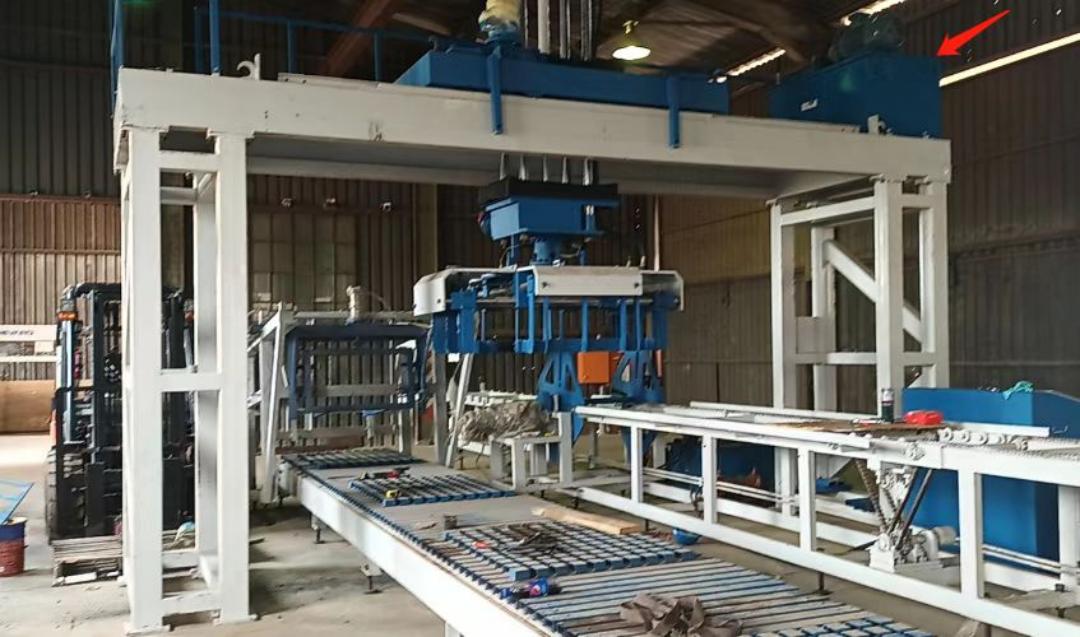
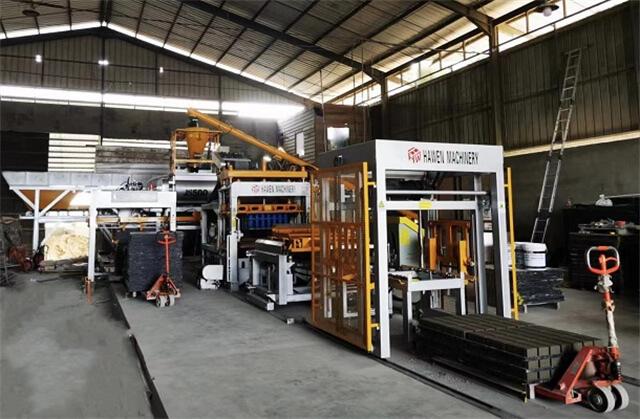
High-level automatic cuber installed above the production line.
A high-level automatic cuber is generally installed on an elevated steel platform and automatically clamps and transfers cured products from upper conveyors.
This solution is usually used in high-capacity block factories with advanced automation requirements.
Advantages of High-Level Automatic Cubers
- Higher automation level
- Compact factory layout
- Higher cubing efficiency
- Lower labor requirement
- Suitable for large production capacities
- Better integration with automatic packing systems
High-level cubers are commonly used in: QT10 Block Machine , QT12 Production Line and QT15 Block Production Lines .
What Is a Low-Level Automatic Cuber?
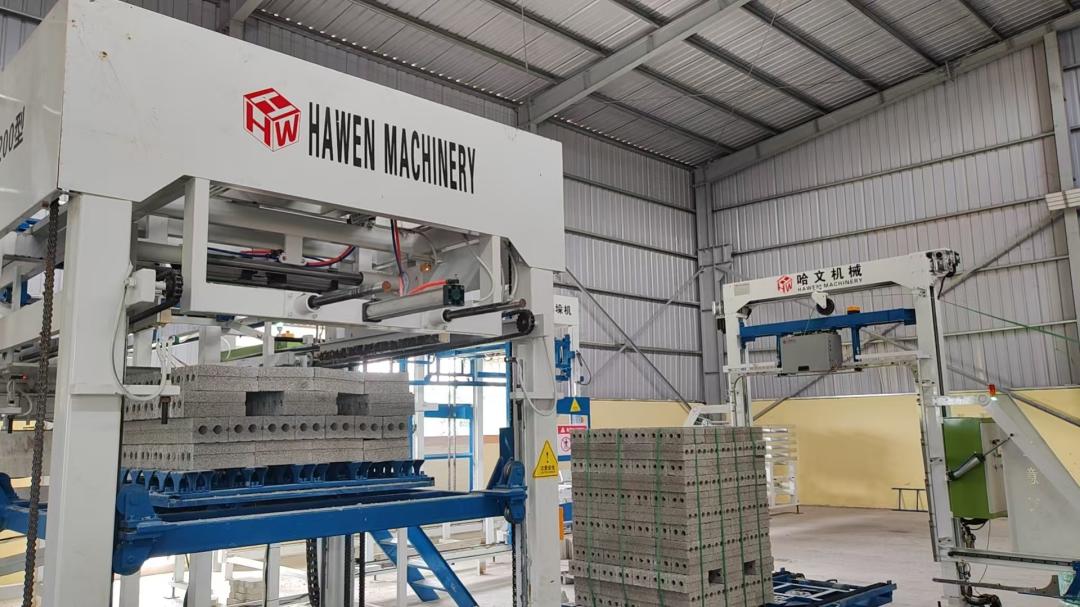
Low-level automatic cuber operating directly at ground level.
A low-level automatic cuber works directly at floor level and transfers cured blocks into cubes using mechanical clamping systems.
Compared with high-level systems, it usually requires lower investment and easier maintenance.
Advantages of Low-Level Automatic Cubers
- Lower investment cost
- Simpler structure
- Easier maintenance
- Suitable for medium-sized factories
- Flexible factory layout
Low-level cubers are commonly selected for medium-capacity automatic block making machines .
High-Level vs Low-Level Automatic Cubers
| Item | High-Level Automatic Cuber | Low-Level Automatic Cuber |
|---|
| Automation Level | ★★★★★ | ★★★★ |
| Investment Cost | Higher | Lower |
| Labor Requirement | Very Low | Low |
| Production Capacity | Large Factories | Medium Factories |
| Factory Layout | More Compact | Larger Floor Area |
| Maintenance Difficulty | Medium | Easy |
| Recommended Models | QT10 / QT12 / QT15 | QT4 / QT5 / QT6 |
How to Choose the Right Automatic Cuber?
Before selecting an automatic cubing solution, manufacturers should evaluate:
- Daily production capacity requirements
- Available factory space
- Labor costs in local markets
- Investment budget
- Future expansion plans
- Product types including hollow blocks, pavers and kerbstones
For factories with large production capacities and high labor costs, a high-level automatic cuber may provide better long-term investment returns.
For medium-sized factories seeking lower initial investment, a low-level automatic cuber can still significantly improve production efficiency.
HAWEN Machinery can provide both high-level and low-level automatic cubing solutions according to customers' production requirements and factory layouts.
Applications of Automatic Cubers
Automatic cubers are widely used for handling:
- Concrete hollow blocks
- Interlocking pavers
- Solid bricks
- Kerbstones
- Landscape products
- Special-shaped concrete products
FAQ
What is the difference between a stacker and a cuber?
A block stacker handles fresh wet products before curing, while an automatic cuber handles finished products after curing.
Which automatic cuber is better?
Neither is universally better. The selection depends on production capacity, factory layout and investment budget.
Can one cuber handle both blocks and pavers?
Yes. By adjusting clamps and packing programs, one automatic cuber can handle various concrete products.
Is a high-level automatic cuber worth the investment?
For large block factories with high output requirements and expensive labor costs, a high-level automatic cuber often provides excellent long-term returns.
Can low-level cubers be upgraded later?
Yes. Many factories initially install low-level systems and later upgrade to fully automatic high-level cubing lines as production expands.
Conclusion
Automatic cubing systems have become an indispensable part of modern concrete block factories.
Choosing between a high-level and low-level automatic cuber should be based on production requirements, factory layout and future development plans.
With the right cubing solution, manufacturers can significantly improve productivity, reduce labor costs and enhance overall factory automation.





 Tel: +86-13905968794
 Email: export@hwmachines.com
 MP/WhatsApp: +86-13905968794
 Manufacturer Address:Nanan,Quanzhou City,Fujian Province,China