Common Mistakes Beginners Should Avoid in Block Production
Author:HAWEN Block MachineFROM:Brick Production Machine Manufacturer
TIME:2026-05-29
Entering the concrete block manufacturing industry may appear straightforward at first glance. Many newcomers assume that once a block machine is installed and raw materials are prepared, stable production and rapid profit will naturally follow. In reality, however, block production is a highly systematic process that depends on material science, mechanical coordination, vibration technology, curing management, and operational discipline. Even minor misjudgments during the early stage can gradually evolve into chronic production instability, excessive cement consumption, low-strength products, and escalating operational costs.
For many first-time investors, the most expensive mistakes are not dramatic equipment failures. Instead, they are repetitive small errors that silently reduce efficiency day after day. Understanding these common pitfalls in advance can significantly improve the long-term performance of a block making machine project and protect the sustainability of the entire business.
1. Choosing a Brick Machine Solely Based on Price
One of the most prevalent mistakes among beginners is purchasing the cheapest available brick machine without carefully evaluating production requirements, technical configuration, or after-sales support.
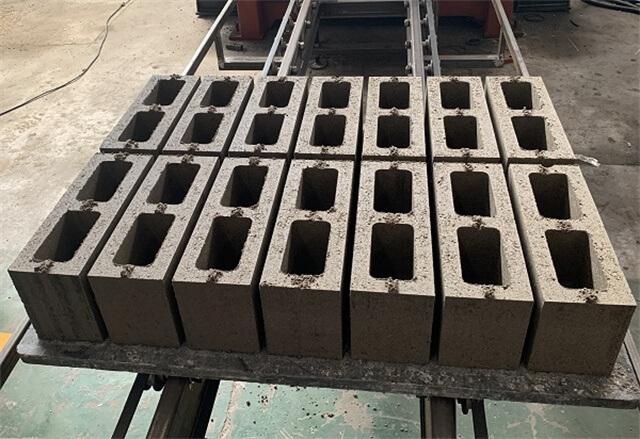
A low-cost block machine may initially reduce investment pressure, yet hidden deficiencies often emerge later, including unstable vibration force, excessive wear of molds, inaccurate batching systems, and inconsistent hydraulic performance. As a consequence, operators frequently encounter cracked blocks, dimensional deviation, uneven density, and rising maintenance expenditure.
In practical production environments, the true cost of a machine is determined not by its purchase price, but by its operational stability over several years.
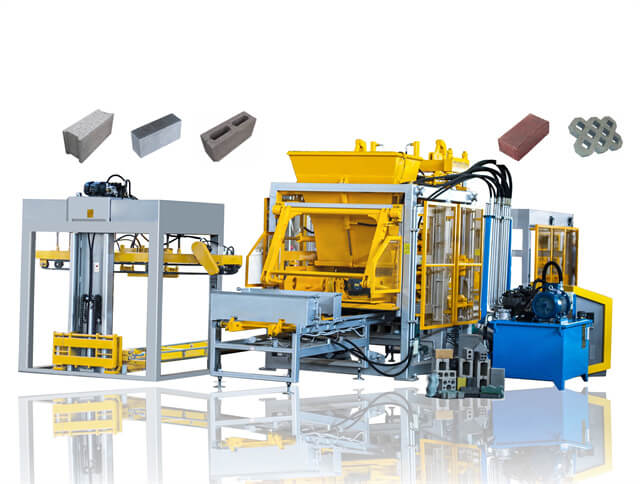
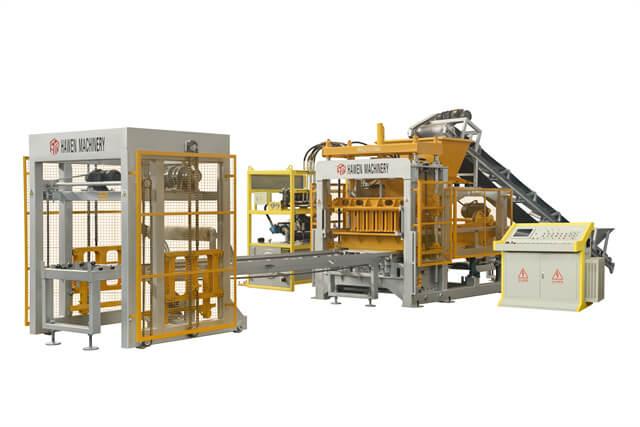
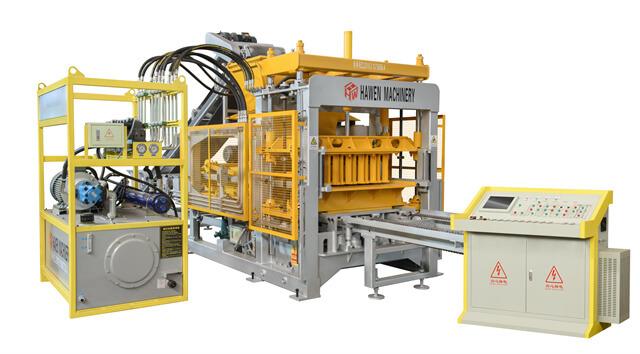
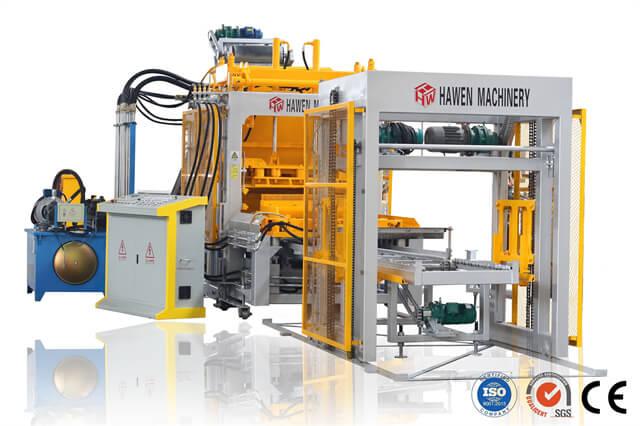
At Hawen Machinery, considerable emphasis is placed on the hydraulic architecture of the block making machine system. The hydraulic station integrates Japanese YUKEN proportional and directional valves together with a high-performance American ALBERT hydraulic pump. This configuration enables smoother pressure regulation, rapid response, and superior endurance under continuous heavy-duty operation.
For investors planning long-term production, reliability is substantially more valuable than temporary savings.
Note: In concrete block manufacturing, unstable equipment frequently causes hidden material waste that operators fail to notice immediately.
2. Ignoring Raw Material Gradation and Moisture Control
Many beginners focus extensively on the machine itself while underestimating the decisive role of raw materials.
In reality, even an advanced concrete block machine cannot compensate for poorly graded aggregates or excessive moisture variation. Improper sand proportion, oversized aggregate particles, or inconsistent water-cement ratios can severely affect compaction quality during vibration forming.
Common consequences include:
Surface cracks
Weak compressive strength
Edge breakage
Uneven color distribution
Increased cement consumption
Successful block production requires stable aggregate grading, controlled moisture content, and accurate batching management.
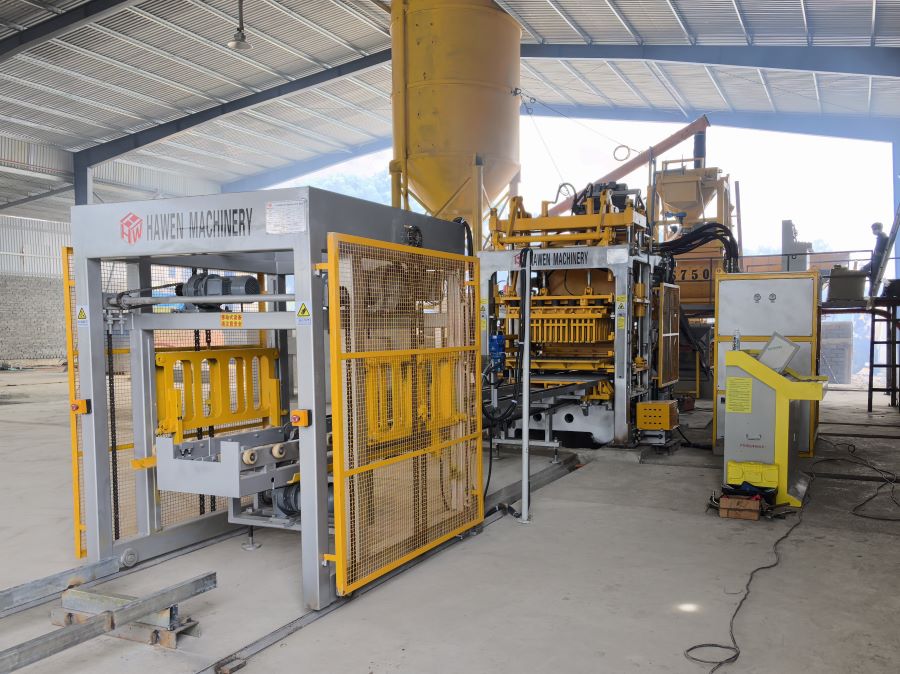
A professional batching system ensures that every cycle of the brick making machine receives a consistent material ratio. Without such consistency, production quality becomes unpredictable regardless of machine sophistication.
3. Overlooking the Importance of Vibration Technology
Some operators mistakenly assume that stronger vibration automatically produces stronger blocks. This oversimplified understanding often leads to excessive vibration force, segregation of aggregates, or internal structural instability.
Efficient vibration is not merely about intensity. It is fundamentally about balance, synchronization, and energy transmission efficiency.
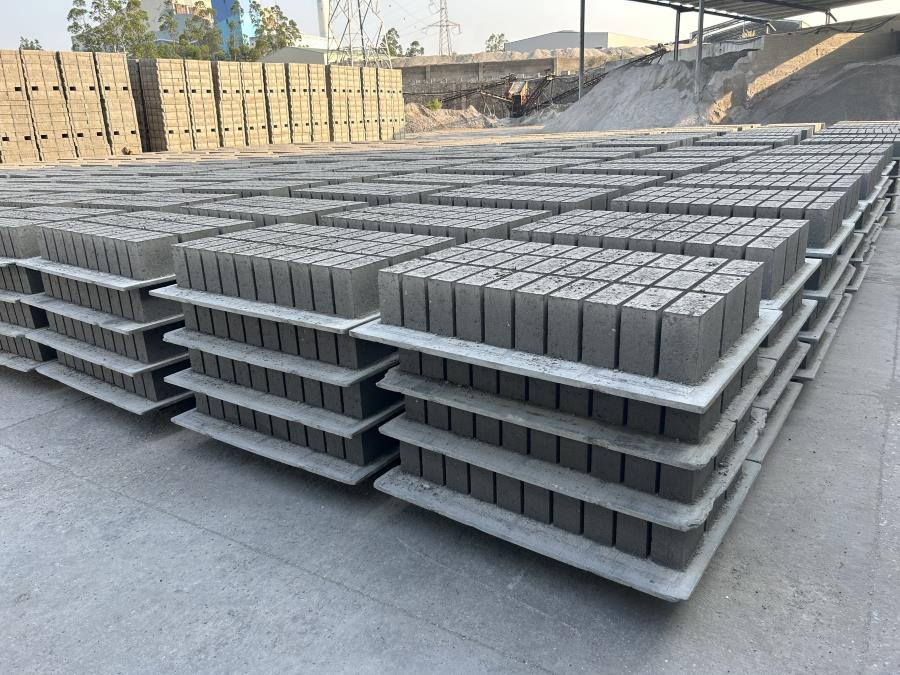
Hawen Machinery adopts a four-shaft vibration box structure with eccentric blocks positioned externally. This engineering arrangement minimizes vibration resistance, improves force transmission efficiency, and ensures more homogeneous compaction throughout the mold cavity. As a result, the finished products achieve higher density while reducing unnecessary cement consumption.
For a modern block making machine, optimized vibration technology directly influences:
Product strength
Surface appearance
Material utilization
Mold lifespan
Energy efficiency
Many inexperienced manufacturers attempt to increase production simply by extending vibration duration. In practice, however, poorly calibrated vibration often accelerates mold wear and increases electricity consumption without improving product quality.
4. Neglecting Mold Quality and Compatibility
Molds are frequently underestimated by newcomers entering the block production industry. Nevertheless, molds are among the most critical components affecting dimensional accuracy and product consistency.
Inferior molds rapidly lose precision after prolonged operation. Once deformation occurs, even a high-quality block machine cannot maintain uniform product dimensions.
Hawen Machinery manufactures molds compatible with internationally recognized brands such as Masa, Hess, Zenith, Poyatos, Besser, Tiger, Columbia, Quadar, and Omag. By adhering closely to original technical specifications, these molds ensure accurate installation, smooth movement, and stable production across different platforms.
Furthermore, all molds undergo professional heat treatment to enhance wear resistance. Hardness testing typically reaches HRC60-62, substantially improving service life under continuous vibration and compression conditions.
For beginners, investing in durable molds is not an unnecessary luxury. It is a strategic decision that stabilizes long-term production quality.
5. Underestimating the Role of Curing
A considerable number of beginners concentrate heavily on the forming stage while neglecting curing management. Yet curing is equally important for determining final block strength.
Even perfectly compacted concrete products can develop internal weakness if curing temperature and humidity fluctuate excessively.
Improper curing commonly results in:
Surface shrinkage cracks
Reduced compressive strength
Color inconsistency
Premature deterioration
Professional curing systems maintain controlled environmental conditions that allow cement hydration to progress uniformly.
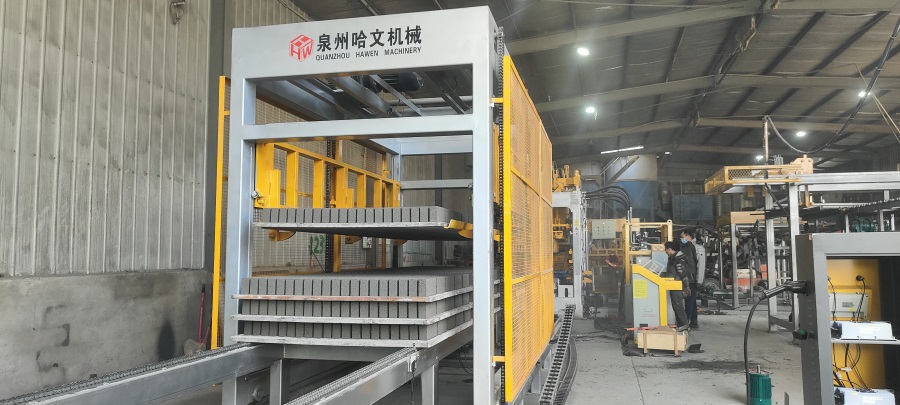
In automated brick making machine plants, curing chambers significantly improve product stability and reduce rejection rates.
6. Failing to Establish Standardized Operational Procedures
Another common beginner error is relying excessively on operator experience instead of standardized production parameters.
Without clear operational standards, different workers may apply inconsistent feeding speed, vibration duration, or pressure settings. Over time, this inconsistency destabilizes production quality.
Hawen Machinery incorporates a SIEMENS S7-200 PLC control system combined with an intelligent touch-screen interface and remote monitoring functionality. Through this system, operators can monitor the real-time operating status of the block machine, optimize production parameters remotely, and maintain stable manufacturing conditions throughout the production cycle.
Automation does not merely improve convenience. More importantly, it minimizes human error and enhances repeatability.
7. Expanding Production Capacity Too Quickly
Many beginners become overly optimistic after initial sales success and immediately attempt to expand production capacity without establishing stable operational management.
Rapid expansion without sufficient planning often creates:
Cash flow pressure
Inventory imbalance
Equipment overload
Labor inefficiency
Maintenance neglect
 A sustainable block production business requires gradual optimization rather than uncontrolled expansion.
Experienced manufacturers typically focus first on stabilizing product quality, reducing waste, and improving operational efficiency before increasing production scale.
Building a Successful Block Production Business Requires More Than Equipment
The concrete block industry is not a shortcut business driven by machinery alone. It is a discipline that combines engineering logic, production management, material science, and operational consistency.
Beginners who succeed in this industry are not necessarily those with the largest investment. More often, they are the ones who understand how to avoid preventable mistakes, optimize production details, and maintain long-term quality stability.
A truly competitive block factory is built step by step — through disciplined management, reliable machinery, stable raw materials, and continuous technical refinement.
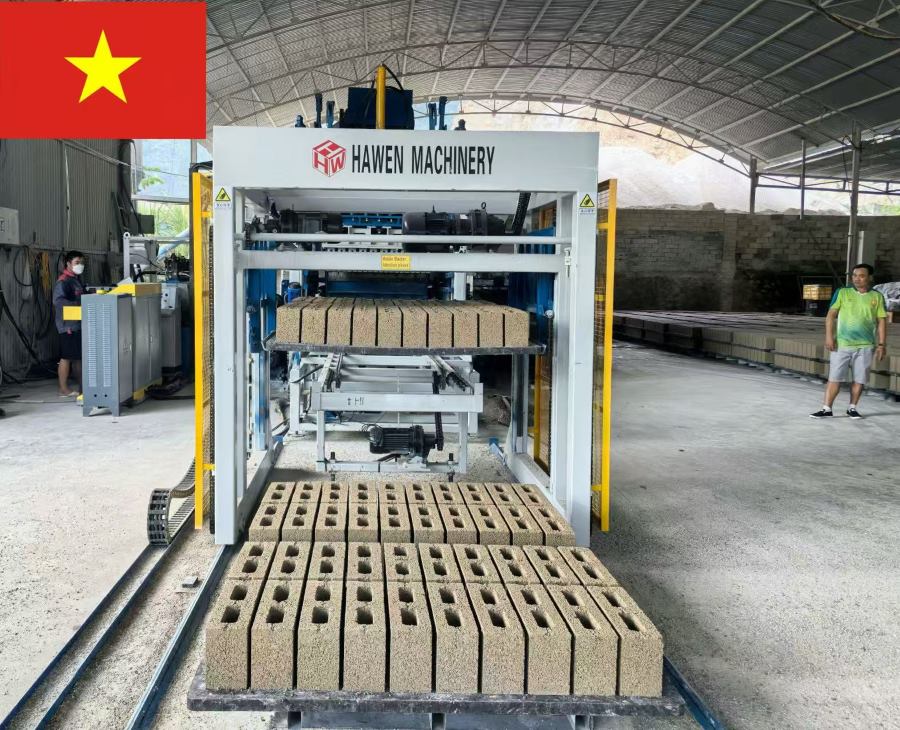
At Hawen Machinery, we believe a high-performance block making machine should not simply produce concrete products. It should help customers reduce waste, improve efficiency, strengthen product consistency, and create sustainable industrial value in increasingly competitive construction markets.
As global infrastructure demand continues to expand, the future of the block manufacturing industry will belong not to the fastest producers, but to the manufacturers capable of combining quality, efficiency, and technological resilience into a coherent production system.
A sustainable block production business requires gradual optimization rather than uncontrolled expansion.
Experienced manufacturers typically focus first on stabilizing product quality, reducing waste, and improving operational efficiency before increasing production scale.
Building a Successful Block Production Business Requires More Than Equipment
The concrete block industry is not a shortcut business driven by machinery alone. It is a discipline that combines engineering logic, production management, material science, and operational consistency.
Beginners who succeed in this industry are not necessarily those with the largest investment. More often, they are the ones who understand how to avoid preventable mistakes, optimize production details, and maintain long-term quality stability.
A truly competitive block factory is built step by step — through disciplined management, reliable machinery, stable raw materials, and continuous technical refinement.
At Hawen Machinery, we believe a high-performance block making machine should not simply produce concrete products. It should help customers reduce waste, improve efficiency, strengthen product consistency, and create sustainable industrial value in increasingly competitive construction markets.
As global infrastructure demand continues to expand, the future of the block manufacturing industry will belong not to the fastest producers, but to the manufacturers capable of combining quality, efficiency, and technological resilience into a coherent production system.
FAQ
1. What is the most common mistake beginners make in block production?
The most common mistake is prioritizing low equipment price over long-term production stability. Many inexpensive block machines create hidden operational problems that eventually increase maintenance and material costs.
2. Why is vibration technology important in a block making machine?
Efficient vibration ensures uniform compaction inside the mold cavity. Proper vibration improves product density, reduces cement consumption, and enhances overall block strength and surface quality.
3. How does poor raw material control affect concrete blocks?
Inconsistent aggregate grading or improper moisture content can cause cracking, dimensional deviation, weak strength, and uneven surface appearance.
4. Why is mold quality critical in block production?
High-quality molds maintain dimensional precision and product consistency during long-term operation. Heat-treated molds with HRC60-62 hardness offer superior wear resistance and longer service life.
5. Can automated control systems improve production quality?
Yes. Advanced PLC control systems reduce human error, stabilize production parameters, and improve consistency throughout the entire brick machine production process.





 Tel: +86-13905968794
 Email: export@hwmachines.com
 MP/WhatsApp: +86-13905968794
 Manufacturer Address:Nanan,Quanzhou City,Fujian Province,China