An automatic cuber can be an important part of a concrete paver factory's finished-product handling arrangement. However, ordering the equipment from a general description of the paver and the required stack height leaves several questions unanswered. The supplier also needs to understand how products arrive, how they must be grouped, and what the completed pack must provide for packaging and dispatch.
A paver pack pattern is not simply a photograph of a neat stack. It is a defined arrangement of products within and between layers, connected to the required pack contents and handling method. A pattern that looks suitable in a drawing still needs to be reviewed against the actual product and proposed equipment configuration.
This guide explains the information buyers can prepare before ordering an automatic cuber or offline palletizing system. It does not prescribe a universal stacking pattern, gripping setting, pack height, or handling limit. Those requirements should be confirmed for the specific equipment, products, packaging arrangement, and intended use.
The core principle: treat the pack pattern as a controlled specification, not a picture. Define the product, the incoming arrangement, the layer sequence, the completed pack, and the acceptance evidence before the order is placed.
A cuber specification should connect the incoming product arrangement with the required finished pack.
Separate the Production Layout from the Finished Pack Pattern
Begin by distinguishing the arrangements involved. The mould layout describes products formed during a production cycle. The incoming arrangement describes how cured products are presented to the palletizing system. The finished pack pattern describes how products must be assembled for the next handling and commercial stage. These arrangements may be related without being identical.
A buyer should not assume that every layer leaving production will become one unchanged layer in the finished pack. The proposed system may require a particular incoming presentation or additional grouping equipment. Ask the supplier to explain the actual transfer and grouping sequence rather than treating the word automatic as confirmation that every rearrangement is included.
Keep a finished shipping pack distinct from a layer intended for mechanical laying. A customer may require a particular arrangement for installation equipment, while another customer buys ordinary packs for manual handling and laying. The intended use changes the specification. A convenient shipping pattern should not be described as suitable for mechanical installation without a separate compatibility review.
Use separate drawing references where the production layout and dispatch pattern differ. Record which document governs each stage and identify any transformation that the supplier must provide. This prevents a quotation from being approved against one arrangement while the buyer expects another arrangement at the system outlet.
Define the Products and Arrangement Arriving at the Cuber
Provide an identified product drawing for each paver included in the proposed scope. Relevant information can include the overall geometry, thickness, surface features, and other details needed for the supplier's handling review. A short description such as rectangular paver does not establish that different products have equivalent handling requirements.
Explain how the cured products reach the system. Identify the production pallet, product orientation, arrangement, and the stage at which products are separated from their production support. The exact sequence depends on the proposed installation. Keep existing equipment and newly supplied equipment distinguishable so that the quotation clearly assigns responsibility for each interface.
Where the plant makes several sizes in one coordinated product range, describe the actual incoming combination. State whether sizes arrive together, separately, or through different production campaigns. The supplier needs to know which grouping task is required. A mixed-size finished pack cannot be assumed available merely because the equipment can handle each size individually.
Discuss the product condition expected at the handling stage. The responsible team should define the release and inspection requirements before products are offered to the cuber. Do not use palletizing equipment as a substitute for product-quality decisions. Products that are held or unsuitable for the intended handling process should retain their status rather than becoming ordinary packing input.
Incoming presentation, grouping, and outgoing packing requirements should be reviewed as connected stages.
Prepare Layer Drawings That Explain the Required Pack
Prepare a clearly dimensioned plan for each distinct layer arrangement. Show the product identity, orientation, quantity, and overall pattern boundary. Where several sizes are included, use unambiguous labels and a matching product schedule. A coloured illustration can support communication, but the drawing should remain understandable without relying on colour alone.
Describe how layers relate to one another. If the proposed pack uses more than one arrangement, identify the sequence and orientation in the pack drawing. Do not assume that a supplier will infer an intended rotation or alternating arrangement from a single photograph. The appropriate technical reviewer should assess whether the requested pattern is suitable for the intended handling and packaging system.
Keep product count, layer count, and commercial pack quantity connected. Record the intended number of each product in the completed pack and verify that it matches the layer drawings. This is particularly important for mixed-size products, where a correct total piece count can still contain the wrong combination of sizes.
When reviewing an automatic offline palletizing system for concrete products, submit the actual proposed patterns for supplier assessment. A general statement that the system handles pavers does not confirm every requested grouping arrangement. Ask which parts of the pattern are included in the offered configuration and which require further review or additional equipment.
Identify any incomplete-pack requirement separately. A short customer order may not correspond to a complete standard pack, but that does not make an improvised partial layer an approved arrangement. Agree how short quantities will be handled and which patterns are permitted. Keep commercial convenience separate from the technical approval of the finished handling unit.
Specification Item
Information to Confirm
Reason for the Review
Product identity
Drawing, revision, dimensions, and relevant surface features
Establishes which products the proposal must handle
Incoming arrangement
Production support, orientation, and grouping before palletizing
Defines the starting condition for the proposed sequence
Layer pattern
Product positions, quantities, orientation, and pattern boundary
Prevents interpretation from photographs alone
Completed pack
Layer sequence, product combination, and commercial quantity
Connects the technical arrangement with the order requirement
Packaging and handling
Support arrangement, packaging interfaces, and intended movements
Identifies requirements beyond forming the stack
Verification
Approved patterns, representative products, and agreed review criteria
Defines what evidence supports acceptance
Confirm Handling Compatibility Without Assuming Universal Tooling
Ask the supplier to review how the offered handling arrangement interacts with the actual products. Tooling and grouping requirements depend on the system design and product details. Avoid assuming that one handling arrangement is suitable for every paver simply because all products fit inside the same nominal pack boundary.
Provide relevant information about the surfaces and features involved in handling. Chamfers, spacer features, shapes, and product combinations may require consideration by the equipment supplier. This does not mean that each feature necessarily creates a problem. It means the proposed configuration should be assessed against the actual product instead of a simplified rectangle used only for preliminary discussion.
Keep mixed-size and mixed-pattern capability explicit in the quotation. Ask whether the offered configuration covers the requested product combinations and how a change between approved arrangements is managed. Do not interpret a general statement about flexible programming as confirmation that any grouping task can be achieved without a tooling or equipment change.
Discuss the treatment of missing, rejected, or unsuitable products in the incoming arrangement. The buyer needs an agreed operating approach for those conditions. It should not depend on workers entering equipment areas or manually completing a pattern during automatic movement. The supplier and plant team should define the permitted procedures and responsibilities.
Review handling quality as well as sequence completion. A completed movement does not establish that the products remain acceptable. The agreed evaluation should consider the relevant product condition after handling and the consistency of the resulting arrangement. Avoid accepting a pattern demonstration solely because the equipment moved through its sequence without stopping.
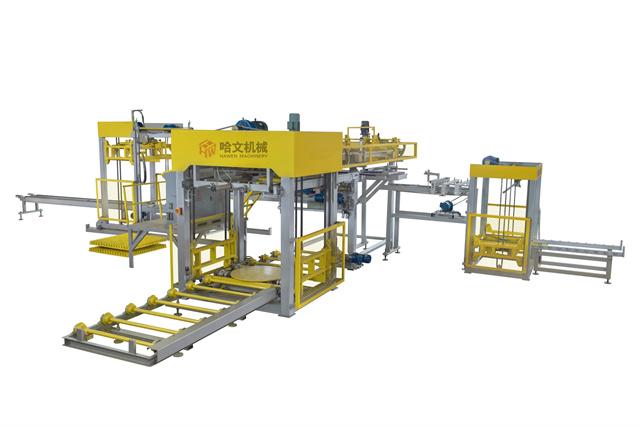
Handling compatibility should be confirmed for the actual product and offered configuration, not inferred from a general equipment photograph.
Connect the Pack Pattern with Packaging and Dispatch
Define how the completed pack will be supported and moved. A production pallet used during forming is not automatically the shipping support used for dispatch. Some proposed arrangements may involve a separate support, while others require a specifically reviewed configuration. Record the actual design rather than using the word pallet for several different items without explanation.
Identify the packaging operations included after grouping. Strapping, wrapping, labelling, and other activities may be supplied by different equipment or remain outside the cuber quotation. A system that completes a stack has not necessarily completed the buyer's entire ready-for-dispatch requirement. Keep those interfaces visible in the equipment list and operating plan.
Review the intended movements with the responsible handling specialists. Yard transfer, loading, customer unloading, and any later installation process can impose different requirements on the completed handling unit. This article does not establish acceptable pack dimensions, mass, or lifting conditions. Those details need a project-specific review using the actual products and equipment.
Connect pack identification with the commercial order. The label or associated record should distinguish product, size combination, quantity, and any relevant lot requirements. A technically consistent pack can still be commercially wrong if it contains an unapproved product combination or cannot be linked to the order it is intended to satisfy.
Approve Pattern Changes and Acceptance Evidence Before Ordering
Create a controlled pattern schedule before final approval. Assign each approved arrangement an identifier and connect it to the applicable product drawings, layer sequence, and completed pack contents. State which patterns are included in the purchase scope. A list of approved patterns provides a clearer acceptance basis than an open-ended request for flexible paver stacking.
Request representative evidence for the patterns that matter to the business. The demonstration should identify the products, incoming arrangement, grouping sequence, handling configuration, and resulting pack. Where the evidence comes from another installation, record the differences and ask the supplier which requirements remain unverified for the buyer's proposed system.
Include pattern changeover in the review. Ask what information, authorized settings, tooling, and operating procedures are needed when moving between the approved arrangements. The objective is not to prescribe a changeover duration, but to understand the actual work and support required. A production plan should not assume that every pattern change is immediate.
Agree the acceptance criteria and evidence requirements with the supplier and responsible plant team. Review sequence completion, product condition, pack contents, interfaces, and the operating scope included in the order. An unloaded movement or a single illustrative stack should not be described as verification of all requested patterns and normal production conditions.
Keep later changes under the same control. If sales introduces another size combination or a customer requests a different pack arrangement, assess the change before routine use. A previously accepted cuber does not automatically approve every future product and pattern. Retain the revised drawings, supplier review, and relevant verification records.
Acceptance should connect approved pack drawings with representative handling and completed-product evidence.
Pack dimensions, mass limits, lifting conditions, and changeover requirements depend on the actual products and proposed configuration. Confirm these points with the supplier and the responsible plant team before the order is finalized.
Information to Prepare Before Requesting a Cuber Quotation
A structured enquiry helps the supplier review the real requirement instead of quoting against a general description. The following checklist organizes the inputs discussed above. Items that cannot yet be confirmed should be marked as open rather than filled with assumed values.
Product drawings for each paver in scope, with revision, dimensions, thickness, and relevant surface features.
The incoming arrangement: production pallet, product orientation, grouping, and the point where products leave their support.
Required layer patterns, including product positions, quantities, orientation, and any alternating or rotated layers.
Completed pack contents: product combination, layer sequence, and commercial quantity per pack.
Packaging and dispatch interfaces: support arrangement, strapping, wrapping, labelling, and intended yard or loading movements.
Mixed-size or mixed-pattern requirements, and how changeover between approved arrangements should be handled.
Retained equipment and unresolved interfaces, so responsibility for each boundary is clearly assigned.
Proposed acceptance evidence and the review criteria the plant team will use to approve each pattern.
For buyers also reviewing the forming side of the line, the Hawen interlocking paver mould reference shows how product geometry is defined at the mould stage, which is a useful starting point for the product drawings requested above.
FAQ
Can the mould layout be used directly as the finished pack pattern?
Sometimes the arrangements may align, but that should not be assumed. Confirm the incoming presentation, any required grouping, the layer arrangement, and the intended completed pack with the supplier.
Does a cuber described as programmable support every paver pattern?
No such assumption is justified. The actual product, handling arrangement, grouping equipment, and proposed configuration must be reviewed. Include the required patterns explicitly in the quotation and acceptance scope.
Can a shipping pack also serve as a mechanical-laying layer?
Only where that intended use has been separately specified and reviewed. A pattern selected for shipment is not automatically compatible with installation equipment or the required laying arrangement.
Should incomplete packs be included in the specification?
Yes, if the business requires them. Agree how short quantities will be handled and which arrangements are permitted. Do not improvise a partial layer and assume it is covered by approval of a complete standard pack.
What should buyers send before requesting a cuber quotation?
Provide product drawings, the incoming arrangement, required layer patterns, completed pack contents, packaging interfaces, and intended handling information. Identify retained equipment and unresolved interfaces so the supplier can review the complete requirement.
Conclusion
A paver pack pattern should be specified as an identified product arrangement connected to incoming presentation, handling compatibility, packaging, and dispatch. Distinguish it from the mould layout and from any arrangement intended for mechanical laying. Use controlled drawings and itemized scope rather than relying on a photograph of a finished stack.
Before ordering an automatic cuber, ask the supplier to confirm which patterns the proposed configuration supports and what evidence will demonstrate acceptance. A clear pattern specification helps the buyer compare offers, plan changeovers, and avoid discovering an important grouping requirement after the equipment has arrived.
Preparing a cuber enquiry? Send your product drawings, incoming arrangement, required layer patterns, and completed pack contents so the supplier can review the full handling requirement. Clear inputs lead to a more accurate quotation and a smoother acceptance process.





 Tel: +86-13905968794
 Email: export@hwmachines.com
 MP/WhatsApp: +86-13905968794
 Manufacturer Address:Nanan,Quanzhou City,Fujian Province,China