A concrete block machine pallet is often treated as a replaceable transport item, yet it also forms the temporary base of every fresh product during filling, vibration, demoulding, and transfer. If that base is bowed, twisted, locally worn, or inconsistent in thickness, the effect can appear in the block before an operator notices anything unusual about the pallet itself. Uneven block height, cracked green products, mould leakage, unstable pallet feeding, and inconsistent vibration are therefore not always caused by the mould or hydraulic settings.
This matters especially when a factory introduces a new pallet batch, changes pallet material, or mixes old and new pallets in one circulation system. A pallet can look acceptable from a distance and still sit incorrectly on the vibration table or move through a clamp at a different reference height. Buyers and plant managers need a measurement method that separates pallet condition from concrete mix, mould, machine, and handling variables. The purpose of this guide is to explain those relationships without assuming that one tolerance value suits every machine.
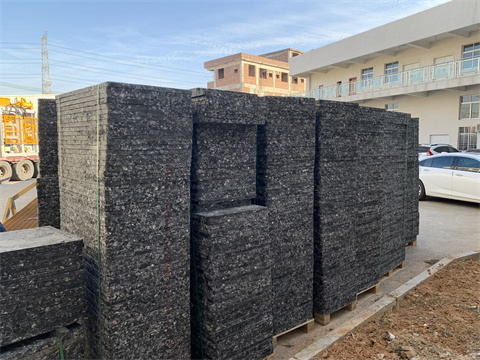
Why the production pallet acts as a forming datum
During a production cycle, the pallet is positioned under the mould box and supported by the vibration table or its supporting elements. Concrete is fed into the mould cavities, vibration rearranges the particles, and the tamper head applies controlled pressure. The mould then rises while the compacted products remain on the pallet. This sequence makes the upper pallet surface a geometric reference for the bottom face of the products.
If the pallet does not contact its supports consistently, vibration energy may not enter every mould area in the same way. A bowed pallet can touch at the center while leaving gaps near the edges, or touch near the ends while remaining unsupported in the middle. Under load it may deflect dynamically rather than remain stable. The visible result can resemble a feeding problem because one side of the mould compacts differently, even when the material distribution is reasonably uniform.
The pallet remains important after demoulding. Fresh blocks have limited green strength and depend on a stable base while conveyors, elevators, finger cars, or curing racks move them. Sudden pallet flexure, impact, or rocking can create fine cracks that open during curing. For this reason, pallet inspection belongs in both forming-machine acceptance and finished-product handling reviews.
Flatness, thickness, and squareness are different controls
Flatness describes how far the pallet surface departs from a single plane. It should not be confused with surface texture, which concerns local roughness, or parallelism, which compares the upper and lower faces. A pallet may have a generally flat upper face while its two faces are not parallel, producing thickness variation across the panel. It may also meet an average thickness requirement while containing local high or low zones.
Thickness tolerance describes permitted variation from the specified nominal thickness. The purchasing drawing should clarify whether the tolerance applies to each measurement point, the average thickness, or the full pallet. This distinction is important because conveyor guides, clamps, magazines, stackers, and lifting devices respond to local dimensions rather than to an average measured elsewhere.
Squareness concerns the relationship between pallet edges and corners. Length and width can be within tolerance while diagonal measurements reveal a skewed panel. Edge straightness also matters where side guides locate the pallet. These controls should be recorded separately; combining them under a vague statement such as "size is correct" gives little diagnostic value.
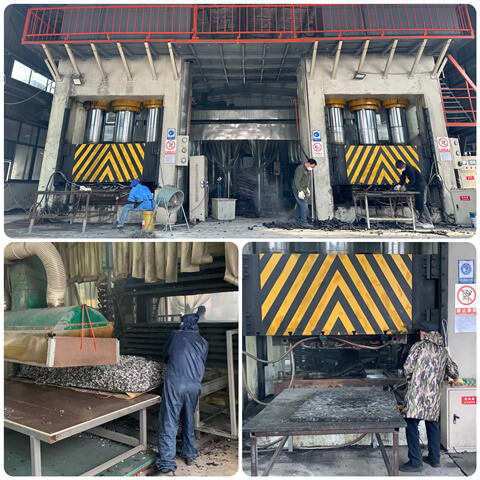
How pallet flatness influences vibration and compaction
A vibration system is designed around defined contact conditions. When the pallet sits firmly on the table, vibration can be transferred through the pallet into the concrete in a repeatable way. If contact varies from cycle to cycle, part of the input energy is spent closing gaps or flexing the pallet. The machine may still complete the cycle normally, but density and green strength can vary across the mould.
Operators sometimes respond by increasing vibration time or pressure. That may hide one symptom while introducing another, including excessive noise, accelerated mould wear, surface segregation, or longer cycle time. Before changing forming parameters, the plant should compare several suspect pallets with known stable pallets while keeping the mix, mould, filling time, and machine recipe unchanged. A repeated defect that follows a pallet is strong evidence that the support surface deserves attention.
Local wear can be as important as overall bow. Repeated contact with table strips, cleaning devices, and conveyor rollers may create grooves or polished zones. Cement paste buildup on the lower face can create artificial high points. Consequently, a flatness check should be performed on a clean pallet and should include both faces when the pallet can circulate in either orientation.
Why thickness variation changes transfer height
Automatic equipment assumes that each pallet presents approximately the same height. A thicker pallet raises the moulding surface and the fresh product relative to fixed guides, sensors, brushes, and transfer forks. A thinner pallet lowers that reference. Small differences may be absorbed by clearances, but accumulated variation can reduce reliability when equipment is already adjusted near its limit.
In a pallet magazine, mixed thickness can change stack height and the position of the lowest pallet at the feeder. Clamps may grip with unequal force, and separator fingers may contact two pallets or fail to release one cleanly. In an elevator or lowerator, fork clearance can become inconsistent. The forming machine may be blamed for intermittent stops even though the fault begins with dimensional variation in the circulating pallet population.
The relevant tolerance must therefore be reviewed against the complete line, not only the moulding station. A buyer should ask which device has the smallest vertical clearance and which sensor relies on pallet position. This system view is more useful than selecting a nominal thickness from a catalogue without checking the existing machine drawing.
Large pavers, kerbstones, and dense solid products can impose different pallet loads from hollow blocks. Mould footprint, product mass, vibration setting, pallet support spacing, and curing-rack arrangement all influence deflection. A pallet that performs acceptably for a light hollow block format may not provide the same stiffness margin for a heavier product layout.
Pallet material also changes how dimensions behave in service. Composite GMT pallets, steel pallets, hardwood boards, and other production pallet types differ in stiffness, moisture sensitivity, edge durability, impact response, and repair practice. Buyers comparing GMT production pallet options should therefore provide the machine model, pallet dimensions, product range, expected loading, curing method, and handling layout rather than requesting a price by length and width alone.
No material choice removes the need for dimensional control. The appropriate question is whether the supplied pallet maintains the required geometry throughout the expected operating environment. Temperature, moisture, cleaning practice, storage support, and accidental impacts can change an initially acceptable pallet over time.
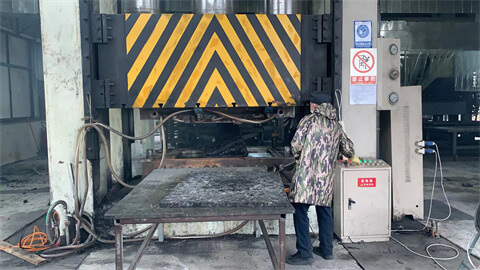
A practical incoming inspection method
Incoming inspection should begin with an approved drawing and an agreed sampling plan. The drawing should identify nominal length, width, thickness, edge profile, corner treatment, holes or inserts, allowable flatness, and measurement conditions. If the supplier and buyer use different support points or measurement tools, their results may not be comparable.
Place each sampled pallet on a clean, verified reference surface. Check whether it rocks under light alternating pressure at the corners. Use a straightedge long enough to span the relevant direction and measure gaps with feeler gauges at defined positions. Repeat the measurement along both diagonals and across several longitudinal and transverse lines. Turning the pallet over can help distinguish pallet bow from an unsuitable measurement surface.
Measure thickness with a suitable caliper or thickness gauge at a documented grid of points, including corners, edge centers, and interior locations. Do not measure over debris, damaged fibers, burrs, or raised identification marks. Record the maximum, minimum, range, and location of each extreme. For squareness, compare diagonals and inspect how the edges contact a reliable square or fixture.
A receiving report should link measurements to batch identification. If a production problem develops later, the plant can compare the affected pallet batch with its original results. This is more informative than keeping only a pass/fail label, particularly when wear or storage deformation is suspected.
Production symptoms and possible pallet causes
The table below is a diagnostic guide, not proof of root cause. Each symptom can also result from mix moisture, mould wear, uneven feeding, sensor position, conveyor alignment, or machine settings. A controlled comparison is required before replacing pallets or changing the production recipe.
| Observed symptom | Possible pallet-related mechanism | Useful verification |
|---|
| One mould area produces weaker green blocks | Local gap or flexure changes vibration transfer | Mark the pallet and see whether the defect follows it |
| Pallet feeder releases inconsistently | Mixed thickness or bowed edges alter separator clearance | Measure thickness at grip and separator contact zones |
| Fresh products crack during transfer | Pallet flexes, rocks, or impacts a guide | Observe slow-motion transfer and compare pallet geometry |
| Intermittent sensor or fork-position alarm | Pallet height falls outside the expected detection window | Record alarm pallet thickness and sensor clearance |
| Bottom face varies across a product group | Surface wear, deposits, or local unevenness changes the datum | Clean both faces and inspect with straightedge and light |
Storage, cleaning, and service-life controls
Good pallets can become unsuitable through poor storage. Stacks should be supported on a level base with support members positioned to avoid long unsupported spans. Leaning pallets against a wall, placing irregular loads on a stack, or storing mixed sizes together can introduce deformation. Outdoor storage should account for water, sunlight, temperature, and contamination according to the pallet material.
Cleaning devices require enough force to remove adhered concrete without cutting or heating the pallet surface. A poorly aligned scraper can wear one strip repeatedly, while aggressive impact cleaning can damage edges. Operators should distinguish removable buildup from permanent surface loss and record the location of recurring deposits, because buildup may also indicate leakage or poor cleaning alignment elsewhere in the line.
Service-life decisions should use measured condition and production behavior, not age alone. Some older pallets may remain stable while a smaller group has been damaged by a handling incident. Periodic sampling, batch marks, rotation records, and a quarantine area for suspect pallets allow the plant to remove the actual source of variation without discarding the entire population.
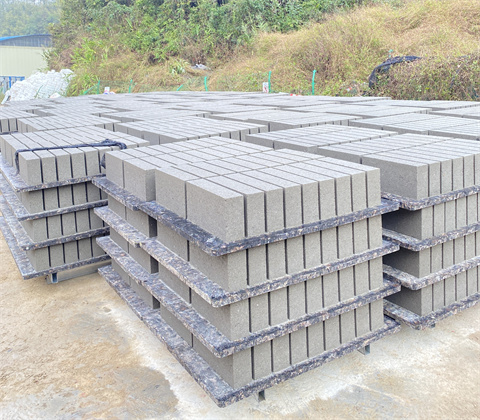
What buyers should request from a pallet supplier
A useful quotation should state material construction, nominal dimensions, dimensional tolerances, density or weight range where relevant, edge treatment, load assumptions, and inspection method. Buyers should ask how flatness is measured, how samples are selected, and whether results can be linked to the delivered batch. A certificate containing only general material claims does not confirm that pallets fit the intended machine.
Before a full order, sample pallets can be checked in the actual circulation route. The trial should include pallet feeding, forming, wet-side conveying, elevator or rack transfer, return handling, and cleaning. Products should cover representative heavy and light formats. The goal is not a short demonstration at minimum speed; it is to identify interfaces where dimensional variation could reduce operating margin.
During machine or line acceptance, record pallet specification together with vibration recipes and product formats. When a future pallet batch is introduced, the factory then has a baseline for comparison. This simple documentation step reduces arguments about whether a new fault comes from pallets, machine adjustment, mould condition, or raw material.
FAQ
Can one flatness tolerance be used for every concrete block machine?
No. Acceptable flatness depends on pallet size, material, support pattern, machine design, product load, and handling clearances. The machine and pallet suppliers should review the same drawing and measurement method.
Should a plant mix pallets from different suppliers or batches?
Mixing is possible only when geometry, stiffness, edge profile, surface condition, and handling compatibility are controlled. A short production trial and dimensional comparison are advisable before mixed circulation.
Does a thicker pallet always provide better stability?
No. Thickness can influence stiffness, but material construction and support conditions are also important. Excess thickness can create feeding and transfer interference if the line was designed for another reference height.
How often should pallet dimensions be checked?
Check new deliveries, investigate immediately when defects follow individual pallets, and establish periodic sampling based on production intensity, cleaning method, handling impact, and observed wear. High-risk interfaces may justify more frequent checks.
What is the fastest way to determine whether a defect follows the pallet?
Mark several suspect and stable pallets, keep the mix and machine recipe unchanged, and record the defect position over repeated cycles. Dimensional measurement should then confirm whether the correlation has a physical basis.
Conclusion
Pallet flatness and thickness tolerances influence more than pallet purchase quality. They affect vibration contact, product geometry, green-block support, magazine separation, sensor height, and transfer clearances across the line. Because similar symptoms can come from the mix, mould, machine, or handling system, diagnosis should combine controlled production comparison with documented geometric measurement.
Before approving a pallet order, buyers should align the drawing, measurement method, sampling plan, machine interfaces, and product loads with the supplier. After delivery, incoming records and batch identification provide a reference for future troubleshooting. A pallet should be accepted not simply because its length and width appear correct, but because it maintains the stable forming and handling datum required by the complete concrete block production process.





 Tel: +86-13905968794
 Email: export@hwmachines.com
 MP/WhatsApp: +86-13905968794
 Manufacturer Address:Nanan,Quanzhou City,Fujian Province,China