Concrete block production is often described as a simple sequence: batch the raw materials, mix them, feed the mold, vibrate, press, demold, and cure. In practice, however, one of the most important quality relationships is hidden inside this sequence. The moisture condition of the concrete and the vibration setting of the block machine must work as a pair. A machine cannot fully compensate for an unsuitable mixture, and a well-proportioned mixture cannot produce uniform blocks when vibration is poorly distributed or incorrectly timed.
This relationship affects green strength, dimensional stability, surface texture, density, water absorption, and final compressive strength. It also influences cycle time, mold filling, pallet cleanliness, and the frequency of production interruptions. Understanding it helps plant operators solve quality problems systematically instead of increasing vibration, pressure, cement, or water without identifying the real cause.
Why Moisture and Vibration Must Be Controlled Together
Most concrete masonry units are produced from zero-slump or very low-slump concrete. The mixture is damp enough for cement hydration and particle rearrangement, but dry enough for the newly formed product to retain its geometry immediately after demolding. This narrow operating condition is what makes block production different from casting conventional fluid concrete.
During mold filling, aggregates, cementitious material, and water enter the mold cavities with air trapped between particles. Vibration reduces internal friction and allows the particles to rearrange into a denser structure. The tamper head applies pressure, controls product height, and assists consolidation. Moisture acts as a lubricant at particle contacts, but excessive water creates a different problem: the mix can become sticky, unstable, and difficult to demold.
If moisture is below the effective range, additional vibration may improve density only up to a point. The material may still resist rearrangement, leaving open edges, weak corners, and visible layers. If moisture is above the effective range, more vibration can encourage paste migration, sticking, deformation, or local segregation. Therefore, “increase vibration” is not a universal response to low block density.
The correct operating window depends on the product, aggregate grading, cement type, admixtures, mixer efficiency, mold geometry, machine design, and local temperature. A hollow block with thin webs does not fill like a thick solid block. A paving block with a face-mix layer also requires different control from a single-layer masonry unit. Plants should establish a verified process window for each product rather than use one fixed water and vibration setting for every mold.
How Moisture Changes Fresh Concrete Behavior
Water in a block mixture has several roles. It supports cement hydration, influences workability, and helps fine particles coat and bind the aggregate skeleton. The total water added at the mixer is not the same as the effective water available to the fresh mix. Aggregate moisture, aggregate absorption, recycled material, and environmental evaporation all change the real condition entering the machine.
For this reason, a recipe expressed only as “liters of water per batch” is incomplete. Sand stored outdoors may contain substantially different surface moisture after rain, during a hot afternoon, or after several dry days. Adding the same measured quantity of water under all three conditions can produce three different mixtures. Moisture compensation should begin with consistent stockpile management and regular aggregate checks.
A suitable zero-slump mixture normally forms a cohesive hand-compacted sample without releasing free water. This field observation is useful for quick screening, but it is not a replacement for controlled testing. Operators should connect fresh-mix observations with block mass, product height, green appearance, cured density, water absorption, and compressive strength. A repeatable measurement system is more reliable than judging the mixture by color alone.
Aggregate grading is equally important. A well-graded blend provides smaller particles to fill spaces between larger particles, reducing the volume that paste must occupy. A gap-graded or excessively coarse mixture may appear dry and difficult to compact even when enough water is present. Adding water may hide the filling problem temporarily while increasing sticking and dimensional variation. Correcting the aggregate blend is often the more durable solution.
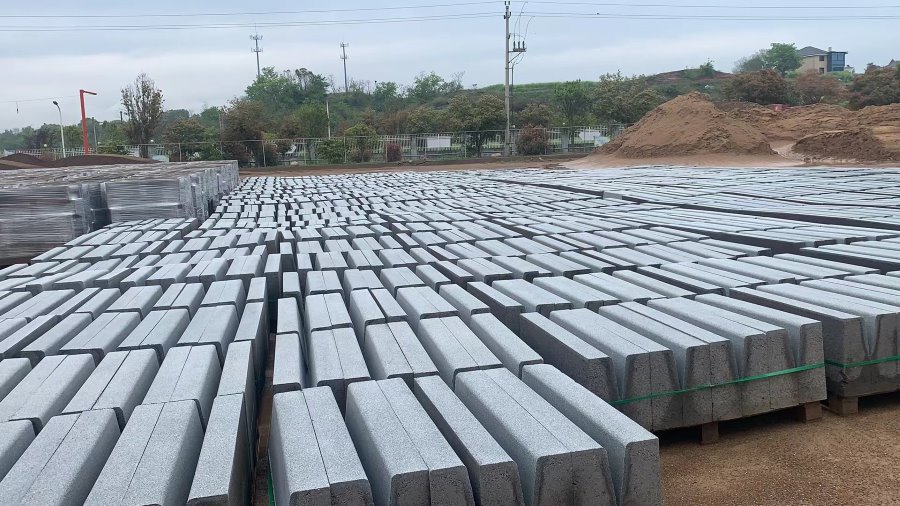
How Vibration Compacts a Block in the Mold
Vibration quality is determined by more than motor power. Frequency, amplitude, duration, synchronization, vibration table condition, mold support, feed distribution, and tamper-head movement all affect the energy delivered to the concrete. The useful question is not how strongly the machine appears to shake, but whether energy reaches every mold cavity in a stable and repeatable way.
Pre-vibration during feeding can help material enter narrow sections and corners. Main vibration under the tamper head then develops density and final height. If feeding is uneven, however, vibration may not correct the difference before compaction ends. One cavity may contain more material and reach target height early, while another remains underfilled. This can cause block mass differences across the same pallet.
Vibration time should be long enough to achieve stable consolidation but not treated as an unlimited quality setting. Excessive time lowers output and can accelerate wear in bearings, vibration components, mold contact surfaces, and pallets. With a wet or paste-rich mixture, prolonged vibration can also increase material adhesion. A stable process uses the shortest verified setting that consistently meets dimensional and strength requirements.
Mold condition has a direct effect on energy transfer and product release. Loose fastening, damaged support areas, inconsistent cavity surfaces, or incorrect clearance between the tamper shoes and mold box can create localized defects. When replacing or specifying a concrete block mould, the buyer should confirm compatibility with the machine, product drawing, pallet size, vibration system, and required output instead of evaluating the mold only by its external dimensions.

Recognizing a Mixture That Is Too Dry or Too Wet
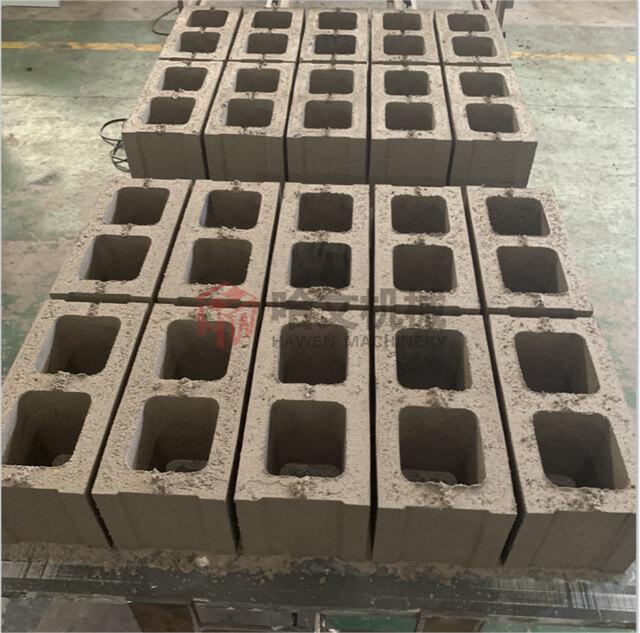
A mixture that is too dry commonly produces rough faces, incomplete corners, weak edges, visible lamination, and low green cohesion. Blocks may fracture during transfer even though their height appears correct. The machine may require longer filling or vibration time, yet mass and density remain inconsistent. Dust around the feed drawer and poor filling of thin webs are additional clues.
These symptoms do not prove that water is the only missing variable. Low cementitious paste, unsuitable fine content, short mixing time, worn mixer blades, restricted feeder movement, or poor mold ventilation can create similar results. Before adding water, compare the current batch with a known acceptable reference and inspect the entire material path from batching to mold filling.
A mixture that is too wet may stick to the tamper shoes or cavity walls, leave smeared surfaces, deform after demolding, or produce variable height during pallet movement. Fine paste may collect around the mold, and the next production cycle can begin with contaminated contact surfaces. Pavers may show edge slump, while hollow blocks can lose web definition.
Again, moisture is not the only possible cause. Excessive fine material, unsuitable admixture dosage, delayed discharge, warm material, or an unclean mold can increase adhesion. The operator should change one controlled variable at a time. Simultaneously reducing vibration, changing water, altering feed time, and adjusting tamper pressure makes it impossible to identify which correction actually worked.
A Practical Adjustment Method for Production Lines
Begin with a stable baseline. Use one product, one mold, a documented raw-material source, a fixed batch size, and a machine that has reached normal operating condition. Confirm that scales, moisture sensors, mixer discharge, feed drawer, mold fasteners, pallet support, and vibration components are functioning correctly. Process adjustment should not be used to conceal a mechanical fault.
Record aggregate moisture before calculating added water. Keep mixing sequence and mixing duration constant. Produce a small controlled series and record the actual batch data, not merely the recipe target. For each pallet, check visual filling, green block mass, height at defined positions, edge integrity, release behavior, and material left on the mold or tamper head.
If the mixture appears dry and blocks are under-compacted, make a small water correction within the plant's approved range while holding vibration settings constant. Observe several consecutive cycles because material remaining in the mixer and hopper can delay the effect. If moisture is acceptable but density varies across the pallet, investigate feed distribution, mold seating, vibration synchronization, and pallet support before changing the recipe.
Once green products are stable, cure samples under the same controlled condition and test them at the required ages. Compressive strength must be interpreted together with density, absorption, dimensions, and appearance. A heavier block is not automatically a better block if it exceeds dimensional limits, consumes unnecessary material, or has poor durability characteristics.
Create a product-specific setting sheet after validation. It should identify raw-material limits, aggregate moisture correction, target fresh-mix indicators, batch mass, mixing time, feed time, vibration stages, product mass range, height tolerance, and inspection frequency. The sheet should be revised when raw materials, mold design, product geometry, or major machine components change.
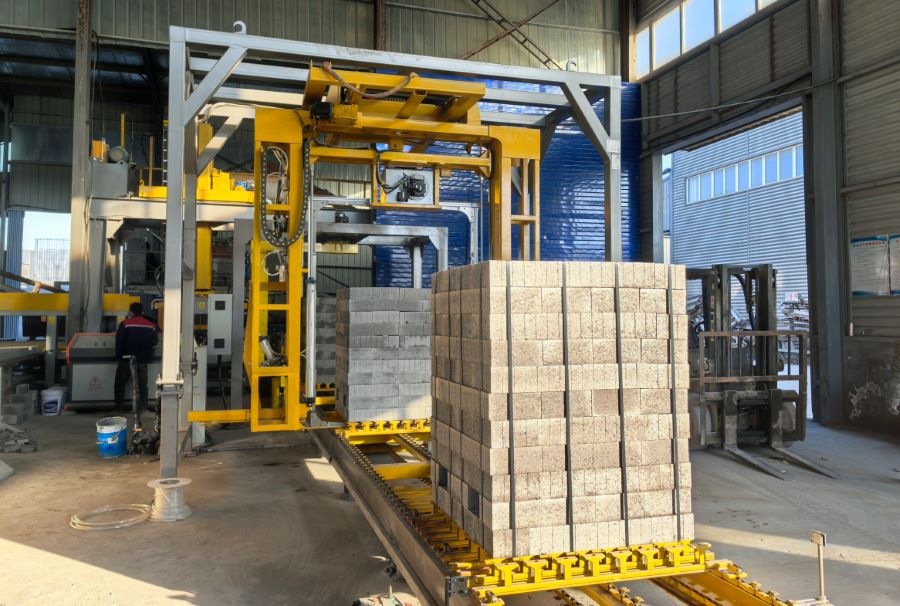
Inspection Table for Operators and Buyers
| Observed condition | Possible causes | First checks |
|---|
| Rough surface and broken corners | Low effective moisture, poor grading, insufficient filling, short compaction | Aggregate moisture, fresh-mix cohesion, feeder coverage, block mass |
| Sticking to tamper or mold | Excess moisture, high fines, dirty surfaces, excessive vibration | Water correction, fines content, cleaning condition, vibration duration |
| Different mass across one pallet | Uneven feeding, vibration distribution, mold seating, pallet support | Cavity-by-cavity mass, feeder movement, fasteners, table alignment |
| Correct appearance but low cured strength | Water-cement imbalance, low binder, poor curing, weak aggregate | Batch records, cement dosage, curing temperature and moisture, material tests |
| Variable block height | Inconsistent fill, wet mix deformation, tamper alignment, sensor variation | Fill level, release behavior, tamper position, height measurements |
For equipment buyers, this table also provides a useful framework for factory acceptance discussions. A supplier should explain how the machine controls feeding, vibration, pressure, product height, and recipe storage. Buyers should request trial data for representative products and understand which results depend on local raw materials. A demonstration with one ideal mixture does not define the full operating range of a production line.
Useful acceptance records include cycle settings, block mass by cavity, height measurements across the pallet, visible defect rate, and test results after controlled curing. The purpose is not to demand one universal setting from the machine manufacturer. It is to confirm that the machine can be adjusted repeatably and that plant personnel understand how mixture condition interacts with mechanical settings.
Frequently Asked Questions
Can an automatic moisture sensor eliminate manual checks?
No. A calibrated sensor can improve water correction, especially for sand, but it does not detect every change in grading, absorption, cement condition, admixture response, or mixer performance. Sensor data should be verified through routine fresh-mix and product checks.
Should vibration time be increased when block strength is low?
Not automatically. Low strength can result from binder content, water-cement relationship, compaction, curing, aggregate quality, or testing variation. Confirm density and production consistency first, then isolate the cause through controlled trials.
Why does the same recipe behave differently in the afternoon?
Aggregate surface moisture, stockpile temperature, evaporation, cement temperature, and material waiting time can change during the day. The nominal recipe may remain unchanged while the effective moisture and fresh-mix behavior shift.
Can one moisture target be used for hollow blocks and pavers?
Usually, a single universal target is not appropriate. Product geometry, face texture, aggregate blend, mold filling path, and compaction program differ. Each product family should have a validated operating window.
How often should block mass and height be checked?
The frequency should reflect production risk and applicable quality requirements. Checks are especially important at startup, after material replenishment, following recipe or mold changes, and whenever appearance or machine behavior changes. Regular interval checks should continue during stable production.
Conclusion
Moisture and vibration are not independent settings. Together they determine how effectively a zero-slump concrete mixture fills the mold, releases trapped air, reaches target density, retains shape after demolding, and develops performance during curing. Too little effective moisture cannot always be corrected by stronger or longer vibration, while excessive moisture can make additional vibration harmful.
A reliable plant controls this relationship through measured aggregate moisture, consistent batching and mixing, verified machine condition, product-specific settings, cavity-by-cavity observation, and cured-product testing. When defects appear, the most efficient response is a structured diagnosis that separates material, feeding, mold, vibration, pressing, and curing variables. This approach reduces random adjustment, protects production equipment, and creates a repeatable basis for manufacturing blocks that meet dimensional and performance requirements.





 Tel: +86-13905968794
 Email: export@hwmachines.com
 MP/WhatsApp: +86-13905968794
 Manufacturer Address:Nanan,Quanzhou City,Fujian Province,China